



Fire safety in most buildings still depends on a simple sequence. Something happens, an alarm sounds, and a response begins. That sequence often runs slower than the way modern buildings behave.
Buildings today carry more electrical load, more connected systems, and more points of failure than earlier structures. The risk is no longer contained in one place or one moment. It builds quietly across systems that are always running. IoT enters this space as a layer that connects what was earlier separate.
Detection has moved beyond the point of origin
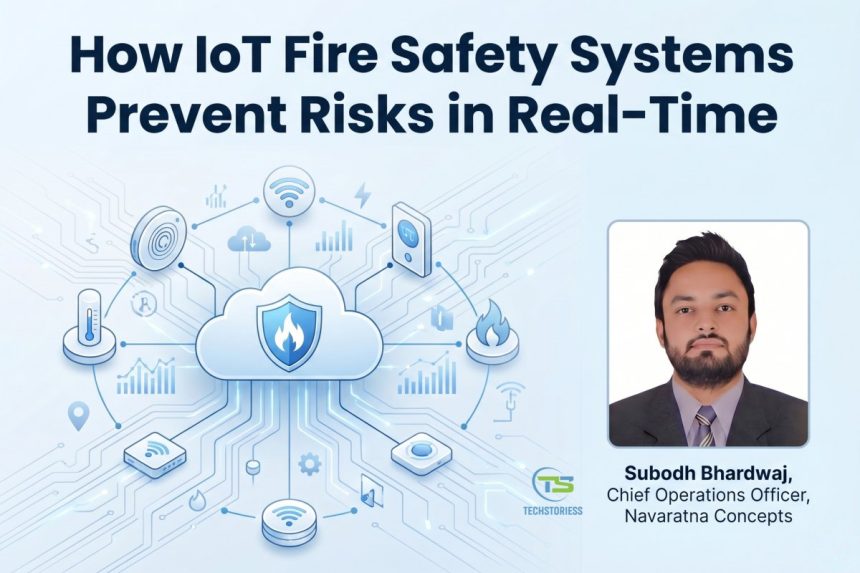
Smoke detectors and heat sensors used to operate in isolation. They triggered alarms and stopped there. With IoT, that signal no longer stays local. Sensors push information across a network in real-time. One trigger becomes visible across devices, control rooms, and mobile phones almost instantly.
In residential buildings, this changes basic awareness. Residents, security teams, and facility managers receive the same alert at the same time. Information no longer waits to be passed along manually.
Mobile alerts, dashboards, and automated notifications extend the reach of a simple smoke signal far beyond the point where it started.
In larger residential developments and integrated communities, this also creates a central layer of visibility for multiple towers and shared infrastructure. A single incident in a basement parking zone, electrical room, or utility shaft is no longer contained within one block. It becomes visible across the entire facility network at once, allowing quicker escalation decisions at the site level.
Fire risk has moved with how buildings are used
Fire incidents are no longer driven only by wiring faults or kitchen accidents.
Continuous charging, inverter systems, EV infrastructure, and long-running appliances have changed where risk sits inside a building.
Lithium-ion batteries are now part of that equation. Found in e bikes, EV charging points, laptops, and everyday devices, they behave differently when something goes wrong. Heat rises fast. Failure escalates quickly. Control becomes difficult once it crosses a threshold.
This shift is also visible in how residential layouts are now being used. Basements double as parking and charging areas. Utility rooms are more densely packed with electrical equipment. Even individual homes carry higher load through multiple charging points operating simultaneously.
This changes attention from visible smoke to early electrical behaviour. Temperature variation, irregular charging cycles, and load fluctuations matter more than they used to. In many cases, the warning signs exist well before ignition, but they are not always captured unless systems are actively monitoring in real-time.
Building Management Systems sit in the middle
Most fire systems still operate on their own. A Building Management System brings them together. Fire alarms, smoke detectors, sprinklers, ventilation, access control, and emergency lighting are connected into a single operating structure.
During an incident, this structure matters. Doors can release automatically. Ventilation can change to limit smoke spread. Alarms can activate across floors without delay. Systems react together rather than separately.
In larger buildings, especially multi tower residential complexes, this coordination extends beyond a single structure. Common basements, shared electrical rooms, and parking facilities require systems that communicate across zones rather than operating in isolation. A BMS creates that shared response layer, ensuring that one trigger does not remain confined to one system.
Without this layer, each system continues its own response without awareness of what the others are doing.
Real-time monitoring changes response timing
IoT shortens the time between detection and action.
Earlier systems depended on someone noticing an alarm and reacting. Now alerts move across multiple channels at once. Residents, security staff, and facility teams receive the same signal together.
That removes delay created by confirmation and communication gaps. Monitoring is also continuous. Systems are tracked for faults, unusual patterns, and early warning signals even when nothing has gone wrong.
Adoption does not match capability
Many buildings have installed sensors and upgraded systems. Fewer have connected them into a working response chain.
Alerts exist but are not always monitored. Systems are present but not always tested or integrated into daily operations. What is installed does not always reflect what will actually function during an emergency.
The gap sits in maintenance, coordination, and consistency of use.
IoT connects fire safety systems that once worked independently. Detection becomes immediate. Information moves without delay. Response becomes shared across multiple points instead of depending on one action.
At the same time, buildings are dealing with new fire sources such as lithium ion batteries and higher electrical dependency. These risks do not follow older patterns and do not give much time once they start.
Fire safety now depends on how early a system picks up change and how consistently connected it is when that change begins.
Article Contributed by Subodh Bhardwaj Chief Operations Officer of Navaratna Concepts