


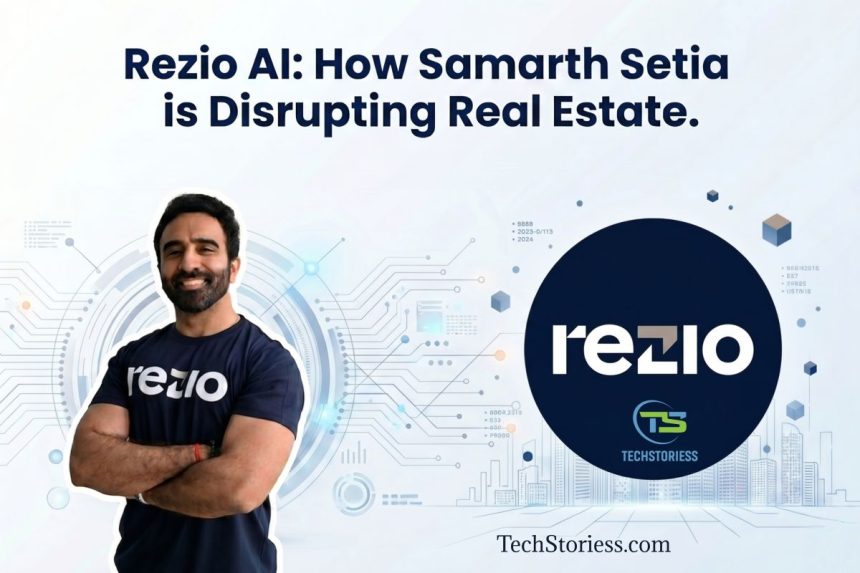
Welcome to TechStoriess, where we dive deep into the tech-native ventures shaping our future. Today, we’re spotlighting Rezio AI, a PropTech pioneer founded by Samarth Setia—the visionary behind the successful DairyTech scale-up, Mr. Milkman.
After organizing India’s fragmented milk supply chain, Setia is now tackling the $200B+ real estate market. Rezio isn’t just another listing portal; it’s an AI-native operating system designed to turn “messy” data—scattered across WhatsApp, voice notes, and local broker networks—into verified decision intelligence.
By autonomously sourcing over 4,000 properties daily and engaging with 20,000+ agents, Rezio’s AI acting as a digital co-pilot for brokers and a personal assistant for buyers. It eliminates the administrative “noise” of lead qualification and follow-ups, allowing stakeholders to focus on high-value trust and negotiation. Join us as we explore how Rezio is moving real estate from a relationship-driven maze to an evidence-based managed journey
Having successfully organised the fragmented dairy sector with Mr. Milkman, what operational lessons are you directly applying to the $200B+ real estate market?
Mr. Milkman taught me that real categories are won in operations, not presentations. When you are dealing with fragmented supply, inconsistent service, and heavy coordination, the real advantage comes from building strong systems, standardising execution, and using real-time data to make better decisions. That lesson applies directly to real estate. At Rezio, we are taking a highly fragmented, relationship-driven market and bringing more structure, visibility, and accountability into it. The principles are simple: build systems early, scale methodically, and stay very close to on-ground reality while doing it.
What does a second-time founder do differently when building an AI-native startup from day one?
The biggest difference is clarity. The second time around, you move faster because you are less romantic about ideas and far more focused on execution, distribution, and feedback loops. You also become much more disciplined about where to spend time. At Rezio, we are not adding AI as a feature on top of an old workflow. We are designing the workflow around AI from day one. That means smaller teams, faster iteration, tighter operating loops, and systems that improve with every interaction. You become less interested in looking innovative and more interested in building something that compounds.
What was the specific frustration or “lightbulb” moment that motivated you to launch Rezio AI?
The lightbulb moment was realising that India’s best real estate inventory often does not live on portals at all. It sits inside broker WhatsApp groups, local networks, and closed circles of trust, while home seekers are stuck dealing with stale listings, fragmented brokers, and a lot of noise. The problem is not a lack of listings; it is a lack of verified truth, aligned advice, and accountable execution. That is what led to Rezio. We are building an AI-powered brokerage layer that can structure messy supply, verify what is real, and help a buyer move from intent to decision to closure with much less friction.
With the shift away from static listing portals, how exactly does Rezio’s AI act as a predictive system to help brokers move from chasing leads to closing deals?
Traditional portals optimise for visibility and lead volume. We are focused on intent and execution. Rezio’s AI helps qualify what a buyer actually wants, structures and verifies inventory coming from fragmented broker networks, and ranks options based on fit, readiness, and real-world constraints. From there, it helps move the transaction forward by coordinating information, reducing back-and-forth, and routing the case to the right execution partner at the right time. So instead of brokers spending most of their time chasing cold leads or repeating the same information, they can spend more time on the high-value parts of the job: advising, negotiating, and closing.
Real estate transactions rely heavily on trust and scattered, unstructured data; how does your platform convert conversational data into reliable decision intelligence?
In real estate, a huge amount of valuable information lives inside conversations: calls, WhatsApp chats, broker notes, site visit feedback, objections, and negotiation updates. Most of that disappears after the conversation ends. At Rezio, we treat that as operational data. Our system captures and structures these signals to understand buyer intent, constraints, urgency, objections, and deal-stage movement. Then it connects that context to inventory, broker interactions, and transaction workflow. The result is a much more reliable decision layer, where the next step is based on actual context rather than memory, guesswork, or whoever followed up last.
How do you build sophisticated tech for a legacy, high-stakes industry that empowers stakeholders rather than trying to completely disrupt them?
In a category like real estate, trust matters too much for technology to come in with a purely disruptive mindset. Our view is that AI should augment strong professionals, not try to erase them. So we build where the pain is real: qualification, verification, follow-ups, information structuring, and transaction coordination. We keep humans central in the moments that need judgment, trust, and negotiation. We are also building alongside market participants, not in isolation from them. That is important because adoption in real estate happens when people feel the product helps them perform better, not when it tries to force them into unnatural behaviour.
Can you share any current user growth metrics, revenue milestones, or tangible efficiency gains from Rezio’s early operations?
We are still early, but the most exciting signal for us is what the system is already able to do autonomously. At present, Rezio’s AI is autonomously sourcing over 4,000 properties daily by having conversations in local languages with more than 20,000 agents across India. We have already structured over 400,000 properties and it’s helping us learn even more about the market. That includes everything from plots and farmlands to schools, commercial spaces, and residential inventory. What makes this especially powerful is that real estate communication in India often happens in shorthand, mixed languages, fragmented voice notes, and highly local terminology that is difficult for even non-real-estate humans to interpret properly. Our AI is built to operate inside that mess, structure it, and make it usable. For us, that is a foundational capability because once you can reliably understand and organise this kind of supply, you can build far stronger matching, verification, and transaction workflows on top of it.
As an entrepreneur, what is your current funding strategy for Rezio—are you bootstrapping to profitability or preparing for institutional capital?
I have always believed in playing the long game. At Mr. Milkman, I took the company to profitability and scale with just angel funding, while retaining 90% ownership, and eventually led it to a successful acquisition. That experience shaped how I think about capital. With Rezio, our focus is to build revenue from day one and stay disciplined while doing it. We already have the playbook in place for that. We will take the business to the level we believe it deserves, and we will raise money when we feel ready. We are in no rush. For us, capital should accelerate the right model, not define it.
How much of the typical administrative and marketing overhead can your AI co-pilot realistically eliminate for real estate firms today?
A meaningful share of repetitive overhead can already be automated or heavily reduced. Tasks like lead qualification, follow-ups, data entry, listing normalisation, inventory checks, and parts of communication workflow do not need to remain fully manual anymore. That does not mean the human role disappears. It means brokers and firms can spend less time on coordination-heavy busywork and more time on trust-heavy work like advising clients, handling objections, negotiating, and closing transactions. The real value of AI here is not just cost reduction; it is better use of human time and sharper operating consistency.
As AI adoption accelerates globally, where do you see Rezio in the next two years, and will you eventually expand into consumer-facing tools?
We are already consumer-facing, and that is a very important part of our direction. Our goal is to give every consumer their own personal AI broker, and we are already testing that. Over the next two years, I see Rezio evolving into a strong decision-and-execution layer for real estate transactions, one that helps structure demand, surface verified supply, coordinate the right people, and move deals forward with much more consistency than the market has today. The long-term vision is not just better search. It is a trusted consumer interface that helps buyers and renters make better decisions while still connecting them to strong execution on the ground. We believe AI will increasingly become the default interface for real estate decision-making.
Stay Tuned for such interesting stories … Tune-in to our TechStoriess Newsletter