



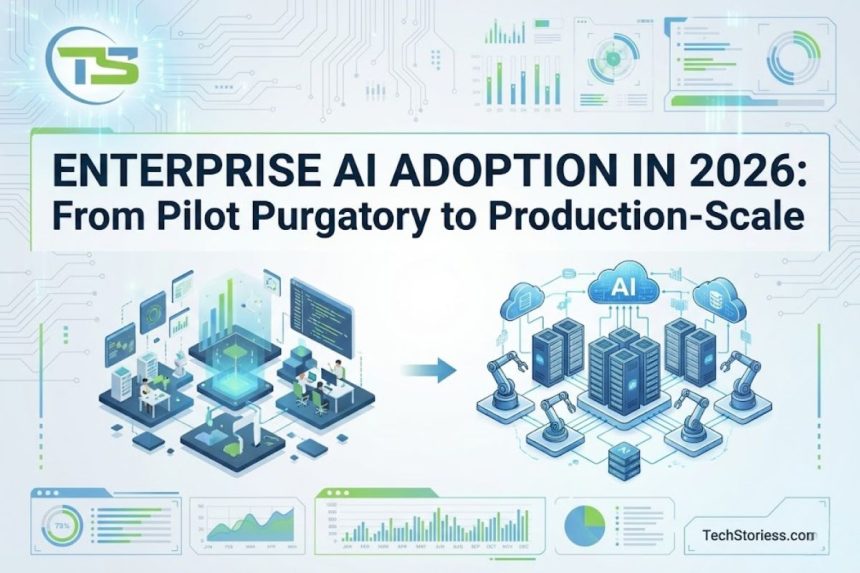
In 2026, fewer than 27% of enterprise AI pilots successfully reach production scale — a gap driven not by algorithmic limitations, but by failures in governance, integration strategy, and organizational design. For enterprises still cycling through proof-of-concepts, the path to production requires a fundamental mindset shift: AI is no longer an innovation experiment. It is operational infrastructure.
- Enterprise AI Adoption at the inflection point:Why 2026 is different
- Understanding the Pilot-to-Production Gap
- The “Science Project” Trap
- AI Integration Strategy Gaps That Block Scaling
- Reframing Enterprise AI ROI: Beyond Model Metrics
- From Labs to Operations: Enterprise AI Adoption Mindset
- From Isolated Models to Enterprise Platforms
- AI Integration Strategy as Value Creation for Enterprise AI Adoption
- AI Governance as a Scaling Enabler for Enterprise AI
- Organizational Maturity: The Human Side of Scale
- A Phased AI implementation roadmap to Production Scale Building your enterprise AI Foundation
- The Economics of AI at Scale: From CapEx Experiment to OpEx Discipline
- Data as the True Moat: Quality, Lineage, and Ownership
- From Automation to Augmentation: Redesigning Work Itself
- Measuring What Matters: Beyond Accuracy to Enterprise Impact
- Conclusion
- FAQ
Organizations that have navigated this transition share three observable characteristics: they treat AI outputs as governed data products with defined SLAs, they embed AI directly into operational decision workflows rather than analytical dashboards, and they define business ROI metrics before deployment — not after. Those that have not made this shift face a compounding disadvantage as production-ready competitors accelerate.
Enterprise AI adoption has reached a defining inflection point in 2026. The companies that successfully moved from AI pilot to production are unlocking transformational business value — while those still trapped in experimentation cycles fall measurably further behind with each quarter. Understanding what separates them is the first practical step toward building an AI integration strategy that scales.
The last 10 years have marked a remarkable shift for Artificial Intelligence. AI is no longer confined to research labs. It has evolved into a core component of daily operations. It has become a central strategic priority for enterprises. That said, most organizations still find it challenging to convert AI potential into industrial productivity. While global enterprises are making unprecedented investments in models, cloud infrastructure, and generative AI capabilities, many continue to struggle to convert experimentation into enduring business impact.
More than model capability, the real bottleneck is organizational readiness.
In 2026, enterprises are encountering a structural inflection point. In the early phase of Enterprise AI adoption was defined by pilots, proof-of-concepts, and innovation labs. Today, competitive advantage is determined by operational scale – embedding AI into workflows, governance systems, cost structures, and enterprise architecture.
The shift underway is fundamental:
- From experimentation to institutionalization
- From model accuracy to measurable enterprise AI ROI
- From isolated innovation to integrated infrastructure
- From short-term enthusiasm to long-term discipline
To achieve tangible success in this phase, organizations do not just need the most advanced algorithms. They must build a resilient foundational environment capable of supporting production-grade AI – aligning data maturity, governance, architecture, economics, and organizational design around scalable AI systems.
In this post, we will explore why 2026 represents a strategic turning point – and how organizations can truly move from pilot purgatory to production power.
Enterprise AI Adoption at the inflection point:Why 2026 is different
Despite rising investments and widespread experimentation, translating early AI success into sustained, production-scale business impact remains a formidable operational challenge. Industry research consistently highlights the persistent gap between ambition and execution. According to KPMG, although 70%–87% of enterprises have launched AI initiatives, only a small fraction successfully scale them into long-term production systems that generate measurable business value.
This reality underscores a critical truth: it is relatively easy to experiment, but far harder to operationalize. Simply refining models is not enough to move from AI pilot to production. It demands resilient infrastructure, governance discipline, cross-functional alignment, and long-term economic sustainability.
To ensure successful transition from AI pilot to production, enterprises today must adopt a well-structured AI implementation roadmap that seamlessly syncs infrastructure readiness, governance maturity, and measurable enterprise AI ROI expectations from the outset.
Often described as “pilot purgatory,” this structural bottleneck defines the current transition phase. In 2026, enterprises are shifting from isolated proof-of-concept experiments toward building sustainable, enterprise-grade AI platforms. Scaled AI is no longer an abstract ambition; it is directly tied to competitiveness, operational efficiency, and innovation capacity.
Leaders now face three stark realities:
High investment, limited realization:
Billions of dollars are invested annually in AI infrastructure, platforms, and tools, yet a significant portion of initiatives fail to generate measurable business value or reach production scale.
Executive optimism versus operational reality: While C-suite leaders remain confident about AI’s transformative potential, frontline teams grapple with integration complexity, data quality issues, governance gaps, scaling constraints, and unclear performance metrics.
The strategic imperative for operational discipline: The difference between failure and sustained success increasingly depends less on model sophistication and more on how effectively AI systems are embedded into daily workflows, decision cycles, and accountability structures.
To craft a coherent enterprise AI strategy, it is essential to understand why this inflection point matters – and how to move decisively beyond experimentation toward durable, measurable value creation.
Understanding the Pilot-to-Production Gap
The gap between a successful pilot and a production-ready AI system is far wider than most executives assume. As many as 73% of AI initiatives fail to progress beyond the pilot stage, leaving behind unused models, stranded budgets, and unmet expectations.
73% of enterprise AI pilots never reach production scale. The root causes are rarely technical — they are organizational: undefined ownership, integration gaps, absent governance frameworks, and ROI metrics that exist only on paper.
Consider a pattern common across financial services deployments: a fraud detection model achieves 94% accuracy in a carefully controlled test environment, earns executive sign-off, and enters a deployment queue. Six months later, it is quietly deprioritized. The model required clean, deduplicated transaction records — a condition the test environment provided but the live CRM did not. There was no assigned owner for ongoing retraining when the model’s performance degraded against new fraud patterns. And when a false positive delayed a high-value commercial transaction, no incident response playbook existed. The technical performance was never the issue. The operational environment was unprepared for it.
This pattern — models excelling in controlled environments but failing under real-world operational pressure — explains why approximately one in five AI pilots successfully scales into production. The following table captures the structural gap between what pilot environments offer and what production actually demands:
| Dimension | Pilot environment | Production requirement |
|---|---|---|
| Data quality | Curated, clean, well-structured datasets | Raw, noisy, evolving — requires governed data pipelines |
| Systems integration | Simulated or minimal integration with core systems | Real-time API connections to CRM, ERP, billing, and operational platforms |
| Ownership | Innovation lab or data science team | Defined AI Ops or DevOps team with 24/7 accountability |
| Lifecycle model | Project: launch, showcase, close | Product: continuous development, versioning, and monitoring |
| Success metric | Model accuracy (precision, recall, F1 score) | Business outcome: revenue lift, cost reduction, cycle time |
| Cost model | CapEx experiment with loose budget | OpEx discipline with cost-per-inference tracking |
| Governance | Informal, manual, ad hoc review | Formal: SLAs, bias monitoring, audit trails, escalation protocols |
| Monitoring | Periodic manual review by data scientists | Automated real-time data drift and concept drift detection |
This gap reveals a systemic weakness in enterprise AI adoption strategies: organizations focus their investment on model performance while underbuilding the operational environment that models need to survive contact with real-world complexity.
The “Science Project” Trap
Many AI pilots begin in controlled, near-academic environments. Teams experiment with carefully curated data, tightly managed test conditions, and polished dashboards that showcase impressive performance metrics. However, applications that excel in a sandbox environment rarely withstand the messy complexity of real-world operations.
In controlled pilots:
- Cleaner, well-structured data is readily available compared to noisy, fragmented live systems.
- Integration with core enterprise systems such as billing platforms, CRM systems, and supply chain tools is simulated or minimal.
- Engineers manually fine-tune parameters and workflows in ways that are not sustainable at scale.
Once exposed to real operational data – characterized by unknown noise, shifting inputs, incomplete records, and unpredictable workloads – these pilots often lose accuracy and stability. This pattern – models excelling in controlled environments but failing under real-world pressure – is a primary reason why only about one in five AI pilots successfully scales into production.
AI Integration Strategy Gaps That Block Scaling
Enterprise AI integration strategy goes much beyond “just engineering”; it is a foundational requirement to transition from AI pilot to production and enable sustainable AI scaling production across complex enterprise systems.
For instance, a customer churn prediction model may demonstrate excellent accuracy in a test environment, but it delivers little value unless it securely and reliably connects to the enterprise’s operational systems. A robust AI integration strategy requires rethinking how systems communicate, how data flows are governed and secured, and how predictions automatically trigger business actions.
To meaningfully operationalize AI, organizations need robust API frameworks, real-time data pipelines, and cross-platform integration capabilities. Many enterprises lack these foundational elements, making it difficult to embed AI into workflows that drive measurable outcomes.
Undefined Ownership & Operational Drift
AI pilots are often led by highly skilled IT teams, data scientists, or innovation labs. But once the pilot phase concludes, accountability for monitoring, retraining, governance, and incident response frequently becomes unclear. Without defined ownership, model performance gradually degrades, feedback loops weaken, and operational trust erodes.
Until a dedicated function – whether DevOps, IT operations, or a formal AI Ops team – assumes clear responsibility, AI systems drift, decay, and eventually lose business relevance.
In the absence of clearly defined ownership models embedded within AI governance frameworks, enterprises face challenges in sustaining trust, accountability, and long-term system performance in production environments.
Reframing Enterprise AI ROI: Beyond Model Metrics
Traditional pilot metrics emphasize abstract model performance indicators — accuracy, precision, recall, and F1 score. Business leaders and investors demand tangible business outcomes: revenue uplift, cost reduction, risk mitigation, and productivity gains. Gartner research indicates that the absence of clearly defined, measurable business value in production is one of the leading reasons nearly 30% of AI pilots stall permanently.
Enterprise AI ROI must be reframed — not as a post-deployment metric, but as a core design principle integrated into the AI implementation roadmap from the earliest stages. ROI must be defined in commercial and operational terms before a single model is trained.
| ROI category | What to measure | Example KPI |
|---|---|---|
| Revenue lift | Incremental revenue directly attributed to AI-driven decisions | Conversion rate improvement, upsell or cross-sell rate, deal win rate |
| Cost reduction | Operational savings from automation or process efficiency gains | Cost per transaction, support cost per ticket, headcount redeployment value |
| Risk mitigation | Reduction in compliance incidents, fraud losses, or regulatory penalties | Fraud loss rate, audit exception rate, regulatory incident count |
| Productivity improvement | Cycle time and throughput gains per employee or process | Claims processing time, invoice approval cycle, support resolution speed |
| Customer impact | Retention and satisfaction improvements attributable to AI intervention | Churn rate reduction, NPS delta, customer lifetime value improvement |
BCG research found that companies explicitly tying AI initiatives to business KPIs in the table above are nearly 2× as likely to report significant AI business value as those measuring only technical performance. The key implementation principle: ROI frameworks must be defined before deployment and built into the project brief — not reverse-engineered from whatever the model happened to improve post-launch.
To convert pilot success into production-scale impact, organizations must shift their focus from technical validation to business performance outcomes. ROI must be defined in commercial and operational terms – not merely in model performance metrics.
From Labs to Operations: Enterprise AI Adoption Mindset
To achieve successful enterprise AI scaling production benefits, organizations cannot rely on individual, specific models or isolated use cases. They need a complete menu of capabilities and systems that can consistently meet the volume and complexity of daily operations. Pilots are controlled experiments that receive careful attention and manual tweaks to gain optimum results. Production, however, is an operational environment that demands systems, automation, controls, quality assurance, and repeatability. To achieve this transition enterprises must align their AI adoption efforts with a long-term vision for scaling AI to production rather than treating pilots as isolated technical issues.
From Isolated Models to Enterprise Platforms
Enterprises treating AI initiatives as isolated innovation pockets rather than integrated components of the complete technology stack often struggle to sustain performance and scale outcomes. Successful organizations, on the other hand, design resilient, end-to-end production systems that treat AI models as modular, composable services – that can seamlessly integrate with APIs, monitoring, and governance.
A product mindset: Treating AI outputs as products, with defined performance standards, SLAs, and user expectations.
Governance discipline: Ethical guardrails, bias checks, and compliance integration baked into process design.
Gartner data suggests that organizations that adopt a product-oriented approach toward AI initiatives, with clear ownership and KPIs, are 4.2× more likely to scale successfully than those without integration planning.
This platform-centric approach is crucial for organizations looking to mature their AI integration strategy and operationalize AI across various key business units.
Project Thinking vs. Product Thinking
Unlike pilots that often operate as projects – launched, showcased, and then closed – production demands ongoing development cycles, maintenance planning, feature upgrades, and lifecycle governance. This is the fundamental organizational shift that demands executive backing, cross-functional alignment, and investment in architectural discipline. Product thinking also helps in better tracking of enterprise AI ROI, as systems are constantly optimized against business outcomes rather than focusing on one-time project success metrics.
The Production Foundation: Industrial-Grade MLOps
Machine Learning Operations (MLOps) holds the central position in scaling AI. It is the practice of applying disciplined software engineering principles to the full ML lifecycle, from data ingestion to deployment and ongoing monitoring. MLOps are a crucial part of the execution that help organizations to transition from AI pilot to production while supporting consistent, repeatable AI scaling production across multiple use cases.
Version Control Across the Board
Unlike conventional software where version control is standard for code, in AI systems the scope expands to include other critical artifacts like:
- Datasets and their lineage
- Model parameters and versions
- Performance metrics and drift indicators
Tools like MLflow, DVC, and Weights & Biases help orchestrate reproducibility and auditability, ensuring that every model version can be traced and rolled back if necessary. This minimizes risk and accelerates confidence in production deployments.
Automated Pipeline Orchestration
Manual procedures like periodically retraining models by hand or reconfiguring environments fail to scale in complex enterprise environments. Automated pipelines employing tools like Airflow, Kubeflow, or proprietary platforms can orchestrate training, validation, deployment, and monitoring in systematic and repeatable ways.
Continuous monitoring is vital:
- Track performance against real-world data
- Detect data drift (when input data distribution shifts)
- Detect concept drift (when relationships between inputs and outputs change)
This ongoing vigilance ensures that models continue to retain their accuracy and relevance over time. Without it, models degrade rapidly and decisions become unreliable.
Strategic Technology Integration
In production settings, these technical practices are the foundation of repeatable and reliable AI systems – systems that evolve beyond handcrafted experiments into robust, enterprise-grade solutions.
Architectural Considerations for Scale
It is essential to choose the right architecture to support production-grade AI. This is not just about “technical implementation” – it involves designing for unpredictable workload patterns, multi-tenant operations, security requirements, and compliance constraints.
AI Integration Strategy as Value Creation for Enterprise AI Adoption
To achieve tangible success with AI, organizations need to understand that models don’t create value – integration does. A well-defined AI integration strategy acts as the primary driver of value realization and a crucial determinant of successful enterprise AI adoption at scale.
In a McKinsey global AI survey, despite 55–60% of organizations using AI in at least one function, very few are able to achieve significant business impact. Even highly advanced models fail to deliver results in the absence of operational embedding.
To scale in real environments, AI needs to move beyond analytical dashboards. It must:
- Impact decisions in real workflows
- Trigger automated actions in real time
- Feed downstream systems
- Operate within defined enterprise SLAs
Embedding AI into Business Workflows
Scaling AI requires moving from “insight delivery” to “decision orchestration.”
For example:
- Fraud detection models must integrate seamlessly with transaction approval systems.
- Demand forecasting models must feed procurement engines.
- Marketing propensity models must trigger real-time campaign automation to increase conversion rates and customer engagement.
Gartner highlights that by 2026, over 70% of enterprise AI value will be derived from AI embedded into operational workflows rather than standalone analytics.
This level of embedding is crucially important to achieve meaningful enterprise AI ROI, as tangible value is realized only when AI influences real decisions and actions.
Treating AI Outputs as Data Products
AI predictions should be treated as governed data assets – versioned, documented, and monitored:
- Timestamped
- Logged
- Quality-monitored
- Auditable
This ensures downstream reliability. It also supports compliance and post-incident traceability.
SLAs and Reliability
Production AI requires:
- Defined uptime expectations
- Latency guarantees
- Incident response playbooks
- Clear accountability structures
As AI influences customer decisions, it becomes infrastructure. At scale, it cannot behave like a research artifact.
AI Governance as a Scaling Enabler for Enterprise AI
Governance is widely misunderstood as compliance overhead. It is the operational mechanism that makes AI scale sustainable. Without defined model approval workflows, bias monitoring protocols, explainability standards, and escalation procedures, production AI systems accumulate risk that compounds over time: model drift goes undetected, accountability gaps widen, and regulatory exposure grows with every deployment.
The EU AI Act (now in active enforcement across European operations) and emerging ISO AI management standards formalize what leading organizations already practice: production AI must be controllable, auditable, and accountable. A 2023 IBM study found that while over 75% of executives acknowledged AI governance as important for long-term competitiveness, fewer than 30% reported having robust frameworks in place.
Choosing the right governance model
Two governance structures have emerged as dominant approaches, with a hybrid model increasingly favoured by mature enterprises. The table below captures the trade-offs:
| Model | Structure | Best for | Primary risk |
|---|---|---|---|
| Centralized CoE | Single team controls AI standards, tooling, model approval, and deployment across the enterprise | Standardization, regulatory compliance, organizations in early AI maturity stages | Creates bottleneck; slows domain teams; limits business-unit responsiveness at scale |
| Federated | Domain teams independently own AI development with minimal central oversight | Speed of delivery, direct business alignment, domain-specific innovation | Shadow AI proliferation; inconsistent standards across units; duplicated infrastructure and cost |
| Hybrid Recommended | Central governance sets standards, guardrails, and tooling; domain teams execute within those rails with autonomy | Organizations scaling across multiple business units; balance of control and speed required | Coordination complexity; requires a clear charter defining central vs. domain authority |
McKinsey research consistently finds that hybrid models — central governance with distributed execution — outperform purely centralized structures in both deployment velocity and business value realization. The hybrid approach is the recommended default for enterprises scaling AI across more than two business functions.
Defining Production KPIs
Model accuracy should not be the sole metric to measure production AI. Mature enterprises track metrics like:
- Revenue lift
- Cost savings
- Risk reduction
- Cycle time reduction
- Customer retention impact
BCG research discovers that companies that tie AI to explicit business KPIs are nearly 2× as likely to achieve significant AI business value.
Forward-looking enterprises are establishing:
- Cross-functional AI oversight boards
- Risk classification frameworks
- Model approval workflows
- Escalation mechanisms
This minimizes shadow AI and synchronizes technical execution with enterprise risk tolerance.
Bias, Explainability, Regulatory Alignment
Scrutiny intensifies as models influence lending, hiring, pricing, and healthcare decisions.
A 2023 IBM study revealed that over 75% of executives acknowledged the importance of AI governance in long-term competitiveness, yet fewer than 30% report having robust frameworks in place.
Organizations must embed governance into production scaling to avoid reputational damage and regulatory penalties.
Cost Transparency
Due to token consumption, GPU time, and inference load, generative AI and LLM deployments introduce unpredictable cost curves.
Enterprises now require:
- Cost per inference tracking
- Model efficiency benchmarking
- ROI dashboards tied to infrastructure usage
To achieve financial sustainability during scaling, cost transparency is essential.
Organizational Maturity: The Human Side of Scale
AI Centers of Excellence (CoE) vs. Federated Models
Two dominant models have emerged:
- Centralized AI CoE that controls standards and tooling
- Federated model enabling domain teams with centralized guardrails
According to McKinsey research, hybrid models – central governance with distributed execution – tend to outperform purely centralized structures.
Cross-Functional Collaboration
Production AI requires seamless collaboration between:
- Data scientists
- ML engineers
- DevOps
- Security teams
- Legal and compliance
- Business stakeholders
- Siloed teams introduce deployment bottlenecks.
Leadership Accountability
- Enterprises that succeed in AI scaling typically:
- Assign executive ownership
- Tie compensation to AI performance metrics
- Embed AI into corporate strategy documents
These structures smartly formalize AI governance while enabling faster, smoother and more confident enterprise AI adoption across multiple departments.
A Phased AI implementation roadmap to Production Scale Building your enterprise AI Foundation
Across enterprise AI deployments in financial services, manufacturing, and healthcare sectors, three structural factors consistently separated organizations that scaled from those that stalled: the presence of a cross-functional AI governance body with real decision authority (not just advisory capacity), a data lineage framework that predated model development, and an executive sponsor held accountable to business outcomes — not technical metrics. The sophistication of the underlying model was never the decisive variable. Organizational readiness was.
A well-structured AI implementation roadmap guides organizations from siloed experimentation toward scalable, production-grade AI through four distinct maturity stages. Attempting to compress or skip stages is the most common reason production timelines extend by 12–18 months:
| Phase | Core activities | Key deliverable | Failure mode to avoid |
|---|---|---|---|
| Phase 1 Assess & align | Inventory existing AI pilots; identify high-value use cases; align stakeholders on measurable business outcomes | Governance structure defined; executive sponsor named; ROI baseline established per use case | Skipping stakeholder alignment — causes accountability gaps that surface at Phase 3 |
| Phase 2 Build the foundation | Implement MLOps pipelines; establish data quality standards; deploy model version control and monitoring protocols | Production-ready infrastructure in place; data lineage documented; drift detection automated | Building infrastructure after model development begins — forces costly retrofit |
| Phase 3 Launch & learn | Deploy selected high-impact use cases in production; monitor ROI vs. pre-defined baselines; stress-test governance under real operational conditions | Validated production deployment; incident response playbooks tested; ROI dashboard live | Launching too many use cases simultaneously — dilutes ownership and governance capacity |
| Phase 4 Scale & institutionalize | Standardize tooling across business units; formalize AI budget as an OpEx line item; integrate AI performance into strategic planning | Enterprise-wide AI platform in production; AI embedded in board-level reporting; CoE or hybrid governance model operational | Treating Phase 4 as the end state — mature AI scaling requires continuous governance iteration |
The Economics of AI at Scale: From CapEx Experiment to OpEx Discipline
Most AI pilots are treated as innovation experiments and lack structured financial governance. Loose budgets, unclear success goals, and undefined accountability are common. In contrast, production AI demands ongoing infrastructure costs, inference workloads, retraining cycles, monitoring overhead, and vendor dependencies. Financial discipline is essential to sustain enterprise AI ROI, especially as organizations move from pilot investments to large-scale operational deployments.
Data as the True Moat: Quality, Lineage, and Ownership
In their eagerness to adopt advanced AI models, enterprises often ignore a crucial reality: unlike models, proprietary data is not replaceable. It is the foundation of sustained AI success and differentiation.
More than algorithmic sophistication, the competitive advantage of AI at scale is determined by:
- Unique data assets
- Clean data pipelines
- Accurate labeling
- Strong lineage tracking
- Responsible stewardship
Data Lineage and Observability
With rapidly scaling AI systems, enterprises must understand the origins of data – and how it has been processed, enriched, and modified across pipelines – to ensure regulatory compliance, audit readiness, and effective debugging.
Strong data foundations directly accelerate AI scaling in production by ensuring models stay accurate, reliable, and contextually relevant in dynamic and evolving environments.
From Automation to Augmentation: Redesigning Work Itself
In automation initiatives, workflow redesign is one of the key challenges that is often overlooked.
Enterprises frequently layer AI onto existing processes without reviewing how work itself should evolve.
In reality, AI scaling requires process transformation.
Human-in-the-Loop Systems
Production AI often delivers the best results in human-in-the-loop environments. Instead of replacing employees, enterprises need to redefine roles and responsibilities:
- AI generates recommendations
- Humans validate or override
- Feedback improves model accuracy
This creates a holistic learning cycle that allows enterprises to evolve with AI without workforce disruption.
This shift is crucial for improving enterprise AI ROI, as human-AI collaboration often delivers more sustainable AI business value than full automation.
Effective change management is a key enabler of enterprise AI adoption, ensuring that technological investments translate into real organizational impacts.
Measuring What Matters: Beyond Accuracy to Enterprise Impact
Conventional ML metrics like precision, recall, and AUC are insufficient for enterprise-scale measurement.
Mature organizations wisely align these metrics with their broader AI implementation roadmap to ensure continuous optimization and accountability.
Conclusion
In 2026, the true achievers will be those that successfully cross into stages four and five – where AI shifts from an experimental initiative to a core capability seamlessly integrated into the operating model.
The lesson is clear. You don’t just need smart algorithms to scale AI. It requires an entire environment comprising smarter systems, disciplined economics, mature AI governance, and aligned organizational design.
Ultimately, success in 2026 depends on the successful integration of AI governance, executing a clear AI implementation roadmap, and sustaining measurable enterprise AI ROI while advancing toward full AI scaling production.
That is how enterprises transition from pilot purgatory to production power – and from experimentation to competitive advantage.
FAQ
What is “pilot purgatory” in enterprise AI?
Pilot purgatory is the organizational state in which enterprise AI initiatives remain indefinitely in proof-of-concept or experimental phases without advancing to production deployment. Industry research consistently estimates that 73% of enterprise AI pilots never reach production scale. The root causes are rarely technical: they typically include undefined ownership of post-pilot operations, ROI frameworks that cannot satisfy CFO-level scrutiny, integration gaps between AI models and core enterprise systems, and insufficient governance structures to support production-grade AI. Pilot purgatory is not a failure of ambition — it is a failure of operational design, and it is entirely preventable with the right foundational architecture.
How do you build an AI integration strategy that scales?
A scalable AI integration strategy requires four foundational capabilities working in parallel. First, robust API frameworks that connect AI outputs to operational systems in real time — not just analytical dashboards. Second, governed data pipelines that ensure quality, lineage, and regulatory compliance before the model runs. Third, clearly defined ownership structures that assign accountability for ongoing monitoring, retraining, and incident response — not just initial deployment. Fourth, business-outcome KPIs defined before deployment, not retrofitted after launch. Organizations that build all four from the outset are significantly more likely to achieve production-scale AI than those that treat integration as an engineering afterthought to be solved post-model development.
What are the key phases of an AI implementation roadmap?
A proven AI implementation roadmap follows four stages:
(1) Assess and align — inventory existing AI pilots, identify the highest-value production use cases, and align executive stakeholders on measurable business outcomes and governance structure before any model development begins;
(2) Build the foundation — implement MLOps pipelines, data quality standards, model version control, and automated monitoring protocols;
(3) Launch and learn — deploy selected high-impact use cases in production, monitor ROI metrics against pre-defined baselines, and stress-test governance workflows under real operational conditions;
(4) Scale and institutionalize — standardize tooling across business units, formalize AI budget allocation as an OpEx line item, and embed AI performance metrics into strategic planning and board reporting cycles.
How should enterprises measure AI ROI?
Enterprise AI ROI should be defined in operational and commercial terms — not model performance metrics like accuracy or F1 score. Mature organizations measure across five categories: revenue lift (incremental revenue attributed to AI-driven decisions), cost reduction (operational savings from automation or efficiency gains), risk mitigation (reduction in compliance incidents or fraud losses), productivity improvement (cycle time and throughput gains per employee or process), and customer impact (retention, NPS, or conversion improvements directly attributable to AI). BCG research found that companies explicitly tying AI to these business KPIs are nearly 2× as likely to report significant AI business value as those measuring only technical performance. The critical implementation principle: ROI frameworks must be built into the project brief before deployment begins — not reverse-engineered afterward.
Why is AI governance a prerequisite for enterprise AI scaling?
AI governance is not compliance overhead — it is the operational mechanism that makes scaling safe and sustainable. Without defined model approval workflows, bias monitoring, explainability standards, and escalation protocols, production AI systems accumulate risk that compounds with each deployment: model drift goes undetected, accountability gaps widen, and regulatory exposure grows. The EU AI Act (now in active enforcement) and emerging ISO AI management standards formalize what leading organizations already practice — production AI must be controllable, auditable, and accountable. IBM research found that while over 75% of executives view AI governance as critical to long-term competitiveness, fewer than 30% have robust frameworks in place. Organizations that build governance into their scaling architecture from the outset — rather than retrofitting it after an incident — deploy faster, with greater executive confidence, and with measurably lower regulatory risk.








My programmer is trying to convince me to move to
.net from PHP. I have always disliked the idea because of
the costs. But he’s tryiong none the less.
I’ve been using Movable-type on a variety of websites for about a year and am nervous about switching to another platform.
I have heard great things about blogengine.net. Is there a way I can transfer all my
wordpress content into it? Any help would be greatly appreciated!
Your writing style is so relatable and authentic It’s a breath of fresh air in a world filled with superficiality and pretense