


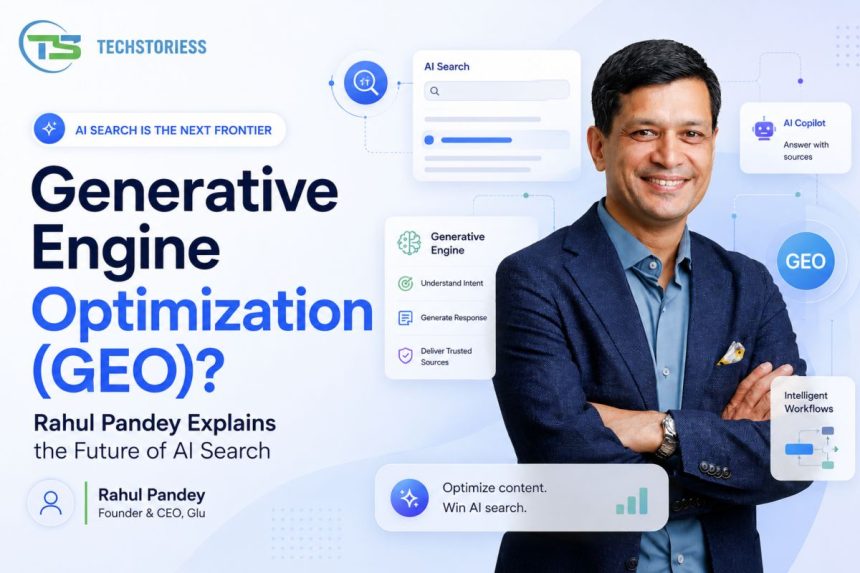
Rahul Pandey is the Founder and CEO of Glu.ai, a startup building the infrastructure layer for the emerging “Answer Economy,” where AI platforms increasingly shape how consumers discover products and brands online. With decades of experience across AI and ecommerce, Rahul launched Glu.ai to help brands adapt to a major shift in digital discovery: moving from traditional search engines to AI-generated answers and conversational commerce.
Glu.ai enables brands to make their product data machine-readable, AI-ready, and optimized for visibility across platforms like ChatGPT, Gemini, shopping agents, and other AI-driven ecosystems. By combining structured data infrastructure, LLM integrations, and AI visibility analytics, Glu is helping companies navigate the future of Generative Engine Optimization (GEO) and AI-led commerce discovery.
What sparked the founding of Glu, and how has your startup journey evolved alongside AI’s rapid advancements?
After decades working across AI and ecommerce, the pattern that finally pushed me to start Glu.ai was simple but impossible to ignore – While marketing is still about persuading a human, success is increasingly dependent on being correctly understood by a machine that then persuades the human.
For years, brands optimized for people and Google Search like keywords, creative, landing pages, funnels. But almost overnight, the primary consumer of product information became AI platforms: answer engines, shopping agents, chat interfaces, and multimodal models that synthesize rather than browse. With AI now being the “front door” for product discovery, then inaccurate, incomplete, or unstructured product data doesn’t just hurt GEO (Generative Engine Optimization) it makes a brand invisible in the answer layer. Glu.ai was born from that inflection point.
What is fundamentally changing in search architecture as AI shifts users from traditional links to direct answers?
AI is fundamentally changing search architecture by replacing the old “retrieve and rank links” model with a “retrieve, understand, and generate answers” pipeline, where the output is a synthesized response rather than a list of pages.
Could you explain Generative Engine Optimisation in simple terms, and how it differs from traditional SEO?
Generative Engine Optimization (GEO) in simple terms:It means structuring your product and brand information so AI tools like ChatGPT, Gemini, and shopping agents can clearly understand, trust, and recommend you.
The fundamentals of SEO and strong organic visibility remain constant. High‑quality, in‑depth content continues to be the single most important ranking factor, supported by the principles of E‑E‑A‑T, demonstrating real experience, expertise, authority, and trust. The technical foundations of SEO still matter as well: sites must be fast, crawlable, and structured in ways machines can easily interpret, link authority remains a durable signal, with reputable backlinks strengthening SEO
What’s different from SEO is the entire output and optimization target. Traditional SEO delivers a list of blue links, but AI systems generate a synthesized written answer and your goal becomes increasing your probability of being cited inside that answer, not climbing a ranking page. Content structure also evolves: scannable is no longer enough; information must be extractable, with direct answers, clear headers, and stand‑alone sections that models can lift cleanly. Your brand story now matters far more because AI describes your brand in its own words, and a missing or incorrect description is something meta tags cannot fix. Finally, off‑site signals such as social proof, directories, PR, and third‑party mentions carry significantly more weight for AI engines than they ever did for Google, shaping how trustworthy and authoritative your brand appears in generated responses.
How must brands restructure their content and data architectures to ensure visibility within these new AI-driven ecosystems?
Brands must restructure their content and data architectures so AI systems can extract, trust, and reuse their information inside generated answers. That means shifting from long narrative pages to modular, machine‑readable fact blocks, supported by a canonical product and brand fact layer that stays consistent across every channel. Content must be structured with clear headers, direct answers, and stand‑alone sections that models can lift cleanly, while schema and structured data become the technical backbone that validates those facts. Because AI now describes brands rather than linking to them, companies must maintain accurate brand narratives and strengthen off‑site authority signals for example PR articles, directories, expert reviews, and social proofto increase citation probability across AI‑driven ecosystems.
How are chat-based interfaces acting as the new digital storefronts, and how does this reshape commerce journeys?
Chat‑based interfaces are becoming the new digital storefronts because they collapse the entire commerce journey: discovery, evaluation, comparison, and decisioninto a single conversational flow where the AI acts as curator, salesperson, and product expert at once. This reshapes the journey from navigating websites to navigating answers, meaning brands must ensure their product data, reviews, and narratives are structured so the AI can confidently understand, trust, and surface the brand information in AI answers.
In building Glu’s infrastructure, how do you handle the complexities of large language model ingestion and interpretability?
Glu handles the complexities of LLM ingestion and interpretability by combining robust API integrations with multiple LLMs, a canonical fact layer that normalizes all incoming product data, and strict guardrails that validate every generated output before it reaches a customer. The system breaks content into structured, machine‑readable units that models can reliably consume, then routes all AI outputs through human‑in‑the‑loop verification to ensure accuracy, safety, and brand alignment. This architecture allows Glu to harness the power of LLMs while maintaining full control, transparency, and trustworthiness across every step of the pipeline.
With non-linear, AI-mediated user journeys, what new visibility metrics should brands track instead of traditional clicks?
Because AI journeys are non‑linear and don’t produce traditional clicks, brands need a new measurement stackand while it’s still early in the GEO era with no industry standards yet, there are few foundational metrics every brand should start tracking now. The most important is AI visibility: how often your brand or products appear in generated answers across platforms. Next is sentiment, which captures whether AI describes you positively, neutrally, or negatively. Then citations, which measure how frequently AI systems explicitly reference your content or facts. And finally, competitor benchmarking, which shows where rivals are being surfaced more often or more favorably. These early metrics ensure brands aren’t flying blind as AI platforms become the primary interface for discovery and decision‑making.
How is the shift toward AI-curated discovery forcing marketing teams and digital workforces to adapt their strategies?
AI‑curated discovery is pushing marketing teams and digital workforces to shift from page‑based optimization to answer‑based optimization, where the goal is to ensure AI systems can understand, trust, and surface a brand’s information inside conversational journeys. Teams now need to structure content into clear, extractable facts, strengthen off‑site authority signals, and continuously monitor how AI platforms describe their products and brand.
What unique opportunities does this AI-led discovery shift create for India’s startup and digital infrastructure ecosystem?
India is already one of the world’s leading AI‑adopting markets, with a massive population using conversational platforms and rapidly shifting buying behaviors and that creates an outsized opportunity for its startup ecosystem. As discovery moves from blue links to AI‑generated answers, India is positioned to lead in structured data platforms, vector databases, AI‑ready commerce infrastructure, and domain‑specific LLM tooling, enabling a new wave of companies that shape how products, services, and brands get represented inside AI interfaces.
Glu fits directly into this opportunity by giving Indian brands and marketplaces the infrastructure to make their product data machine‑readable, their brand narratives AI‑ready, and their visibility measurable across global conversational platforms
Can you share insights into Glu’s funding, revenue models, and how investors view the emerging Answer Economy?
Glu is fully bootstrapped, and its revenue model is a SaaS subscription with three tiers, giving brands scalable access to AI‑ready commerce platform. Investors are increasingly excited about the emerging Answer Economy, where companies that power AI‑driven discovery and product representation are becoming category‑defining. Very recently, one company Tryprofound reached billion‑dollar unicorn status. This momentum signals strong investor conviction that platforms like Glu, which make brands visible and trustworthy inside AI answers, will become essential infrastructure in the new discovery ecosystem.
Looking ahead, what is Glu’s roadmap, and how do you plan to scale these AI infrastructures globally?
Glu’s roadmap will always be customer driven. In our upcoming roadmap, we will expand beyond Shopify, introduce multilingual capabilities, broaden support for additional AI commerce ecosystems, and enhance automation capabilities. Glu also aims to expand into new industry verticals, scale globally, build recurring enterprise revenue streams, and achieve its targeted ARR milestones.