


For long there has been persistent boardroom debate about Zero Trust. In fact, many companies still rely solely on conventional security systems. In fact, a study by IBM and Ponemon Institute research reported that 78% of companies hit by ransomware in 2025–2026 were still running traditional perimeter security at the time of breach. It indicates that they still believe that a firewall was enough.
The reality can’t be more different. Especially with rapid developments in AI technologies, AI-powered vulnerability scanners compress mean time-to-exploit down to just several days, effectively closing the gap between “patch released” and “breach attempted”. Unlike traditional attack cycles, attackers no longer need to work for weeks anymore. Modern threat actors leverage sophisticated technologies to identify and exploit the front door through your legacy VPN infrastructure.
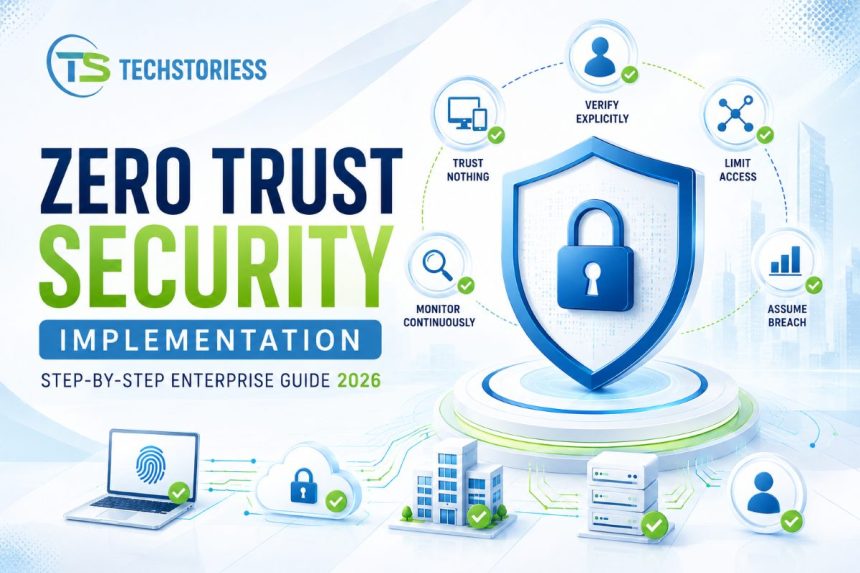
More than a security product, Zero Trust is an architectural philosophy built on a single core principle: instead of trusting implicitly, always verify – each user, device, workload, and even time. This may sound operationally overwhelming. This guide simplifies the process to help you make informed implementation decisions.
Why Zero Trust Security Is Replacing VPN – and Fast
Conventional VPN works on a trust-based model. After being authenticated, the user enters the perimeter and moves laterally with unchecked freedom. It can significantly accelerate ransomware activity.
Zero Trust Network Access (ZTNA) entirely reverses that model. Rather than granting broad network access, ZTNA offers application-specific access based on contextual factors – and only after continuously verifying identity, device health, and behavioral signals.
This space is mainly dominated by CrowdStrike, Palo Alto Networks, and Zscaler. Many vendors naturally create vendor-biased content that aligns with specific architectures. In this guide, we take a framework-first approach. It will help you evaluate requirements independently. The framework should inform technology decisions, not the other way around.
Phase 1
Instead of network topology, Zero Trust begins with identity. It requires a strong identity infrastructure before you can configure a single policy.
Deploy Multi-Factor Authentication (MFA) universally, with uniform enforcement across all users, including executives or service accounts.
Implement Privileged Access Management (PAM) to vault and rotate credentials securely for all high-privilege accounts.
This identity-first security principle forms the foundation of Zero Trust. Before granting any access request, organizations must answer three questions: Who is this? Is this device healthy? Does this request match expected behavior?
Phase 2
Once a device is compromised, even an authenticated user can become a threat. That’s why in Zero Trust, device posture assessment is not just recommended; it’s a mandatory gate.
To achieve this, organizations should deploy Endpoint Detection and Response (EDR) across the entire digital estate.
Instead of just pre-login verification, OS patch compliance should be validated throughout the access lifecycle.
Device trust signals directly feed the access policy engine.
Phase 3
While identity and device trust act as preventive controls, microsegmentation can be compared to an internal containment mechanism. It stops attackers from moving laterally through the environment even if they have breached one segment.
Rather than network topology, microsegmentation implementation should follow workload logic to define security boundaries.
No application can communicate with any other application except explicitly defined peers.
In cloud-native environments, microsegmentation is commonly enforced through Kubernetes Network Policies and service mesh controls (Istio, Linkerd).
Phase 4
The threat landscape is fundamentally shifting. By using AI-powered scanning tools, threat actors have reduced mean time to exploit to a matter of days. Now attackers can continue penetrating deeper even before human SOC teams can respond to alerts. To counter this trend, you need to gear up your detection and response capability to match or exceed the attacker’s pace.
- SIEM integration: Centralize logs from identity, endpoint, network, and application layers into a single analytics plane.
- UEBA (User and Entity Behavior Analytics): normal behavior is baselined, while deviations are flagged in real time.
- On that last point: the EU AI Act, with key provisions becoming applicable from August 2026, explicitly demands robust security and risk controls for high-risk AI systems.
For organizations operating in Europe or processing EU resident data, ZT-level controls on AI pipelines are not just best-practice options anymore – they are compliance mandates.
Phase 5
In the absence of governance, Zero Trust is reduced to mere technology deployment. Most implementations often struggle in this final phase because it is not just another deployment; it is a continuous operating model demanding sustained organizational commitment.
Define access policies in policy-as-code formats, version-controlled and peer-reviewed like software.
Run quarterly access reviews using automated discovery to detect orphaned accounts, excessive privileges, and policy drift.
Establish a Zero Trust maturity scorecard against CISA’s Zero Trust Maturity Model or NIST SP 800-207 to measure quarterly progress across the five pillars.
The governance challenge for large enterprises is both organizational and technical.
Zero Trust necessitates security, networking, and application teams sharing a policy plane – that’s a level of cross-functional alignment resisted by many organizations. Not getting executive sponsorship early can fragment implementation into isolated point solutions that fail to deliver enterprise-wide outcomes.
Common Implementation Failures to Avoid
Zero Trust is an enterprise-wide architecture that covers domains such as identity, data, applications, and workloads. If you scope it too narrowly, it will deliver similarly narrow results.
Build a comprehensive data inventory and classification framework before implementing data-layer controls.
Zero Trust changes the way users access resources. It introduces MFA friction, device compliance blocks, and session timeouts that increase help desk tickets and user support requirements. To succeed, organizations must be ready to invest in communication, training, and a phased rollout. Instead of rolling out across the entire enterprise on day one, start with high-risk use cases and critical assets.
Implementation Timeline
Organizations trying to force a 90-day “Zero Trust transformation” typically end up with a ZTNA product deployed on top of old underlying architecture – which is not Zero Trust. It adds a new product without fundamentally changing the security posture.
Conclusion
In 2026, Zero Trust is the security architecture of record because the threat landscape has fundamentally changed. AI-accelerated exploitation, ransomware scale, and regulatory mandates like the EU AI Act have collectively rendered traditional perimeter-dependent security obsolete.
It provides a clear path forward: start with identity, enforce device trust, segment everything, monitor continuously, and govern rigorously. Execute these five pillars consistently, with strong organizational commitment and executive sponsorship, and you build a security architecture that actually limits the impact of a breach rather than simply detecting one after the fact.
As the traditional perimeter continues to dissolve, you need to build security architectures accordingly.