


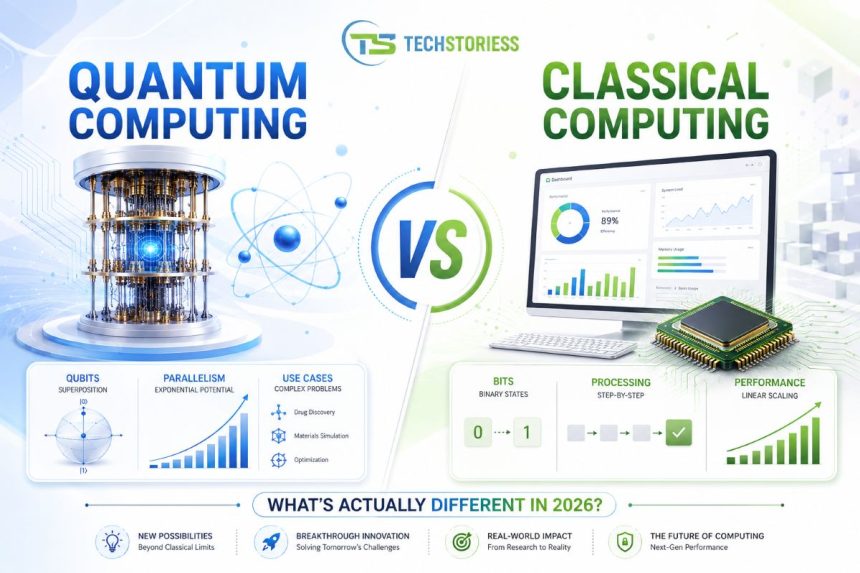
For a long time, quantum computing was at an awkward angle in technology space: the majority of audiences could not understand it, it sounded nearly like science fiction and was still hyped out of proportion, often being projected as a novelty rather than a realistic concept. It was a topic most tech professionals were curious about but still kept far from production architecture decisions. However, we have moved past that era. In 2026, quantum computing has gone beyond theoretical discussions to demonstrable, measurable utility. It has started solving specific problems that are simply beyond the capacity of classical machines, at the scale, time, and cost crucial for real enterprises. In this scenario the real concern is how well you understand it to recognize when it arrives in your domain.
- The Foundation: Bits, Qubits, and Why the Difference Matters
- Quantum Superposition Explained – No Physics Degree Required
- Why Exponential Scaling Breaks Classical Systems
- The Milestone Moment: What 2026 Actually Means
- Google Willow and the Error-Correction Threshold
- The Error Problem: Why Quantum Is So Difficult
- When Quantum Computing Actually Makes Sense
- The Hybrid Architecture Reality
- The NISQ Era and Its Limitations
- The Post-Quantum Security Imperative
- What CTOs Should Actually Do in 2026
- Conclusion
In this article we will keep things straight and plain without hype, jargon, and unrealistic optimism. Whether you are a CTO assessing infrastructure investment timelines, a CISO concerned about your post-quantum cryptography strategies, or a technically curious reader looking for an unbiased, realistic account of what’s actually happening inside these machines – this is an honest guide for you.
The Foundation: Bits, Qubits, and Why the Difference Matters
Before jumping to quantum, let’s start with understanding conventional systems deeply. Classical computing fundamentally relies on bits – the binary units of information that underpin all digital processing. The information processed by your devices – your laptop, phone, and cloud infrastructure – resolves to either of two states: zero or one, on or off. Every single chip no larger than a postage stamp carries billions of transistors that effortlessly switch between these states at astronomical speed. It is an extremely effective model that has been powering the digital landscape for decades – right from the first microprocessors to the world wide web, artificial intelligence, martech, genomic sequencing, real-time logistics, and global financial markets. In its attempt to elevate quantum to a magical identity, much of the public discourse around quantum computing diminishes classical computing. That is not only technically inaccurate but also strategically dangerous.
Quantum computing employs a fundamentally different physical substrate compared to classical systems. Unlike a classical bit, the quantum bit – typically called a qubit – is not constrained to zero or one. It exploits quantum superposition, which allows a qubit to simultaneously exist in a combination of zero and one until it is measured. That may sound strange in physical terms, but here we are assessing things from the view of quantum physics – where such behavior is not an anomaly but a foundational principle. The moment it is measured, this superposition collapses to a definite state, and that is not an approximation. It is the way quantum mechanics actually works. The entire point of quantum computing is to harness this property in the way that makes certain classes of problems tractable that are otherwise not.
Quantum Superposition Explained – No Physics Degree Required
Let’s understand quantum computing in an easy way. For instance, you are trying to solve a maze. A classical computer explores different paths one by one, even if it does so at extreme speed. A quantum system, on the other hand, can encode a number of possible paths simultaneously into a quantum state. Incorrect paths are cancelled out through carefully engineered interference, while correct paths are amplified. It’s not like science fiction with the machine trying every possibility at once. By manipulating probability amplitudes in certain ways it is changing the structure of computation itself.
This is an important distinction. Unlike common notion, speed is not the key strength of quantum computing. In that case, classical hardware could have been eventually scaled up to catch up. The actual advantage of quantum computing is that certain classes of problems become mathematically different under quantum mechanics. Quantum computing changes the computational landscape itself.
Another crucial property is quantum entanglement. Entanglement is a state where one qubit becomes inseparable from the state of another. As a result, measuring one qubit immediately constrains the possible outcomes of the other, even if they are physically separate – the phenomenon that legendary scientist Einstein famously called “spooky action at a distance.” Though it appears to defy classical intuition, repeated experiments validate it conclusively. Due to entanglement, quantum systems can coordinate information across multiple qubits simultaneously, resulting in computational relationships that classical systems can never achieve.
Now comes the important question: what do these properties enable us to achieve in practice? By exploiting interference and entanglement, quantum algorithms can compress computational search spaces that would otherwise explode exponentially on classical hardware. While in some cases it makes an incremental difference, in others, the difference is astronomical.
“In a demonstration, a 12-qubit quantum system solved a memory-intensive task that would have required at least 62 classical bits – not necessarily at a faster speed, but fundamentally in a more efficient representational structure – something that a classical architecture cannot match.”
That single statement reframes the conversation. In such scenarios, clock speed does not define the quantum advantage. It is defined by representational efficiency. Certain problems become structurally manageable in quantum systems that are beyond the capacity of classical systems.
Why Exponential Scaling Breaks Classical Systems
Beyond the hype, there are genuine reasons the industry has started taking quantum seriously. For that we need to understand exponential scaling. Classical computing is highly effective in solving complex problems but it starts struggling when the problem’s complexity doubles repeatedly. One of the best examples is molecular simulation. It can simulate a molecule with a handful of electrons. But it becomes increasingly impossible to simulate larger molecular interactions as the number of quantum states grows exponentially.
That makes nature itself inaccessible. It creates a paradox – at its core, matter is defined by the behavior of molecules, but simulating quantum systems on classical computers means approximating quantum behavior using fundamentally non-quantum machinery.
The pragmatic way to eliminate this challenge is to use quantum computers, running on quantum mechanics, to simulate quantum systems directly.
This is precisely what makes pharmaceutical companies, materials researchers, and energy laboratories the earliest serious adopters of quantum computing. The real value proposition of quantum computing is to solve crucial chemistry and materials problems that are beyond the capacities of classical systems.
The Milestone Moment: What 2026 Actually Means
Due to inflated announcements and overpromised timelines, quantum computing has attracted a great deal of skepticism. Yearly “breakthroughs” without any operational development disappoint both enthusiasts and specialists. So we will present a moderate, unbiased account of what has actually changed in 2026 and whether or why it really matters.
The industry has ventured beyond speculative research milestones into engineering milestones.
That is an enormous distinction.
Google’s Willow processor succeeded in reducing errors – instead of compounding them – by scaling qubits. IBM publicly announced that 2026 is the first year quantum computing can outperform classical systems on specific commercially meaningful tasks. Microsoft introduced Majorana 1, a chip built on topological qubit architecture purpose-built for fault tolerance, advancing its topological qubit program significantly. AWS brought cat-qubit systems to substantially cut down error-correction overhead.
In short, unlike so many prior years when quantum announcements were mostly proving that quantum mechanics worked, the announcements in 2026 are proving that quantum engineering works at an operational level.
So for the first time, the focus of the narrative is not about whether quantum systems are physically possible. It is about when they can become industrially useful.
Google Willow and the Error-Correction Threshold
Among the most crucial achievements is Google’s Willow processor crossing the quantum error-correction threshold, thus paving the way for scalable, fault-tolerant quantum computation. Quantum error correction rates have now fallen below the 1% threshold – a technical milestone that fundamentally changes the trajectory of the field.
One of the biggest operational challenges with quantum systems is that they are extremely fragile. Qubit states can be corrupted by even minute disturbances – thermal noise, electromagnetic interference, vibration, and cosmic radiation can all corrupt qubit states. As opposed to classical transistors, quantum states decay naturally through decoherence. This is the central barrier to practical quantum computing.
That is why increasing qubit volume historically worsened systems instead of improving them. Additional qubits added more noise, increased instability, and propagated errors.
This entire trajectory is dramatically changed by crossing the error-correction threshold.
It simply means that adding more qubits will yield the expected outcome – reducing errors and improving reliability – provided they are correctly arranged under quantum error correction schemes. We can build bigger systems without making them noisier. That represents the foundational prerequisite for fault-tolerant quantum computing – enabling useful, stable, industrial-scale quantum workloads viably without catastrophic error propagation.
For decades a key bottleneck in quantum computing was that scaling led to noise and errors. In 2026, Google’s Willow processor has demonstrably shown that we can safely scale quantum systems to our advantage without those unwanted consequences.
The Error Problem: Why Quantum Is So Difficult
Classical engineers sometimes fail to accurately appreciate how operationally demanding quantum hardware really is compared to classical systems.
When it comes to operational stability, modern CPUs are incredibly reliable. The error rates of classical transistors are so low they are effectively invisible to users. Quantum hardware presents a completely different reality. Superconducting qubits generally require temperatures around 15 millikelvin – colder than deep space. Even the refrigeration systems look like experimental physics infrastructure rather than commercial computing equipment.
Even under those ideal conditions, errors persist constantly due to decoherence and environmental interference.
To solve this, quantum error correction spreads one logical qubit across a number of physical qubits. The system doesn’t treat qubits as isolated units. Instead it encodes information redundantly across multiple entangled states. Measurements indirectly identify errors without collapsing the quantum computation itself.
In short, effective quantum error correction requires enormous overhead.
For a long time it was estimated that for every single stable logical qubit, thousands of physical qubits might be required, creating an immense overhead. This bottleneck made quantum systems impractical for many years. The economics change dramatically with every reduction in error-correction costs.
Here, Microsoft’s Majorana 1 topological approach presents a meaningful alternative. It focuses on creating decoherence-resistant qubits instead of constantly correcting fragile states afterward, which substantially reduces overhead. AWS’s cat-qubit approach is an alternative strategy to resolve the same problem by engineering states that naturally suppress certain error categories.
Instead of relying on a single architecture, the industry is actively exploring multiple paths toward the same destination. That is the road toward fault-tolerant computation at industrial scale.
When Quantum Computing Actually Makes Sense
At this point the narrative becomes really useful. When are we going to realize the actual benefits of quantum computing over classical computing across different real-world use cases?
Here is the quick, straightforward answer: for the majority of workloads in 2026, classical computing still remains the best choice. Mainstream applications like web applications, ERP systems, cloud databases, SaaS platforms, recommendation engines, and transactional infrastructure don’t require quantum hardware. The majority of AI inference workloads don’t require quantum hardware either.
Quantum computing is definitely not a universal replacement for classical systems.
Quantum computing is a specialized accelerator that is specifically useful for computationally extreme problem domains.
In the near term, the ideal use cases will be those involving enormous combinatorial search spaces, quantum-mechanical simulations, or optimization problems beyond classical computing’s scaling capacity.
Molecular Simulation and Drug Discovery
This is the strongest commercial candidate.
At their core, protein folding, molecular interaction modeling, catalyst design, and materials discovery all involve quantum behavior. With growing molecular systems, classical approximations become exponentially expensive, making accurate simulation practically infeasible. Quantum processors can model these interactions natively.
IBM and research partners have already succeeded in running large-scale protein simulations on hybrid quantum-centric systems. In the space of molecular modeling, even marginal improvements can compress years of R&D timelines. That is why major pharmaceutical companies are actively investing in these capabilities.
Optimization Problems
Problems like logistics, manufacturing, portfolio optimization, and supply-chain orchestration involve finding optimal configurations across massive solution spaces.
Quantum Approximate Optimization Algorithms (QAOA) and variational approaches present a promising possibility, despite fierce classical competition. As classical algorithms are fast improving, a majority of near-term quantum advantage claims may diminish. So it’s not the right time to oversell this category yet.
That said, optimization still remains one of the most commercially attractive applications, especially at enterprise scale where even small efficiency improvements generate enormous financial value.
Cryptography
This is the category CISOs and CTOs need to take most seriously.
Once sufficiently large fault-tolerant quantum computers arrive, Shor’s algorithm theoretically breaks RSA and elliptic curve cryptography. We haven’t built such machines yet, but the roadmap has already become concrete enough to demand action.
It doesn’t present an immediate decryption threat, but the real risk lies in “harvest now, decrypt later.” Adversaries can steal and store encrypted communications today, waiting for quantum systems to mature enough to decrypt them later.
For organizations with long-lived sensitive data, beginning post-quantum cryptography migration is an important and pressing need.
The Hybrid Architecture Reality
Many narratives overexaggerate the capabilities and utility value of quantum systems and end up framing it as a superior replacement for classical systems. The reality is quite the opposite.
The actual architecture model emerging in 2026 is hybrid computing.
Quantum Processing Units sit alongside CPUs and GPUs inside larger computational workflows. Classical systems handle orchestration, memory management, preprocessing, and post-processing. Quantum systems accelerate specific computational bottlenecks embedded within larger pipelines.
This is the same pattern seen throughout computing history.
GPUs did not replace CPUs. TPUs did not replace GPUs. Specialized accelerators emerge because certain physics are better suited to certain computations.
Quantum systems are another layer in that evolution.
IBM’s quantum-centric supercomputing architecture formalizes this approach clearly. Quantum processors become part of heterogeneous computing environments rather than standalone replacements for existing infrastructure.
That architectural reality makes adoption far more practical than popular narratives suggest.
Organizations do not need to rebuild their entire computing stack around quantum systems. They need to identify whether parts of their workflows contain computational subroutines where quantum acceleration eventually matters.
The NISQ Era and Its Limitations
Despite the momentum, we are still firmly inside the NISQ era – Noisy Intermediate-Scale Quantum.
That phrase matters because it defines the current ceiling.
Modern quantum systems are capable enough to demonstrate narrow advantages, benchmark superiority, and meaningful scientific experimentation. They are not yet broadly fault-tolerant industrial machines.
Benchmarks also require caution. Some quantum advantages evaporate once better classical algorithms emerge. This feedback loop is healthy. Quantum pushes classical innovation. Classical innovation pushes back.
The strongest quantum milestones are the ones where the separation becomes structurally overwhelming rather than marginal. Google’s Random Circuit Sampling benchmark matters because the classical gap was astronomically large. Narrower claims require constant scrutiny.
There are also brutal infrastructure realities. Superconducting systems require exotic refrigeration. Talent remains scarce. Quantum programming demands expertise spanning mathematics, physics, and computer science simultaneously.
Even the software ecosystem remains immature relative to classical computing. Toolchains are improving rapidly, but the field is still closer to early supercomputing than mainstream enterprise software engineering.
The Post-Quantum Security Imperative
For security leadership, the most urgent quantum issue is not quantum advantage. It is cryptographic survivability.
RSA and ECC underpin enormous portions of modern digital infrastructure. Once sufficiently capable fault-tolerant quantum systems emerge, these standards become vulnerable.
NIST already finalized post-quantum cryptography standards because the migration timeline itself is massive. Large enterprises cannot swap cryptographic infrastructure overnight. Certificates, authentication systems, VPNs, embedded systems, hardware security modules, and compliance frameworks all require staged transitions.
Organizations waiting for “real quantum computers” before planning migration are misunderstanding the problem entirely.
The migration window exists now precisely because the cryptographic threat arrives later.
What CTOs Should Actually Do in 2026
The practical response depends entirely on industry context.
If you work in pharmaceuticals, chemistry, energy systems, or advanced materials research, quantum literacy is now strategically relevant. Your competitors are already experimenting with quantum-accessible cloud infrastructure.
If you work in finance, optimization and risk modeling warrant pilot exploration. More urgently, post-quantum cryptography planning belongs in executive risk discussions now.
If you work in logistics or manufacturing, hybrid optimization workflows deserve monitored experimentation as hardware improves.
For everyone else, the correct strategy is informed observation.
Do not panic-buy quantum strategy decks. Do not ignore the field either.
The organizations best positioned for technology transitions are rarely the first movers. They are the informed movers – the ones that understand enough to identify leverage when it becomes economically meaningful.
Conclusion
Quantum computing and classical computing are not competitors in the way Intel and AMD compete. They are different computational instruments designed for different categories of problems.
What changed in 2026 is not that quantum suddenly replaced classical computing. It is that quantum systems finally became credible enough to matter operationally in narrow but extremely important domains.
The combination of Google’s Willow chip achieving quantum supremacy and crossing the error-correction threshold, IBM’s confirmation that 2026 marks the first year quantum can outperform classical on specific tasks, Microsoft’s Majorana 1 advancing fault-tolerant qubits, and accelerating investment across the ecosystem signals something larger than another hype cycle. The engineering foundations are beginning to stabilize.
That does not mean universal quantum disruption is imminent. It means the field crossed from speculative physics into early-stage industrial computing.
Twenty-five years of watching technology cycles teaches a simple lesson: transformative technologies rarely arrive all at once. They emerge unevenly, first appearing impractical, then niche, then suddenly unavoidable in specific industries before the broader market fully notices.
Quantum computing is entering that middle stage now.
The organizations that succeed over the next decade will not necessarily be the ones making the loudest announcements today. They will be the ones building enough understanding now to recognize exactly where quantum creates leverage when the hardware matures.