


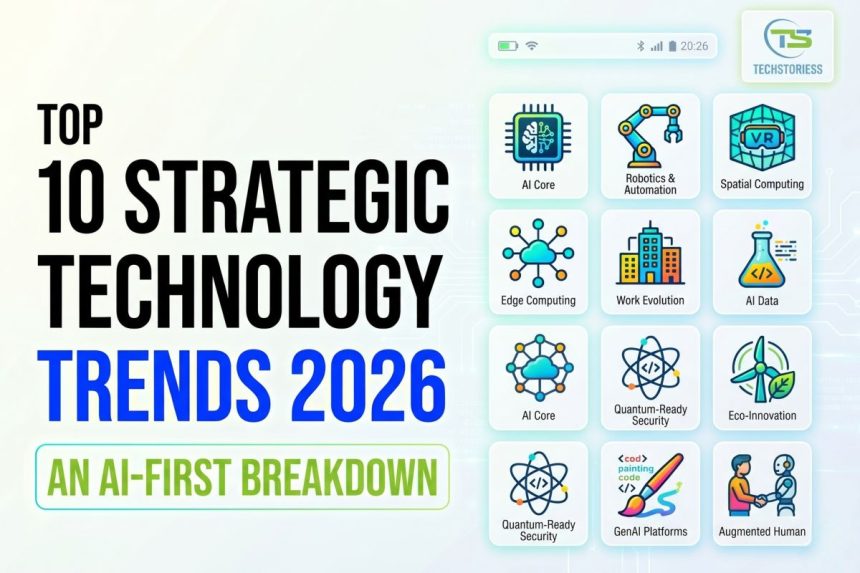
About this analysis: This breakdown draws on Gartner’s Top Strategic Technology Trends 2026, the McKinsey Global Institute’s research on generative AI’s economic potential, IDC’s AI spending forecasts, and the World Economic Forum’s Future of Jobs Report 2025 — cross-referenced with how these trends are actually landing across finance, healthcare, manufacturing, retail, and energy.
- The Economic and Strategic Forces Driving 2026’s AI Agenda
- 1. Sustainable Technology to Facilitate Eco-Friendly AI
- 2. Digital Twins as Predictive Nerve Centers
- 3. The Rise of Agentic Platforms
- 4. Multiagent Systems: How Coordinated AI Agents Are Scaling Enterprise Automation
- 5. AI Supercomputing Platforms: The Hybrid Compute Backbone
- 6. Extended Reality (XR): From Experimentation to Enterprise Mainstream
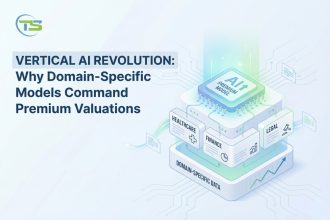
- 7. Domain-Specific Language Models (DSLMs): Context-Aware AI for Industry Precision
- 8. AI Security Platforms: Securing Autonomous Systems at Scale
- 9. AI-Native Development Platforms: Rewriting the Software Engineering Playbook
- 10. Geopatriation and Zero-Trust Edge
- How Enterprises Can Strategically Use Emerging Trends in Technology
- Sector-Wise Relevance of 2026’s AI Trends
- The Strategic Reality of 2026
- Conclusion
Structural transformation is the central theme running through enterprise technology planning this year. By 2026, artificial intelligence has evolved into a role-defining force for enterprises. The shift is architectural, economic, and organizational — enterprises are moving from digital-first operating models toward AI-first ones, where intelligence sits at the core of decision-making, automation, security, and innovation rather than bolted on at the edges.
That shift is being driven by real macro pressure, not hype. Aging workforces in developed economies, skills shortages in emerging markets, and sustained cost volatility are compelling organizations to rethink how value is created and delivered. Competition in finance, healthcare, manufacturing, retail, and energy is forcing a rethink of operational efficiency at the same time digital transformation programs are finally maturing.
The Economic and Strategic Forces Driving 2026’s AI Agenda
The scale of capital moving into this shift is unusually well-documented for a technology cycle this early. Gartner forecasts that worldwide AI spending will total $2.52 trillion in 2026, a 44% year-over-year increase, with AI infrastructure alone adding roughly $401 billion as providers build out compute capacity (Gartner, January 2026). Separately, IDC’s Worldwide Artificial Intelligence Spending Guide projected as early as 2022 that spending on AI-centric systems — software, hardware, and services combined — would surpass $300 billion by 2026, a forecast that has largely held (IDC, via Business Wire). Either way you cut it, CIOs are no longer debating whether to adopt AI — boards are asking how fast it can be embedded into core operations.
The McKinsey Global Institute puts a number on the return side of that equation: generative AI alone could add the equivalent of $2.6 trillion to $4.4 trillion annually to the global economy across the 63 use cases it analyzed, concentrated in customer operations, marketing and sales, software engineering, and R&D (McKinsey, “The economic potential of generative AI”).
The labor side of the story is also being rewritten in real time. Earlier estimates of AI-driven job displacement (85 million roles by 2025) are now dated. The World Economic Forum’s more recent Future of Jobs Report 2025 — drawing on more than 1,000 employers across 22 industries and 55 economies — puts the number at 92 million roles displaced against 170 million newly created by 2030, a net gain of 78 million jobs, even as the mix of work shifts hard toward technology, data, and AI-adjacent roles (World Economic Forum, January 2025). That’s a profound labor reconfiguration, not a net decline in employment — but the reconfiguration is real, and it’s arriving faster than most workforce plans account for.
Against this backdrop, these trends aren’t ten siloed innovations — they’re a single transformation agenda. Gartner’s own Top Strategic Technology Trends for 2026 groups its ten named trends into three themes — The Architect (foundational infrastructure), The Synthesist (orchestrating value from agents and specialized models), and The Vanguard (protecting trust and compliance) — reflecting how organizations build, orchestrate, and protect digital value in an AI-powered, hyperconnected world (Gartner, “Top Strategic Technology Trends for 2026”). The ten trends below combine six that map directly onto Gartner’s named 2026 list with four additional shifts — sustainability mandates, digital twins, agentic platforms, and XR — that are shaping enterprise roadmaps alongside them. For more on how these forces are converging across industries, see our broader look at how frontier tech is reshaping industries in 2026.
The 10 Trends at a Glance
| # | Trend | Core Shift | Primary Sectors | Analyst Basis |
|---|---|---|---|---|
| 1 | Sustainable Technology | Optional CSR → mandatory disclosure | Manufacturing, Energy | EU CSRD |
| 2 | Digital Twins | Reactive troubleshooting → predictive simulation | Manufacturing, Healthcare, Energy | Gartner hybrid-computing research |
| 3 | Agentic Platforms | Prompt-based assistants → autonomous execution | Finance, IT Ops, Insurance | Gartner Agentic AI (2025) → Multiagent Systems (2026) |
| 4 | Multiagent Systems | Single models → orchestrated agent teams | Supply chain, Cybersecurity, IT | Gartner Top Strategic Technology Trends 2026 |
| 5 | AI Supercomputing Platforms | Cloud-only → hybrid compute backbone | Cross-industry infrastructure | Gartner Top Strategic Technology Trends 2026 |
| 6 | Extended Reality (XR) | Pilot projects → embedded operations | Manufacturing, Healthcare, Logistics | Market research (Grand View Research) |
| 7 | Domain-Specific Language Models | General LLMs → industry-tuned models | Healthcare, Finance, Legal | Gartner Top Strategic Technology Trends 2026 |
| 8 | AI Security Platforms | Perimeter security → AI-lifecycle governance | Finance, Healthcare, cross-industry | Gartner Top Strategic Technology Trends 2026 |
| 9 | AI-Native Development Platforms | Manual coding → AI-assisted engineering | Software, cross-industry | Gartner Top Strategic Technology Trends 2026; McKinsey |
| 10 | Geopatriation & Zero-Trust Edge | Global cloud-first → sovereign, zero-trust architecture | Finance, Government, Energy | Gartner Top Strategic Technology Trends 2026 |
1. Sustainable Technology to Facilitate Eco-Friendly AI
With the EU Corporate Sustainability Reporting Directive (CSRD) now in force, sustainability has moved from a nice-to-have CSR line item to a board-level compliance obligation — particularly for large enterprises, which must now prepare detailed disclosures on environmental impact and mitigation. That regulatory pressure is colliding with a genuinely uncomfortable fact: AI workloads are energy-intensive, and the more enterprises scale AI, the harder it becomes to hit their own sustainability targets without deliberate engineering effort.
Green Software Engineering and AI-Driven Optimization
Enterprises are responding by adopting green software engineering practices: profiling code for energy efficiency, right-sizing compute instead of over-provisioning by default, and deploying AI-driven monitoring systems that measure emissions and track sustainability metrics against compliance thresholds in something close to real time.
Illustrative scenario: A mid-size manufacturer running AI-driven predictive maintenance across three plants might use workload-scheduling software to shift non-urgent model training to off-peak, lower-carbon-intensity grid windows — cutting the carbon footprint of that training workload materially without touching accuracy. This is the kind of “boring” sustainability win — scheduling, not headline innovation — that’s actually available to most enterprises today.
2. Digital Twins as Predictive Nerve Centers
Digital twins have moved well past siloed simulations of isolated systems. Enterprises are now modeling entire processes, factories, supply chains, and organizational ecosystems, integrating real-time sensor data with AI modeling to shift from reactive troubleshooting toward predictive optimization and scenario planning.
The scale of what this unlocks is already visible in Gartner’s own commentary on hybrid computing adoption: by 2028, Gartner expects more than 40% of leading enterprises to have integrated hybrid computing architectures into core operations, up from just 8% today — and the simulation use cases driving that shift are concrete. Gartner VP Analyst Tori Paulman has pointed to pharmaceutical companies modeling new drug candidates in weeks instead of years, financial institutions simulating global markets to reduce portfolio risk, and utility providers modeling extreme weather to optimize grid performance as live examples of what this capability now enables (Gartner, via Process Excellence Network).
Operational Intelligence and Risk-Free Experimentation
In 2026, digital twins function as operational nerve centers — letting businesses simulate, test, and optimize mission-critical decisions without real-world risk or expense. For a closer look at the ROI mechanics specifically in manufacturing, see our deep dive on the ROI of AI predictive maintenance in manufacturing.
3. The Rise of Agentic Platforms
The rise of agentic platforms is among the most consequential shifts feeding into 2026’s technology agenda. There’s a crucial distinction between AI assistants and AI agents: assistants respond to prompts and surface insights, while agents work autonomously toward a defined goal, executing multi-step workflows with an efficiency that can meet or exceed a human operator’s. If you’re new to the concept, our pillar guide on what are autonomous AI agents breaks down how they actually work, step by step, before you get into the enterprise deployment detail below.
From AI Assistants to Autonomous Agents
Gartner named agentic AI as a top strategic trend for 2025; by 2026, that trend has matured and folded into the more architecturally specific Multiagent Systems trend covered in the next section — the underlying shift is the same: systems that plan, decide, and execute with minimal human intervention, built as orchestrated frameworks combining reasoning engines, memory systems, integration layers, and governance controls. For a broader look at where this is heading, see our companion piece on agentic AI and the next wave of autonomous business systems.
Enterprise Applications of Agentic AI
In enterprise settings, agentic platforms can reconcile financial transactions, process insurance claims, or manage IT incident resolution with far less manual prompting — employees define objectives and guardrails rather than re-entering instructions task by task.
Illustrative scenario: Picture a mid-market insurer that lets an agent triage incoming claims: it pulls policy data, checks documentation completeness, flags likely fraud indicators against known patterns, and routes only the ambiguous 15–20% of cases to a human adjuster. The agent doesn’t replace the adjuster — it removes the repetitive first pass so the adjuster’s time goes to judgment calls, not data entry.
Orchestration, Governance, and Scaling Without Amplifying Risk
This evolution demands robust orchestration layers to monitor performance, ensure compliance, and manage risk — agents must adhere to regulatory requirements while interacting with external systems, and transparency mechanisms need to log decisions and track actions for auditability. The efficiency gain is real, but so is the failure mode: governance gaps don’t just cause errors, they can amplify them at agent speed across every workflow the agent touches. Enterprises considering this shift may also want to review our agentic AI deployment playbook for Indian enterprises, which covers the 90-day rollout patterns that separate successful pilots from the roughly 40% that stall.
4. Multiagent Systems: How Coordinated AI Agents Are Scaling Enterprise Automation
Multiagent Systems is one of Gartner’s ten officially named Top Strategic Technology Trends for 2026 — and it’s arguably the trend with the clearest line to near-term ROI. Organizations are deploying multi-agent frameworks that integrate models from multiple providers, reshaping vendor ecosystems around interoperability rather than lock-in.
Redefining Productivity Metrics in the AI Era
By the end of 2026, agentic systems are expected to redefine productivity metrics: instead of measuring work by hours logged, enterprises increasingly assess performance by tasks autonomously completed end to end.
From Individual Agents to Coordinated Intelligence
A single agent automates a specific task; a multiagent system coordinates an entire workflow across distributed intelligence. Gartner describes multiagent systems as agents that “interact to pursue individual objectives or collaborate on shared, complex goals,” operating either within one environment or independently developed and deployed across distributed systems (Gartner, October 2025).
Illustrative scenario: In IT operations, one agent might monitor infrastructure performance, a second forecasts security threats, and a third coordinates remediation. In a supply chain, procurement agents predict demand, logistics agents optimize routing, and finance agents manage the resulting cash-flow implications — three narrow agents producing a result none of them could reach alone.
Modularity, Governance, and Where the Risk Actually Sits
The composability of multiagent architectures — swapping or upgrading one agent without rebuilding the whole system — is the operational upside. The downside is coordination risk: well-defined communication protocols, conflict-resolution mechanisms, and centralized oversight dashboards aren’t optional extras, they’re what keeps five specialized agents from quietly working at cross purposes. Structured validation checks, simulation testing, and staged rollouts are the standard mitigation before any large-scale deployment.
5. AI Supercomputing Platforms: The Hybrid Compute Backbone
AI Supercomputing Platforms is another of Gartner’s ten named 2026 trends, and it’s the one every other trend on this list quietly depends on — agentic systems and domain-specific models lose responsiveness fast without the compute foundation underneath them. These platforms weave CPUs, GPUs, and specialized AI accelerators into hybrid environments tuned for both training and inference.
Private AI Infrastructure and Sovereign Cloud Imperatives
An increasing number of enterprises are investing in private AI infrastructure to keep sensitive data and IP under their own control, and sovereign cloud strategy is increasingly a compute-design decision, not just a legal one. Applications with strict latency requirements — autonomous manufacturing systems, for instance — need edge deployment tightly integrated with centralized processing. The scale of the recent hardware build-out is visible in deals like Google’s 3-million-chip order with Intel, which illustrates just how much capital is now flowing into the physical compute layer behind these platforms.
Energy Demand as a Strategic Constraint, Not a Footnote
High-performance AI workloads meaningfully increase electricity demand, especially for large-model training — which is precisely why compute strategy and sustainability strategy (Trend 1) can’t be planned in separate silos anymore. Organizations that treat energy and carbon accounting as an infrastructure decision, not an afterthought, are the ones avoiding compliance surprises down the line.
6. Extended Reality (XR): From Experimentation to Enterprise Mainstream
Extended Reality — combining VR and AR into immersive digital-physical experiences — has been maturing in enterprise pilots for years. In 2026, hardware finally caught up: headsets have gotten lighter and more efficient, and smart glasses have benefited from real gains in optics, battery life, and processing, making all-day wear practical rather than theoretical.
Market sizing varies widely by research house — a reminder that “the market will be worth $X” claims deserve scrutiny regardless of who’s making them. Grand View Research puts the global XR market at roughly $142 billion in 2023, growing to over $1 trillion by 2030 at a compound annual growth rate near 33% (Grand View Research) — with enterprise training, design collaboration, and remote assistance use cases driving a growing share of that expansion, rather than consumer gaming alone.
Enterprise Use Cases Gaining Scale
Organizations are using XR for immersive employee training on high-risk or technically complex tasks in simulated environments, collaborative design review, and remote expert assistance — where a specialist guides a field technician in real time via AR overlays. Hands-free, hazard-aware XR is showing up in manufacturing, logistics, and healthcare settings, including real-time safety warnings in dangerous environments.
7. Domain-Specific Language Models (DSLMs): Context-Aware AI for Industry Precision
While general-purpose LLMs offer broad interpretive range, enterprises are increasingly prioritizing accuracy over breadth — and Domain-Specific Language Models are Gartner’s answer to that demand, one of the ten named 2026 trends. DSLMs are trained on curated industry datasets to deliver domain-relevant outputs with far more contextual precision than a generalist model can offer out of the box.
Industry Applications: Healthcare, Finance, and Legal
In healthcare, DSLMs trained on medical literature and regulatory standards support diagnostics documentation and compliance workflows. In finance, they incorporate compliance rules and risk models to sharpen fraud detection and regulatory reporting. In legal work, they analyze jurisdiction-specific precedent to help professionals draft documents and research case law faster. Because they’re trained on narrower, more curated data, DSLMs tend to hallucinate less and offer higher reliability than generalized models on in-domain questions — though they’re only as good as the governance around the data they were trained on.
Competitive Differentiation Through Proprietary Models
Domain-specific AI is becoming a genuine competitive moat: models trained on a company’s own internal data offer contextual understanding that’s hard for competitors to replicate quickly, at the cost of higher upfront investment in data governance, annotation pipelines, and validation protocols. Growth here is often accelerated through partnerships with cloud providers and research institutions that bring infrastructure and domain expertise enterprises don’t have in-house.
8. AI Security Platforms: Securing Autonomous Systems at Scale
Every agent and model deployed is another digital gateway, and Gartner’s Top Strategic Technology Trends for 2026 treats AI Security Platforms as a core architectural layer for exactly that reason — centralizing visibility and control across third-party and custom AI applications (Gartner, “Top Strategic Technology Trends for 2026”).
New Vulnerabilities Introduced by Autonomous Agents
Agents that interact with APIs, enterprise systems, and databases introduce genuinely novel attack surfaces — adversaries can target model reasoning processes or poison training data to skew outcomes, not just steal credentials the old-fashioned way. AI security platforms are built to monitor behavioral patterns, flag anomalies in real time, and enforce policy constraints across the model lifecycle, not just at the network perimeter. For a closer look at the specific threat classes involved, see our breakdown of AI agent security practices for 2026, including prompt injection and MCP risks.
AI Security as a Board-Level Priority
Because autonomous systems can escalate the blast radius of a single breach, security budgets and AI-expansion budgets increasingly need to move together rather than security playing catch-up a year behind deployment. Explainability tooling — letting organizations audit AI-generated decisions — matters here too, especially as AI touches higher-stakes domains like lending decisions and clinical recommendations where regulatory scrutiny is only going up. Enterprises evaluating vendors in this space may find our review of the 8 best zero-trust security platforms for cloud environments in 2026 a useful starting point.
9. AI-Native Development Platforms: Rewriting the Software Engineering Playbook
AI-Native Development Platforms round out Gartner’s named 2026 list — generative AI is reshaping software engineering by automating repetitive work and compressing development cycles, with platforms integrating code generation, testing automation, and deployment orchestration into a single workflow.
AI Copilots and the Acceleration of Productivity
Developers increasingly work alongside AI copilots that write, debug, and optimize code, while low-code AI tools let non-technical staff build working applications — genuinely widening who can ship software, not just speeding up the people who already could.
Evolving Roles, Not Disappearing Ones
Automated coding has reduced routine development work, but it’s simultaneously increased demand for architecture design, model oversight, AI governance, and systems integration skills. The realistic path for most engineering teams is retraining developers into AI-supervisor and solution-architect roles, not replacing them — McKinsey’s productivity research (cited above) is consistent with this: the value shows up in speed and quality gains, not headcount reduction alone. See our companion explainer on AI-native platforms in 2026 — definition, architecture, use cases, and benefits for the full architectural picture.
10. Geopatriation and Zero-Trust Edge
As global regulatory environments fragment, enterprises are recalibrating cloud strategy around data sovereignty — a shift Gartner names directly in its 2026 trends list as geopatriation: the deliberate relocation of data and compute to sovereign or regional providers to mitigate geopolitical risk and meet compliance requirements. Gartner projects that by 2030, more than 75% of enterprises in Europe and the Middle East will have geopatriated at least some workloads (Gartner, via Prolifics).
The Rise of Zero-Trust Edge Architectures
This shift pairs naturally with zero-trust edge architectures, which verify every access request regardless of origin under a “never trust, always verify” principle — eliminating the old assumption that anything inside the corporate network is automatically safe. Continuously validating identity, device posture, and access privileges meaningfully cuts the risk of lateral movement after an initial breach. For a practical comparison of vendors, see our guide to the 8 best zero-trust security platforms for cloud environments, and for the broader cloud-architecture implications, our explainer on multi-cloud strategy and avoiding vendor lock-in.
Resilience Through Cloud Diversification
Diversifying cloud providers and distributing workloads across regional zones reduces systemic exposure to any single vendor or jurisdiction — multi-cloud and distributed architectures buy operational continuity and adaptability in a world where regulatory environments can shift faster than a single-cloud migration plan can adapt to them.
How Enterprises Can Strategically Use Emerging Trends in Technology
These ten shifts aren’t upgrades bolted onto existing systems — they’re a structural change in how enterprises operate, compete, and manage risk. The compounding benefit only shows up when AI supercomputing, agentic systems, digital twins, zero-trust security, and sustainable infrastructure are treated as interconnected capabilities, not ten separate line items competing for the same budget.
Cost vs. Benefit Analysis
Higher upfront costs are a real barrier, especially for small and mid-sized businesses — AI infrastructure, domain-specific models, and security platforms aren’t cheap. The framing that holds up better under scrutiny is evaluating these costs against structural productivity shifts and long-term risk mitigation, not treating them as a single fiscal-year expense to be minimized.
Where this plays out concretely: AI-native development platforms can cut software cycle times by months, not weeks. Digital twins prevent the kind of unplanned downtime that costs far more than the simulation software itself. Zero-trust architectures are cheap relative to the cost of a lateral-movement breach that reaches a core system. None of these show up as dramatic line items in year one — the return compounds as automation and predictive intelligence scale across more of the business.
Where investment tends to justify itself:
- Labor efficiency gains from automation and AI copilots
- Reduced losses from automated security and compliance monitoring
- Downtime prevention via predictive simulation models
- Faster time-to-market from AI-native development
- Brand and regulatory protection through sustainable technology integration
Sector-Wise Relevance of 2026’s AI Trends
Finance & Banking
For institutions in a heavily regulated environment, AI’s biggest payoff is precision and governance that reduces both compliance and operational risk. Domain-specific language models streamline compliance reporting, while agentic AI reconciles transactions and monitors fraud patterns in real time.
Strategic focus: Domain-specific AI for regulatory accuracy · Real-time fraud detection agents · Zero-trust cloud architecture · AI security observability platforms
Healthcare
Efficiency and safety dominate healthcare priorities. AI extends workforce bandwidth by reducing administrative burden, digital twins model hospital capacity for safer operational planning, and XR strengthens surgical and emergency training — all while patient data protection stays the non-negotiable constraint.
Strategic focus: Clinical documentation automation · Digital twin modeling for hospital operations · XR for surgical and emergency training · Strong AI governance and security layers
Manufacturing
Manufacturing gets the most direct benefit from predictive intelligence: digital twins cut equipment downtime, multiagent systems coordinate complex supply chains, and edge AI enables real-time floor decisions. Robotics-as-a-service is increasingly the delivery model for this automation without the capex of owning the hardware outright — see our analysis of how robotics-as-a-service is redefining business automation for how that shift is unfolding.
Strategic focus: Predictive maintenance via digital twins · Multi-agent supply chain orchestration · Edge AI deployment · XR-enabled field support
Retail & E-Commerce
Speed and personalization are retail’s competitive currency. Agentic AI optimizes inventory, pricing, and customer engagement; AI-native development platforms accelerate feature releases; multi-agent systems coordinate demand forecasting and logistics to close supply-demand gaps faster than manual planning cycles allow.
Strategic focus: Inventory optimization agents · Personalized marketing models · AI-driven pricing strategies · Automated logistics coordination
Energy & Utilities
Infrastructure-heavy sectors need resilience above all else. Digital twins simulate grid performance and asset lifecycles, sustainable technology helps hit emission targets, and zero-trust, distributed cloud architecture hardens the security posture of increasingly connected grid infrastructure.
Strategic focus: Grid simulation modeling · Carbon monitoring integration · Distributed cloud architecture · Predictive maintenance intelligence
The Strategic Reality of 2026
Sustainable advantage requires unifying infrastructure, intelligence, governance, and workforce adaptation under one coherent strategy rather than pursuing each trend independently. The sequencing that tends to work, roughly in order:
- Modernize infrastructure — AI supercomputing and compute foundations first; nothing else scales without this.
- Deploy securely — AI security platforms and zero-trust architecture from day one, not retrofitted after an incident.
- Add domain-specific precision — DSLMs where generalist models create ambiguity or compliance exposure.
- Orchestrate with multiagent systems — once single agents are proven, coordinate them into full workflows.
- Shift to predictive optimization — digital twins and simulation replace reactive troubleshooting.
- Align sustainability and sovereignty — geopatriation and green engineering as strategic constraints, not compliance afterthoughts.
Organizations that jump straight to agentic deployment without the infrastructure and governance underneath tend to see cost overruns and governance failures within the first year — the foundation work isn’t optional, even when it’s less exciting than the agent demo.
Conclusion
The AI technology shifts defined here represent a unified transformation agenda, not ten isolated bets. Gartner projects worldwide AI spending will reach $2.52 trillion in 2026, and the McKinsey Global Institute estimates generative AI alone could add $2.6 trillion to $4.4 trillion annually to the global economy — while the World Economic Forum’s 2025 Future of Jobs Report points to 92 million roles displaced against 170 million created by 2030, a net gain of 78 million jobs alongside a significant skills reshuffle.
Enterprises that integrate these ten trends coherently — rather than chasing each as a standalone pilot — are the ones positioned to redefine their business models rather than simply automate their existing ones. For the fundamentals behind the agentic layer running through several of these trends, our pillar guide on what are autonomous AI agents and how they work in 2026 is the right place to start; for the broader cross-industry picture, see how frontier tech is reshaping industries in 2026.