



Quick answer:
- From Automation 1.0 to Agent-First Enterprise Automation
- Why Single Agents Fall Short
- The Multi-Agent Revolution
- The Business Case: Beyond Automation to Autonomy
- Where the Numbers Stand: A Quick Reference
- Orchestration: The Heart of Agentic Automation
- Organizational Impact: Reinventing Enterprise Operating Models
- The Reality Gap: Challenges in Production Readiness
- Measuring Impact: Autonomy at Scale
- Infrastructure Evolution: Why Legacy Systems Cannot Sustain Agentic Workflows
- Economic Impact: Productivity, Cost Structures, and Competitive Advantage
- Talent and Governance: Building Internal Autonomy Capabilities
- The Strategic Shift: From AI Tools to Autonomous Operating Systems
- Key Takeaways for Enterprise Leaders
- Frequently Asked Questions
- Conclusion
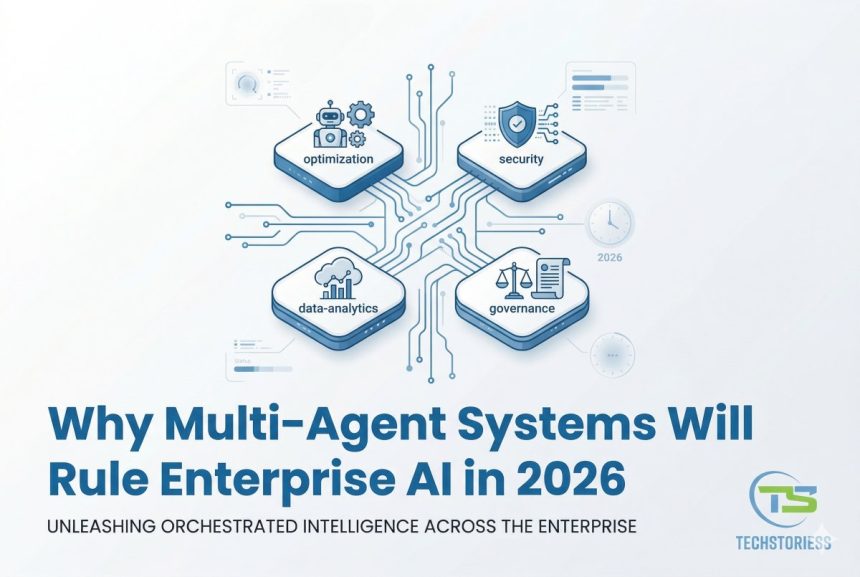
- Enterprises are moving from single AI agents to coordinated multi-agent systems because one agent trying to handle an entire business process runs into the same walls that killed monolithic software: bottlenecks, weak governance, and poor auditability.
- Multi-agent systems split the work across specialized agents — retrieval, reasoning, compliance, execution — coordinated by an orchestration layer.
- Gartner has tracked a 1,445% jump in enterprise inquiries about this architecture in about a year, but Deloitte’s research shows barely one in ten companies has actually gotten one into production.
- The rest of this piece walks through why single agents fall short, what a multi-agent architecture actually looks like, and where the real deployment gaps are in 2026.
If you’re starting from the basics, it’s worth first understanding what are autonomous AI agents and how they work on their own — this piece builds on that foundation and looks at what happens when you connect several of them together.In 2026, agentic AI isn’t a futuristic concept anymore — it’s reshaping how enterprises actually operate. A single AI agent was the breakthrough a couple of years ago. Now, orchestrated multi-agent systems are becoming the backbone of enterprise modernization, changing not just what gets automated but how entire workflows are designed.
From Automation 1.0 to Agent-First Enterprise Automation
Early enterprise automation relied on structured rules and robotic process automation (RPA): data entry, batch updates, rule-based routing. It worked for predictable tasks, but the orchestration underneath was rigid. The moment a workflow crossed multiple systems or needed judgment calls, RPA created friction instead of removing it.
The Architecture Shift: Introducing Agentic AI
Agentic AI changes that architecture at the root. Instead of following a fixed script, these systems reason through a problem, hold context across steps, and adapt as conditions change. UiPath describes agentic AI as software that can perceive context, decide, and act toward a business outcome — not just answer a question or run a pre-set routine.
From Scripted Execution to Context-Aware Collaboration
Unlike RPA or a basic AI assistant, an agentic system can break a task into subtasks, read the situation as it evolves, and loop in a human — or another agent — when it needs to. That’s the piece that lets it operate across a messy, real enterprise environment instead of a clean sandbox.
Why Single Agents Fall Short
Most of the agents enterprises deployed through 2024 and 2025 were single large language models doing broad, general-purpose work: summarizing, drafting, answering questions, light analysis. They’re good at that. They’re not built for what comes next.
Scalability and Governance Constraints
A single agent handling an entire multi-step business process becomes a bottleneck by design — one model reasoning through every decision, with no natural way to divide labor. It also tends to be wasteful: one model stretched across unrelated domains needs constant re-tuning without a matching payoff. And because a single agent has no built-in separation of duties, it’s genuinely hard to audit, which is exactly why so few of these projects have made it past a pilot.
The Enterprise Deployment Gap
This isn’t a minor gap. Deloitte’s 2025 Emerging Technology Trends study found that while 30% of organizations are exploring agentic AI and 38% are piloting it, only 14% have something deployable — and just 11% are actually running it in production. That’s the gap multi-agent architecture is trying to close: distributed, coordinated systems that behave more like a cross-functional team than one very busy assistant.
The Multi-Agent Revolution
A multi-agent system (MAS) is a network of specialized AI agents that share context and work together toward a shared business goal, rather than one generalist agent trying to do it all.
Surge in Interest and Adoption
Enterprise appetite for this shift has been sharp. Gartner reports a 1,445% surge in enterprise inquiries about multi-agent systems between Q1 2024 and Q2 2025. That’s not a niche curiosity — it reflects CIOs and automation leaders actively reworking their architecture plans, not just kicking the tires on a new buzzword.
Core Components of Multi-Agent Architecture
A typical multi-agent setup has four moving parts:
- Specialized agents — each one owns a narrow job: data retrieval, reasoning, validation, compliance, or execution.
- An orchestration layer — coordinates which agent acts when, resolves conflicts, and manages dependencies.
- Shared context and memory — agents reference a common knowledge base so decisions stay consistent.
- Communication protocols — standards like Agent-to-Agent (A2A) and Model Context Protocol (MCP) let agents from different vendors talk to each other securely.
Coordinated Workflow Execution Across Systems
That separation of roles is what lets a multi-agent system handle something like end-to-end procurement, cross-departmental financial reconciliation, or an adaptive customer journey — with more resilience and scale than one agent trying to hold the whole process in its head.
The Business Case: Beyond Automation to Autonomy
The real shift isn’t automating more tasks — it’s enterprises getting comfortable handing off entire decision chains.
Complex Workflow Execution
Instead of one agent reasoning through an entire workflow alone, a multi-agent system splits the reasoning across specialists working in parallel. A typical sequence looks like this:
- A data extraction agent pulls the relevant enterprise records.
- A reasoning agent evaluates the context and decides the next step.
- A compliance agent checks the proposed action against governance rules.
- An execution agent pushes the update into connected systems — ERP, CRM, finance.
That structure removes manual handoffs between departments, and it’s the main reason cycle times and accuracy both improve.
Enterprise-Level Value
Analysts increasingly treat agentic automation as a strategic capability, not a tactical efficiency play. Capgemini Research Institute’s 2024 survey of 1,100 executives found 82% of organizations planned to integrate AI agents within one to three years. Ambition, though, doesn’t automatically become production maturity — which is exactly the gap the next two sections dig into. If you’re weighing this against a simpler copilot-style rollout, the ROI comparison between agentic AI and traditional copilots lays out the decision math in more detail.
Where the Numbers Stand: A Quick Reference
Enterprise AI research is scattered across a handful of firms, each measuring something slightly different. Here’s how the core data points line up:
| Source | Stat | What it actually measures |
|---|---|---|
| Gartner | 1,445% surge (Q1 2024–Q2 2025) | Growth in enterprise inquiries about multi-agent architecture |
| Deloitte | 14% deployable / 11% in production | Share of organizations with agentic AI beyond the pilot stage |
| Capgemini (2024) | 82% plan to integrate | Organizations planning AI agent adoption within 1–3 years |
| Capgemini (2026) | 2% deployed at scale / 61% still exploring | Actual maturity of AI agent deployment as of 2026 |
| UiPath | 78% say reinvention is required | Executives who believe operating models must change to capture agentic value |
Read together, the pattern is consistent across every firm: intent is high, production maturity is low, and the gap between the two is where multi-agent orchestration is meant to do its work.
Orchestration: The Heart of Agentic Automation
Orchestration is what keeps a multi-agent system from turning into five agents working at cross purposes. It’s the structured coordination layer that keeps every agent aligned with business objectives, compliance rules, and operational priorities.
What Orchestration Enables
- Task sequencing — deciding which agent acts, and when, based on dependencies.
- Conflict resolution — reconciling disagreements between agents into one coherent path.
- Governance enforcement — building compliance and audit requirements into the execution logic itself, not bolting them on after.
- Human–agent collaboration — structured approval points and escalation paths where a person needs to sign off.
Without this layer, agents tend to drift into silos — each one technically working, but the overall outcome fragmented or inconsistent.
Protocol Evolution
Agent-to-Agent (A2A) and Model Context Protocol (MCP) are emerging as the shared plumbing for cross-agent communication — A2A for agent-to-agent messaging, MCP for secure data exchange with enterprise systems. The comparison to TCP/IP gets made a lot, and it’s a fair one: these protocols are trying to become the connective tissue that lets agents from different vendors work together instead of each vendor building a closed island.
Organizational Impact: Reinventing Enterprise Operating Models
Adopting multi-agent systems isn’t just a technology rollout. It tends to force a rethink of how the organization itself is structured.
Reinvention Imperative
UiPath’s 2026 AI and Agentic Automation Trends Report found that 78% of executives believe they’ll have to reinvent their operating models to capture agentic AI’s full value — technology adoption alone isn’t enough. Rigid hierarchies and siloed process ownership slow this down. The enterprises moving faster are the ones restructuring around cross-functional accountability that matches how the automation actually flows.
Human-Agent Collaboration
Autonomous agents shift what people spend their time on. Less repetitive execution, more oversight, governance, and exception handling. New roles — agent orchestration architects, AI governance leads, enterprise data curators — exist specifically to keep that oversight layer functioning as the automation scales. If you’re curious how this plays out for individual roles rather than the org chart, how AI agents are changing jobs and the future of work goes deeper on that specific question.
The Reality Gap: Challenges in Production Readiness
Enthusiasm is outrunning readiness, and the data backs that up from more than one angle.
Readiness Shortfall
Deloitte’s research already showed the deployment gap — 14% deployable, 11% in production. The newer Capgemini “Rise of Agentic AI” report puts a finer point on it: as of 2026, only 2% of organizations have deployed AI agents at scale, another 12% at partial scale, and 61% are still in the exploration phase. Three things keep showing up as the actual blockers:
- Legacy infrastructure — most enterprise systems were never built for real-time autonomous interaction.
- Data silos — agents need clean, structured, cross-system data access, and most enterprises still don’t have it.
- Governance limitations — without structured oversight, execution risk climbs fast.
Technical Complexity
Multi-agent systems also add real architectural complexity: communication standards, conflict resolution, shared memory management, and resilience engineering all have to be designed deliberately. This is still an active area of research, not a solved problem — coordination among reasoning agents at scale is genuinely hard engineering, not a checkbox.
Measuring Impact: Autonomy at Scale
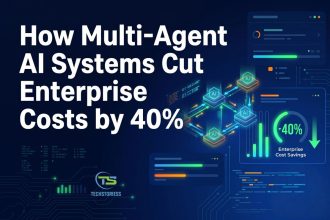
Where multi-agent systems do reach production, the reported gains are consistent: shorter cycle times from coordinated execution, higher throughput from parallel agent reasoning, and lower error rates from distributed validation compared to manual handoffs. TechStoriess’ own reporting on how multi-agent AI is cutting enterprise costs by 40% walks through what that looks like in practice across finance, compliance monitoring, and supply chain orchestration, and 7 enterprise use cases that actually deliver ROI covers the workflow-by-workflow breakdown.
Infrastructure Evolution: Why Legacy Systems Cannot Sustain Agentic Workflows
Traditional enterprise architecture was never built for autonomous decision-making at scale. Monolithic systems, static APIs, and siloed data repositories all constrain the fluid execution agentic workflows need.
The Three Foundations of Agentic Infrastructure
Three things need to be in place before multi-agent systems can run reliably:
- Composable architecture — APIs and microservices that let agents interact dynamically and reconfigure execution paths without rigid dependency chains.
- A unified data fabric — secure, real-time access to enterprise-wide knowledge, not scattered across disconnected systems.
- Event-driven design — agents need to respond to triggers and state changes immediately, not on a batch schedule.
From Pilot to Enterprise-Scale Autonomy
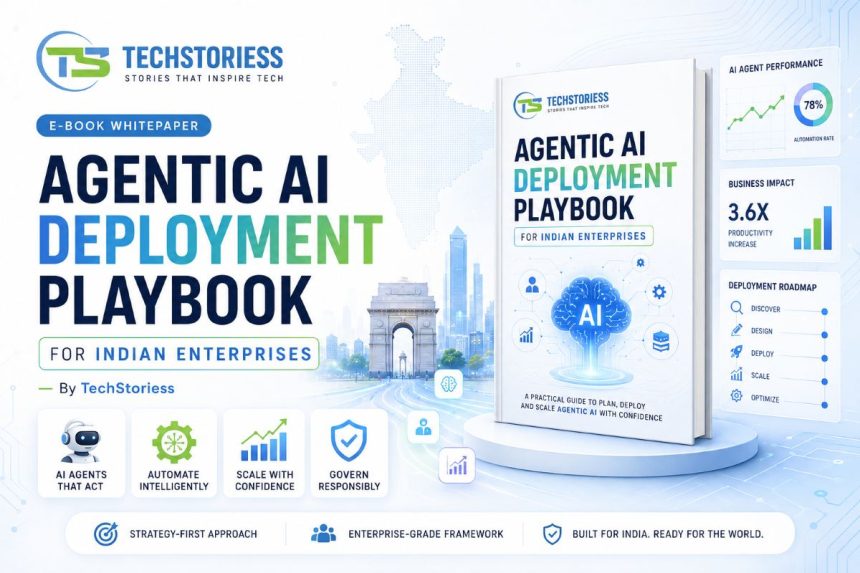
Without these three, even a well-built agent stays stuck in a sandbox. This is a big part of why TechStoriess’ own Agentic AI Deployment Playbook for Indian Enterprises puts infrastructure readiness ahead of model selection in its 90-day rollout framework — the research behind that playbook found Gartner expects roughly 40% of agentic AI projects to be cancelled by 2027, and infrastructure gaps are consistently a bigger factor than the AI model itself.
Economic Impact: Productivity, Cost Structures, and Competitive Advantage
The economic case for this shift is moving from “it saves time” to “it changes the cost structure.” In a conventional enterprise, departments operate in silos, reconciliation is manual, and approval chains create bottlenecks by default. Multi-agent orchestration removes a lot of that friction directly — agents can negotiate task dependencies and execute across systems without waiting on a manual handoff.
Automating Decision Velocity
The compounding effect isn’t really about doing more tasks faster. It’s that latency drops across the whole workflow, redundant coordination work disappears, and cross-departmental friction shrinks. Enterprises that get this right build an advantage that’s hard to copy quickly, because it’s structural rather than a single feature. For a closer look at how these gains actually translate to the balance sheet, Generative AI ROI: 5 Metrics That Map to EBITDA breaks down the specific financial metrics worth tracking.
Talent and Governance: Building Internal Autonomy Capabilities
Multi-agent systems don’t remove the need for human oversight — they change its shape. New enterprise roles are emerging specifically to manage that shift:
- AI Orchestration Architects — design the coordination logic and interaction protocols between agents.
- Agent Governance Leads — own compliance, auditability, and accountability for autonomous systems.
- Prompt and Policy Engineers — define behavioral constraints and escalation pathways.
- Autonomy Analysts — evaluate agent performance against business KPIs.
Building Internal Orchestration Competency
Enterprises are increasingly building these capabilities in-house rather than outsourcing them, treating orchestration design as a core competency rather than a supporting IT function. Governance isn’t just a compliance checkbox here either — it’s tightly linked to security. If agents are executing real transactions, AI agent security practices around prompt injection and MCP risk become part of the same governance conversation, not a separate one.
The Strategic Shift: From AI Tools to Autonomous Operating Systems
The most significant change in 2026 isn’t technical — it’s conceptual. AI is no longer a feature bolted onto an existing app. Enterprises are starting to treat agentic AI as a coordination layer that sits above their software stack and directs it. The question has shifted from “where can we apply AI in this system?” to “how can autonomous agents run this entire process end-to-end?”
Multi-Agent Architecture as the New Enterprise Model
That reframing is why multi-agent systems are replacing single agents. A single agent is a powerful but isolated assistant. A multi-agent architecture behaves more like a coordinated team — specialized, collaborative, and built to scale. As MCP and A2A mature and enterprise infrastructure moves toward composable, event-driven design, this is on track to become the default operating model, not the advanced option.
Key Takeaways for Enterprise Leaders
- AI agent orchestration has moved from experimental to an enterprise-level priority.
- Multi-agent systems provide task specialization, distributed reasoning, and scalability that single agents structurally can’t match.
- The gap isn’t ambition — it’s production readiness. Deloitte puts real deployment at 11%, Capgemini’s newer data puts scaled deployment at 2%.
- Organizational redesign and workforce adaptation matter as much as the technology itself.
- A2A and MCP are becoming the structural foundation for a secure, interoperable agentic future.
Frequently Asked Questions
What is a multi-agent system in enterprise AI?
A multi-agent system (MAS) is a network of specialized AI agents — each handling a narrow task like retrieval, reasoning, compliance, or execution — coordinated by an orchestration layer so they work toward one shared business outcome.
How is a multi-agent system different from a single AI agent?
A single agent tries to reason through an entire workflow on its own, which creates bottlenecks and makes auditing difficult. A multi-agent system splits that reasoning across specialized agents working in parallel, which scales better and is easier to govern.
What is AI agent orchestration?
Orchestration is the coordination layer that decides which agent acts when, resolves conflicts between agents, enforces governance rules, and manages the points where a human needs to approve an action.
Are multi-agent systems actually being used in production in 2026?
Not widely yet. Deloitte’s research puts organizations with agentic AI actually in production at 11%, and Capgemini’s 2026 data puts full-scale deployment at 2%, with 61% of organizations still in the exploration phase. Interest is far ahead of production maturity.
Conclusion
Agentic AI in 2026 isn’t about deploying smarter individual tools — it’s a structural shift toward orchestrated systems where agents coordinate and execute with limited human intervention. The opportunity is real, but so is the gap between plans and production: most of the data in this piece points the same direction, whether it’s Deloitte’s 11% production figure or Capgemini’s 2% at-scale number. Closing that gap takes more than a good model — it takes the operating model, governance framework, and infrastructure to match.







I usually skim long posts but this one kept me around
From the bottom of my heart, thank you for being a source of positivity and light in this sometimes dark and overwhelming world
Your ideas and insights are unique and thought-provoking I appreciate how you challenge your readers to see things from a different perspective
Thank you for providing a positive and constructive space for discussion It’s refreshing to see a blog with a kind and respectful community