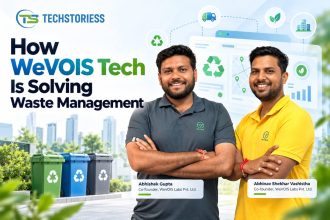



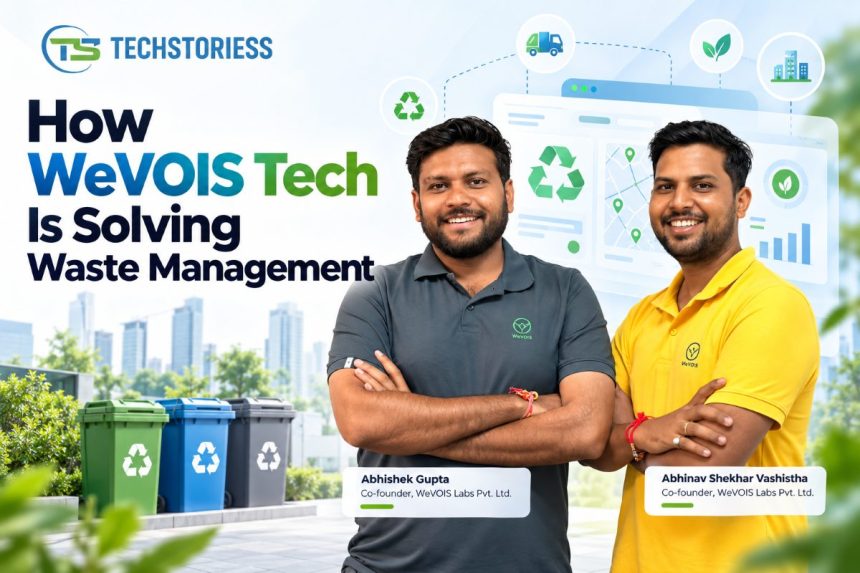
Ask any waste-management platform whether it’s actually digital or just digitized on paper, and the answers usually get vague fast. WeVOIS’s didn’t. The company gave straight, specific responses on its GPS/RFID stack, how it verifies collection instead of simply tracking a truck, where its Series A capital is going, and the challenge technology alone cannot solve: consistent segregation at source. We approached Sarita Meena, Sales Operations Manager at WeVOIS, and her answers offered an interesting look inside the company’s technology-enabled waste-management model.
What tech actually drives your near-100% collection coverage, and which layer matters most?
Our high collection coverage is driven by an integrated technology stack rather than a single technology:
- GPS/RFID Tracking – real-time vehicle and operational traceability
- Vehicle Routing System – digital route planning and optimisation
- Worker App & Officer Dashboard – digitises field execution, monitoring and supervisory control
- Citizen App – enables citizen complaints, service feedback and collection-related engagement
GPS provides vehicle visibility, RFID enables identification and traceability, route planning structures daily operations, and the Worker App captures field-level activity. The real-time monitoring and accountability layer is the most critical, because it connects all these technologies with actual field execution. It allows supervisors to identify operational gaps, route deviations and missed coverage and take corrective action rather than simply observing what happened.
Is your route optimisation real-time or pre-planned, and how do you verify waste was actually collected, not just that a vehicle passed by?
Our process starts with a field survey and operational mapping. We map the service area, identify households and other entities, and geo-tag them. We then establish ward boundaries through geo-fencing and configure collection routes based on the actual geography, service requirements and ground conditions.
The routes are digitally planned and optimised, while their execution is monitored in real time through GPS and field-level digital reporting. We do not consider vehicle movement alone as proof of collection. Verification combines geo-tagged service locations, assigned routes, GPS movement, worker activity and collection records.
This allows supervisors to compare planned routes with actual execution, identify route deviations, missed locations and incomplete coverage, and take corrective action.
Is segregation-compliance tracking manual today, or is computer vision/sensors coming?
Today, segregation compliance is supported through a combination of digital applications, dashboards, field-level reporting, supervisory monitoring and IEC/BCC interventions.
Our mobile applications and dashboards enable segregation-related activities and performance to be recorded, monitored and analysed. Alongside the digital layer, we conduct IEC campaigns and behaviour-change interventions, including awareness around segregation at source, to improve compliance at the point where waste is generated.
We are also extending this capability through the development and integration of AI-powered computer vision for waste identification and classification. Our AI development is focused on both source-level segregation monitoring and downstream automated sorting, creating a pathway toward more intelligent and automated waste management.
How much of the platform is standardized vs. rebuilt per city as you scale from Jaipur to 25 cities?
The core technology platform is standardised, including GPS/RFID integration, Vehicle Routing System, Worker App, Officer Dashboard, Citizen App, monitoring architecture and data systems.
We do not rebuild the technology for every city. Instead, we configure the existing platform according to each city’s operational requirements, including:
- Geo-tagging and ward boundaries
- Collection routes
- Vehicle and workforce structure
- User roles and workflows
- Reporting requirements
- ULB-specific processes
- Local operational conditions
This standardised core + configurable deployment model allows us to replicate the platform across cities while adapting to local requirements.
What will the recent ₹36 crore Series A concretely build — AI, IoT, or something else?
The Series A capital is being used to scale WeVOIS’s technology-enabled circular waste-management model, rather than being allocated exclusively to AI or IoT.
Key areas include:
- Expansion into additional cities
- Technology and product enhancement
- IoT and digital infrastructure
- Circular infrastructure including MRFs, recycling and processing
- Textile recycling and resource recovery
- Operational capacity and working capital
- Development of advanced data and AI capabilities
The broader objective is to evolve from a primarily collection-led model into an integrated technology and circular-resource-recovery platform, where digital intelligence provides visibility, traceability and accountability across the waste value chain.
Does your data/traceability extend past collection into processing and recycling, or stop at the truck?
Yes, our model extends beyond the truck.
The digital layer starts with source-level collection, vehicle movement and operational tracking, while our physical and operational infrastructure connects this with segregation, MRF operations, composting, recycling and resource recovery.
Our objective is therefore not simply to establish that waste was collected. We are building increasing visibility into where the material moves, how it is processed, how much is recovered or recycled, and how much is ultimately diverted from disposal.
This creates a pathway toward end-to-end waste traceability and measurable circularity, rather than treating collection as the endpoint.
What’s one waste-management problem you still can’t solve, and is it a tech, data, or civic gap?
One of the hardest challenges remains consistent source segregation and behaviour change at scale.
This is not purely a technology or data problem. Technology can monitor, measure and create accountability around segregation, but the final outcome also depends on awareness, behaviour, enforcement and operational consistency at the point where waste is generated.
Our approach therefore combines the technology layer — including applications, dashboards, real-time monitoring and increasingly AI-based capabilities — with IEC/BCC, worker engagement, community participation and field-level interventions.
The role of technology is not to replace behaviour change; it is to make behaviour visible, measurable and actionable, allowing field teams and authorities to identify gaps and intervene.
Wrapping Up
Technology can monitor, measure and create accountability, but lasting segregation requires people to participate. That is why WeVOIS combines its real-time technology stack with field operations, IEC/BCC, worker engagement and community participation.
The objective is not simply to digitise waste management, but to make the entire system more visible, measurable, traceable and accountable — from the point of collection to processing, recycling and resource recovery.