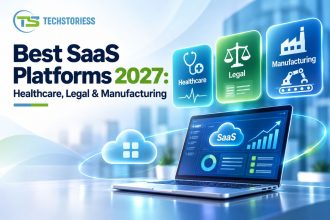



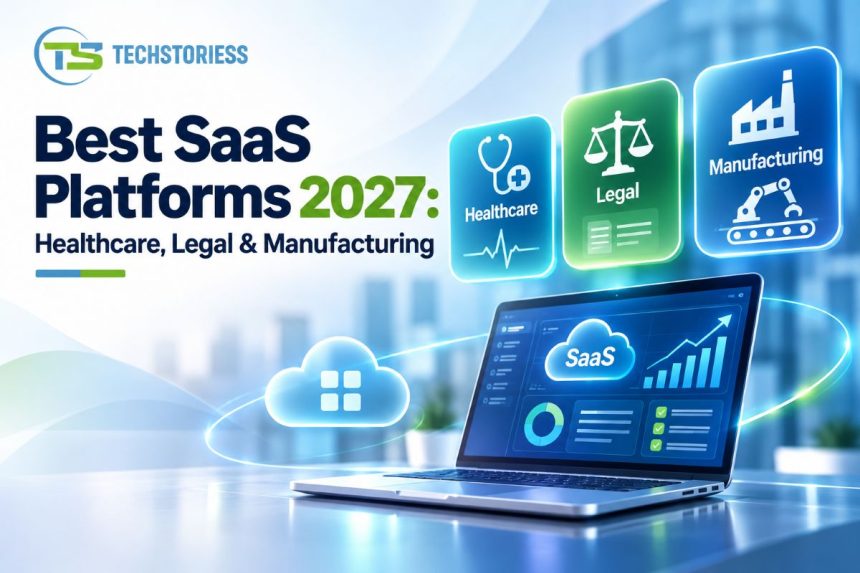
It wasn’t long ago that when people chose software, they had to settle for generic options and customise them to suit their needs. That era is over. In 2027, healthcare, legal, and manufacturing buyers are selecting industry-specific SaaS platforms rather than general templates.
- Understanding Industry-Specific SaaS Platforms
- Why Industry Specific SaaS Platforms Matter More Than Ever in 2027
- Best EHR Healthcare Software Platforms in 2027
- Best LPM Platforms for Legal Firms in 2027
- Best MES Platforms for Manufacturing in 2027
- Comparing Healthcare, Legal, and Manufacturing SaaS Needs
- Essential Features to Look for in Industry-Specific SaaS Platforms
- How to Choose the Right Industry-Specific SaaS Platform
- Emerging Trends in Vertical SaaS for 2027 and Beyond
- Conclusion
- FAQs
- Ready to Find Your Industry’s Perfect Platform?
That’s not a lawyer’s mindset in a hospital. A factory floor isn’t a court either. That is why vertical SaaS has surged in recent years. However, buyers are looking for tools that are familiar with their compliance rules, comfortable with their terminology, and aware of their daily bottlenecks.
This guide explores the best industry-specific SaaS platforms for healthcare, legal and manufacturing in 2027, focusing on three critical categories:
- EHR healthcare software
- Legal practice management platforms (LPM)
- MES manufacturing software
You may be a healthcare administrator, a partner at one of the law firms, a manufacturing executive, or a decision-maker in a company considering tech solutions for your organisation, and this comparison might help you select the platform that’s right for you.
Understanding Industry-Specific SaaS Platforms
Be familiar with and comprehend Industry-Specific SaaS Platforms. Know and understand Industry-Specific SaaS Platforms.
Industry-specific SaaS platforms are software-as-a-service apps designed to meet the requirements of a particular industry.
While generic CRM, ERP, or project management tools may offer a generic set of features, compliance, reporting capabilities, and workflows, industry-specific ERP solutions provide specialised features, compliance tools, reporting, and workflows tailored to that industry.
Why Vertical SaaS Is Dominating in 2027
Organisations increasingly prefer vertical SaaS because it delivers:
- Faster implementation
- Better compliance management
- Industry-specific automation
- Lower customization costs
- Higher user adoption
- Improved operational efficiency
For example:
- Hospitals need HIPAA-compliant patient record management.
- Law firms require matter tracking and document automation.
- Manufacturers need real-time production visibility and machine monitoring.
Generic software often requires expensive customisation to achieve these goals.
Why Industry Specific SaaS Platforms Matter More Than Ever in 2027
Industry-specific SaaS platforms are software designed to meet the workflows, regulations, and data structures of a single market area, rather than providing general functionality for all markets.
Generic software tries to please every customer at once. That sounds efficient, but it usually means nobody gets exactly what they need. A clinic using a basic project management app to track patient intake will hit walls fast — no HIPAA controls, no clinical coding, no insurance workflows.
Vertical platforms close that gap. They’re shaped by people who’ve actually worked inside hospitals, law offices, and factories. That domain knowledge shows up in small but important details:
- Pre-built compliance templates instead of custom legal review
- Industry-specific terminology baked into forms and reports
- Integrations with tools your sector already relies on
- Support teams who understand your regulatory pressure points
By 2027, this specialisation will be the number one attribute for most enterprise buyers. Yet another McKinsey finding that crops up in procurement conversations: Teams move to vertical SaaS not for the slick bells and whistles, but because it reduces the amount of money needed to explain the team’s own business into the product.
Best EHR Healthcare Software Platforms in 2027
What Is EHR Healthcare Software?
An Electronic Health Record (EHR) system allows health care providers to maintain patients’ health records, treatment data, appointments, billing, and compliance in a single system.
Today, EHR healthcare software is more than simply record-keeping. AI-powered clinical support, telehealth, patient engagement, analytics, and interoperability are a part of today’s platforms.
1. Epic Systems
Best For Large Hospitals and Health Networks
Epic continues to dominate large healthcare organisations worldwide.
The platform offers:
- Comprehensive patient records
- Advanced clinical workflows
- Telemedicine integration
- Population health management
- AI-assisted clinical recommendations
- Revenue cycle management
Strengths
- Highly scalable
- Extensive integration ecosystem
- Strong analytics capabilities
- Industry-leading interoperability
Potential Drawbacks
- Expensive implementation
- Longer deployment timelines
Organisations seeking enterprise-grade EHR healthcare software often shortlist Epic first due to its extensive functionality and proven performance.
2. Oracle Health (Cerner)
Best For Large and Mid-Sized Healthcare Systems
Oracle Health has significantly expanded its AI and cloud capabilities.
Key features include:
- Cloud-native infrastructure
- Clinical documentation automation
- Predictive analytics
- Patient engagement tools
- Care coordination features
Why It Stands Out in 2027
Oracle’s investment in healthcare AI has enhanced physician productivity and cut down on administrative load.
Healthcare providers increasingly view Oracle Health as a strong alternative to Epic.
3. Athenahealth
Best For Ambulatory Practices
Athenahealth focuses on smaller healthcare providers and outpatient clinics.
Features include:
- Practice management
- Revenue cycle automation
- Patient scheduling
- Telehealth services
- Clinical documentation
Key Advantage
Its ease of deployment makes it attractive for organisations lacking large IT teams.
4. eClinicalWorks
Best For Growing Practices
eClinicalWorks remains popular among physician groups and speciality clinics.
Highlights include:
- Patient engagement tools
- Telemedicine support
- Population health management
- Mobile accessibility
The platform delivers a strong balance between functionality and affordability.
Best LPM Platforms for Legal Firms in 2027
What Is Legal Practice Management Software?
Legal Practice Management (LPM) software supports case and document management, billing, client communication, workflow, and compliance.
Today, Legal Practice Management Software integrates case management, automation, and AI-driven legal support.
Law firms operate on precision and deadlines. Missing a filing deadline isn’t just inconvenient — it can lead to malpractice exposure. That pressure shapes what makes a legal SaaS platform genuinely useful.
- Clio
Clio has become a near household name among small and mid-sized firms. It integrates key case management, time-tracking, and trust accounting features into an easy-to-use dashboard, which can make a tremendous difference to bars’ compliance with the Rules.
The open API also enables firms to integrate document-automation software, e-signature solutions, and accounting software without switching systems.
Its platform includes:
- Matter management
- Time tracking
- Billing automation
- Document storage
- Client portals
- Workflow automation
Why Law Firms Choose Clio
The platform balances usability with robust functionality.
Small and mid-sized firms particularly appreciate its ease of use.
Major Benefits
- Strong integrations
- Cloud accessibility
- Excellent client experience
- Reliable compliance controls
2. MyCase
MyCase closely resembles Clio and easily outshines some companies that overlook the need for a more streamlined interface and a powerful client portal. Clients can view case updates, message attorneys directly and pay invoices through the portal.
Key capabilities include:
- Case management
- Client communication
- Payment processing
- Calendar management
- Document sharing
3. PracticePanther
Best For Workflow Automation
PracticePanther focuses heavily on productivity.
Features include:
- Automated workflows
- Task management
- Billing automation
- Trust accounting
- Document management
Many firms adopt PracticePanther to improve operational efficiency and reduce manual processes.
4. Smokeball
Best For Document Automation
Document generation remains one of Smokeball’s strongest capabilities.
Highlights include:
- Automated document creation
- Case tracking
- Time recording
- Legal templates
- Productivity analytics
Smokeball can be an extremely efficient solution for companies that generate vast numbers of legal documents.
What to Look for in a Legal SaaS Platform
The strongest LPM platforms typically offer:
- Trust accounting that meets state bar requirements
- Document automation for repetitive filings
- Secure client communication portals
- Conflict-of-interest checking built into intake
Consider a litigation firm juggling forty active cases. Without an automated deadline service, paralegals would spend hours each week reviewing court calendars to ensure no deadlines are missed. With the right platform, that becomes a background process rather than a daily fire drill.
Best MES Platforms for Manufacturing in 2027
What Is MES Manufacturing Software?
Manufacturing Execution Systems (MES) connect manufacturing planning data to activities on the shop floor. MES software provides real-time visibility into manufacturing, enabling organisations to enhance their operational performance, quality and productivity.
With the onset of Industry 4.0 and the need for digitisation in manufacturing operations, MES platforms have gained traction at the heart of these developments.
Siemens Opcenter
Large-scale manufacturers that require comprehensive integration with industrial equipment will continue to choose Siemens Opcenter as their first choice for industrial automation. It provides a firm linkage between production planning and execution on the shop floor, thus reducing the time delay between production scheduling and its impact on the production line.
Plex Systems (Rockwell Automation)
Now owned by Rockwell Automation, Plex has gained a ravenous following in the automotive and discrete manufacturing industries. It’s designed to be cloud-based, allowing smaller plants to leverage MES capabilities without a large on-premises IT setup.
Tulip
Tulip has also caught on as a more versatile, no-code MES solution. Documentation for smaller production lines can be created quickly by frontline workers without relying on the IT team for support.
What to Look for in a Manufacturing SaaS Platform
Key features worth prioritising include:
- Real-time machine and sensor data integration
- Quality management with traceability records
- Downtime tracking and root-cause analysis
- Scalability across multiple plant locations
Imagine a company that produces auto body parts has 3 production shifts. If a quality problem occurs on the night shift, it may not be detected until the morning, if at all. A strong MES platform flags it immediately, saving both materials and reputation.
Comparing Healthcare, Legal, and Manufacturing SaaS Needs
| Factor | EHR (Healthcare) | LPM (Legal) | MES (Manufacturing) |
| Primary concern | Patient safety & compliance | Deadline accuracy & ethics rules | Production uptime & quality |
| Key regulation | HIPAA | State bar trust accounting rules | ISO 9001 / industry quality standards |
| Core integration | HL7/FHIR clinical systems | E-signature & accounting tools | IoT sensors & ERP systems |
| Buyer pain point | Fragmented patient records | Manual deadline tracking | Delayed defect detection |
This comparison makes one thing obvious: there’s no universal “best” platform across industries. The best industry-specific SaaS platforms that healthcare, legal, manufacturing, and 2027 teams adopt are those precisely matched to their regulatory and operational realities.
Essential Features to Look for in Industry-Specific SaaS Platforms
- AI and Automation
Artificial intelligence is becoming a standard feature across vertical SaaS platforms.
Look for:
- Predictive analytics
- Intelligent recommendations
- Workflow automation
- Automated reporting
AI reduces repetitive work while improving decision-making.
- Security and Compliance
Industry-specific SaaS solutions handle sensitive information.
Critical capabilities include:
- Role-based access controls
- Encryption
- Audit trails
- Regulatory compliance tools
Security should never be an afterthought.
- Integration Ecosystem
Software rarely operates independently.
The best industry-specific SaaS platforms (healthcare, legal, manufacturing, 2027 provide integrations with:
- ERP systems
- CRM platforms
- Financial software
- Communication tools
- Analytics platforms
Strong integrations eliminate data silos.
- Scalability
Organizations grow. Choose platforms that support:
- Additional users
- Multiple locations
- Increased transaction volume
- Future technology adoption
Scalability protects your investment over the long term.
How to Choose the Right Industry-Specific SaaS Platform
Start with your biggest pain points—billing delays, compliance risks, or production bottlenecks. Evaluate:
- Fit for Scale: Small teams need simple interfaces; large orgs need robustness.
- Integrations: Ensure seamless connections to existing tools (EHR to labs, LPM to accounting, MES to ERP/PLM).
- Total Cost: Factor implementation, training, subscriptions, and ROI. Cloud often wins on predictability.
- Vendor Support & Roadmap: Check user reviews, AI investments, and update frequency.
- Trial & References: Always test with your workflows and talk to peers in your industry.
Pro Tip: Prioritise platforms with strong change management support—user adoption drives success more than features alone.
Emerging Trends in Vertical SaaS for 2027 and Beyond
AI agents for routine tasks, deeper ecosystem partnerships, and sustainability tracking (especially in manufacturing) shape the future. Expect better cross-platform data sharing and low-code customisation. Vertical SaaS continues to outpace horizontal tools in adoption for regulated fields due to built-in expertise.
Conclusion
The best industry-specific SaaS platforms in healthcare, legal, and manufacturing for 2027—Epic and athenahealth for EHR, Clio and PracticePanther for LPM, Plex and Siemens Opcenter for MES—deliver specialised power that transforms operations. They solve sector-specific challenges while offering modern cloud benefits such as scalability and AI capabilities.
Match the platform to your size, workflows, and goals for the biggest impact. The right choice reduces friction, ensures compliance, and positions your organisation for growth.
Actionable Takeaways:
- Audit current processes and identify the top 3 pain points.
- Shortlist 2-3 platforms per category and request demos.
- Calculate 3-year TCO including training and integrations.
- Plan for user training and phased rollout.
Ready to modernise your operations? Explore demos of these leading platforms today and take the next step toward smarter, more efficient workflows. Your industry deserves tools built specifically for it.
FAQs
What are the best EHR systems for healthcare in 2027?
Epic Systems leads large organisations, while athenahealth and similar cloud options suit smaller practices. Focus on interoperability and AI features.
Which LPM software is best for small law firms?
Clio and PracticePanther top the list for usability, billing, and automation. Clio offers broader integrations; PracticePanther emphasises simplicity.
What should manufacturers look for in MES platforms?
Real-time visibility, ERP integration, quality management, and cloud scalability. Plex and Siemens Opcenter are strong contenders depending on complexity.
How do industry-specific SaaS platforms compare to general ones?
Vertical platforms offer built-in compliance, workflows, and expertise that generic tools require heavy customisation to match, leading to faster value and lower long-term costs.
Are these SaaS platforms secure and compliant?
Yes, top solutions invest heavily in security (HIPAA, SOC 2, etc.) and regular audits. Always verify certifications for your specific regulatory needs.
Ready to Find Your Industry’s Perfect Platform?
Picking the right software shouldn’t feel like a gamble. Whether you’re evaluating EHR systems for your clinic, LPM tools for your firm, or MES platforms for your production floor, start by listing your top three compliance requirements — then test only platforms that meet all of them. That single step eliminates most of the guesswork before you ever book a demo.