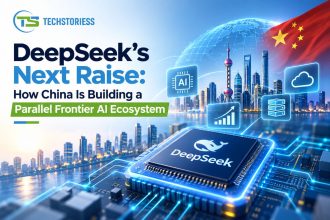



For years, DeepSeek was the frontier lab that didn’t need outside money. Its second funding round in five months shows that China is now building a full AI stack of capital, chips, models and public markets, and enterprise leaders can’t treat that as a side story.
- A founder who resisted capital, until the economics changed
- The second round: demand outruns the target
- Capital is only one layer of the stack
- The business model is more commercial than the philosophy suggests
- DeepSeek is not alone
- What enterprise leaders should do with this
- What to watch
- Conclusion
A founder who resisted capital, until the economics changed
DeepSeek spent its first years funded by High-Flyer, the quantitative hedge fund behind founder Liang Wenfeng. It resisted external capital, reportedly deciding to take it only to set a well-defined market value that would help retain top talent. The scale of the first round went well beyond a stock-option exercise. DeepSeek raised more than 50 billion yuan, about $7.4 billion, at a valuation above $50 billion, after figures of roughly $10 billion were floated as recently as April.
The terms were unusual. Investors put money into a limited partnership managed by Liang rather than into DeepSeek directly, with no voting rights and a five-year lock-up. The exception was China’s state-backed AI investment fund, which invested directly and kept its voting rights. The structure keeps control with the founder, and the state is on the cap table.
The second round: demand outruns the target
The next round came fast. DeepSeek originally planned to raise about 50 billion yuan, but investor demand after its latest model releases was considerably higher than expected. On 6 October, Bloomberg reported that DeepSeek was close to securing at least 80 billion yuan ($12 billion), with Tencent and battery maker CATL among the largest investors.
Later reports pushed the number higher. Chinese financial media reported on 13 October that DeepSeek plans to raise roughly 100 billion yuan (about $14 billion), which would imply a post-money valuation of about 600 billion yuan ($84 billion). The same reports say the terms are still being adjusted and DeepSeek hasn’t confirmed them. Treat every figure here as reported, not final.
The destination is a listing. DeepSeek has reportedly hired CITIC Securities to prepare a possible STAR Market IPO, though timing, valuation and size remain undecided. Reports point to a filing as early as late 2026 and a 2027 listing. A domestic listing would put a Chinese frontier lab in front of Chinese public-market investors, away from Western capital markets.
Capital is only one layer of the stack
The funding story matters because of what it connects to. The first round’s investor list reads like a supply chain: Tencent, NetEase, JD.com, CATL, several venture firms and state-backed funds. One report at the time suggested that the state’s Big Fund, which backs semiconductors, was seeking to lead, a sign of Beijing’s intent to bind model builders and chipmakers into a single ecosystem. That was one report, not a confirmed fact, but the pattern around it is consistent.
Take the chip layer. DeepSeek’s V4, released in April 2026, is the largest open-weights model to date and runs on Huawei chips. Huawei, Cambricon and MetaX have all said they are optimising their processors for V4, part of China’s drive to build a locally developed AI supply chain. More recently, DeepSeek partnered with Huawei on coding tools optimised for its Ascend AI chips, underlining the effort to reduce dependence on Nvidia’s ecosystem.
The loop closes when a lab trains and serves on domestic silicon, domestic cloud and internet platforms fund it, and a domestic exchange gives it liquidity. Each layer reinforces the others, and none of them needs a US counterpart. That is what “parallel ecosystem” means here.
The business model is more commercial than the philosophy suggests
DeepSeek presents itself as a research-first, open-source lab. Management has reportedly told investors it will prioritise long-term research and open-source models over near-term commercialisation. Its numbers look more commercial. The Information reports annualised revenue of about $1 billion, up from under $500 million a few months earlier, after API price increases of 2.3 to 4.5 times depending on model and period. DeepSeek’s API business reportedly posted an 82.9% gross margin in the first seven months of the year.
That sits oddly beside the lab’s reputation as a price disruptor. Earlier this year, DeepSeek made a 75 percent discount on V4 Pro permanent, which made it roughly 11 times cheaper on input and 35 times cheaper on output than OpenAI’s GPT-5.5. The picture that emerges is a lab that used aggressive pricing to win developers, then repriced once usage was locked in. The same playbook has worked in cloud and SaaS for two decades.
Compute efficiency supports the margins. DeepSeek is reportedly exploring ways to run smaller models on gaming GPUs, reserving high-end chips for training. In a market constrained by export controls, that discipline is a strategic advantage as well as a cost saving.
DeepSeek is not alone
Focusing on one company understates the pattern. Beijing-based Moonshot AI is reportedly raising at a valuation of about $31.5 billion. DeepSeek is also reaching beyond language models. It reportedly took a small strategic stake in humanoid-robot maker Unitree through its IPO allocation and is said to be leading the seed round of robotics AI startup Winverse AI. If that holds, DeepSeek is positioning itself as a platform investor, not a model vendor.
The comparison with US labs needs context. DeepSeek’s valuation remains modest next to OpenAI and Anthropic, both reportedly approaching the trillion-dollar mark. An $84 billion valuation is a fraction of that. But the gap in capital is far smaller than the gap in capability per dollar, which is the number that has worried Western competitors since January 2025.
What enterprise leaders should do with this
Most CXOs outside China won’t buy DeepSeek’s API for regulated workloads. Three practical consequences still follow.
- Open-weight models are a pricing lever. Frontier-class open weights set a ceiling on what proprietary vendors can charge. Even if you never deploy DeepSeek, its price points show up in your next renewal negotiation. Benchmark your current contracts against open-weight alternatives at least annually.
- Hardware diversity is coming whether you plan for it or not. If the leading Chinese labs optimise for Huawei, Cambricon and MetaX silicon, the software ecosystem around non-Nvidia hardware will mature. Companies operating in Asia, the Middle East and other markets where multiple stacks coexist should expect to support more than one.
- Governance questions get harder. An ownership structure with state-backed investors, a founder-controlled partnership and non-voting outside capital raises due-diligence questions for any procurement team. Data residency, model provenance and regulatory exposure (and, for some sectors, sanctions risk) need legal review before any deployment, including self-hosted ones.
For Indian enterprises in particular, the near-term opportunity is practical. Cheap, capable open models can lower the cost of internal copilots, document processing and customer-service automation, provided the compliance review comes first.
What to watch
Four signals will show whether this ecosystem holds together.
– Round close and IPO filing. Does the round close at the reported scale, and does a STAR Market filing follow on the expected timeline?
– Revenue durability. Do customers accept the higher API prices, or do they migrate to cheaper alternatives?
– Silicon performance. Does Ascend-based training and inference keep pace with Nvidia hardware on the next generation of models?
– Policy response. Do US and allied export controls tighten further, or does the market adapt around them?
Conclusion
DeepSeek’s second raise is less about one company’s valuation than about a system forming around it. Capital, chips, cloud platforms, models and exchanges are aligning inside one national ecosystem, and that system can keep running whatever Washington decides on export controls.
Enterprise leaders don’t need to adopt it, but they do need to plan around it. In 2027, the AI market is likely to be less a single global race than two partially overlapping ones, and the strategic questions will be about which stack you build on and which dependencies you can live with.