


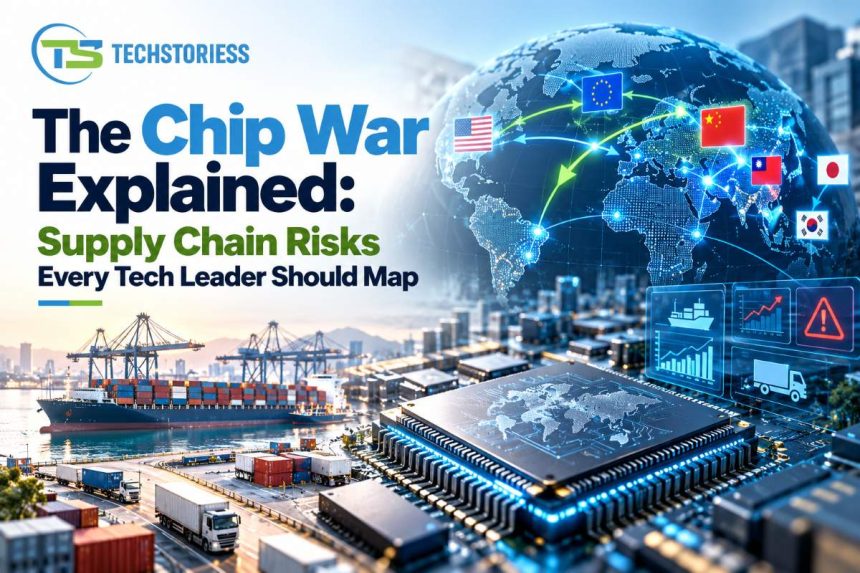
Most executives still file the chip war under geopolitics: a contest between Washington and Beijing that someone in government will eventually settle. That framing is a mistake. For a CIO, CFO, or COO, it is a procurement problem. It shows up as delayed server deliveries, a license that changes mid-contract, and a laptop refresh that costs more than the budget assumed.
This piece breaks the chip war into the layers that touch enterprise operations, then offers a way to map your own exposure.
Layer one: policy that moves faster than contracts
The foundation of the current regime is US export control law. The Foreign Direct Product Rule extends US jurisdiction to foreign-made products that derive from US technology, even when the finished chip contains no US content. That reach is why a restriction written in Washington can stop a shipment between two other countries.
The rules are also unstable. In roughly twelve months, the US administration banned Nvidia’s H200 for China, lifted the ban, attached a 25% tariff, and built a licensing framework that experts called contradictory. The same analysis notes that annual licences for TSMC, Samsung, and SK Hynix replaced the earlier exemptions that gave their China fabs stable access to US equipment.
Enforcement is tightening at the edges too. Taiwan’s Economy Minister confirmed on October 16 that unauthorized AI chip exports to China will become criminal offences under the Foreign Trade Act, following a guilty plea in a $2.5 billion Supermicro server diversion case. And a US proposal is pending: Reuters reported that the FCC planned an October 29 vote on restrictions affecting Chinese laboratories that test electronic devices for the American market. That is a proposal, not a rule, but it shows how far the contest now reaches into ordinary electronics certification.
For a buyer, the lesson is simple. Treat any assumption about what you can buy, from whom, and at what tariff as valid for one quarter, not one budget cycle.
Layer two: controls that reshape the market without freezing it
The controls have not locked China out of the market, but they have changed it. IDC data cited by Reuters shows Nvidia’s share of data Centre chips in China fell to 34% in the first half of 2026, with its AI accelerator shipments down 44% year on year. Rakesh Kumar, the University of Illinois professor and author of Chip Age, argues that the controls spurred China to build its own chip ecosystem.
You can reach different conclusions about whether the policy is working. The operational point holds regardless: a parallel Chinese stack is forming. A company with operations or customers in China may soon face two hardware and software ecosystems with different suppliers, different performance profiles, and different compliance rules.
Layer three: concentration you cannot see on an invoice
Your vendor list shows the brand on the box. The risk sits several tiers down.
Fabrication. Leading-edge manufacturing is concentrated in Taiwan. [Insert TSMC share of leading-edge logic capacity, with named source and date] A disruption there would not hit one vendor. It would hit every vendor that designs chips for the latest nodes, which includes most of the AI hardware market.
Equipment. The Dutch government, under US pressure, has withheld a licence to export ASML’s extreme ultraviolet lithography machines to China since 2019. The industry’s most advanced tools come from a very small set of suppliers, and each is a policy lever.
Materials. China accounts for around 80% of world gallium supply and about 60% of germanium. Beijing introduced export licensing for both metals in 2023, and the controls were seen as likely to raise costs for hardware makers. Those materials are small in volume and large in leverage.
Layer four: the shortage already here
Not every chip risk is a future scenario. The memory squeeze is hitting budgets now. Conventional DRAM contract prices rose as much as 98% in the first quarter of 2026. Large DRAM orders now regularly exceed forty weeks, and some infrastructure projects planned for 2026 have slipped into 2027 or 2028.
The cause is allocation, not a collapse in capacity. AI-related demand, including high-bandwidth memory and server DRAM, now accounts for nearly 70% of available DRAM capacity at the major suppliers. Hyperscalers sign long-term contracts at premium prices, and everyone else queues behind them. TrendForce expects conventional DRAM contract prices to rise another 13 to 18% quarter on quarter in the third quarter of 2026. Analysts suggest some stabilisation is possible by late 2027, if AI demand eases and planned production capacity arrives.
For finance leaders, this breaks an old habit. Waiting for hardware prices to fall no longer works as a strategy.
The India angle
India is moving from importer to participant, though from a low base. Micron’s $2.75 billion assembly and test facility in Sanand was inaugurated on February 28, 2026, and shipped its first made-in-India memory modules to Dell and HP in March. Tata Electronics’ Dholera fab, built with Taiwan’s PSMC, is scheduled to deliver its first batch of chips by December 2026. Treat that date as a target. A slip would say a lot about how fast the wider domestic ecosystem can scale.
Assembly, test, and mature-node production help resilience at the margin. They do not remove dependence on Taiwanese leading-edge fabs or imported equipment, and enterprise planning should not assume they will soon.
How to map your exposure
A workable chip supply chain map has five steps.
- Start from what the business cannot lose. List your ten most critical systems and the hardware behind them: servers, network gear, endpoints, and embedded devices in operations.
- Trace each one down the tiers. For every critical system, ask the vendor who fabricates the main silicon, who supplies the memory, and where it is packaged. Expect partial answers. Record the gaps as findings.
- Mark concentration. Flag every item that depends on one foundry, one memory supplier, or one geography.
- Mark policy exposure. Note which suppliers rely on US licences, Chinese materials, or products that could face tariff changes.
- Attach time and cost. Record lead times, current inventory, and contract terms. Forty-week lead times turn a procurement delay into a project delay.
Then test the map against four scenarios: a licence change that cuts off a product line, a new Chinese material restriction, a further memory price jump, and a serious disruption in Taiwan. For each, write down who decides, what you would buy, and how long it takes.
Conclusion
The chip war will not end with a treaty that returns the old, predictable market. The more useful assumption is a permanent contest in which rules shift, supply is allocated by whoever pays most, and the biggest dependencies sit several tiers below your vendor. Companies that map those tiers now will make better decisions when the next announcement lands. The rest will learn about their exposure from a delivery notice.