


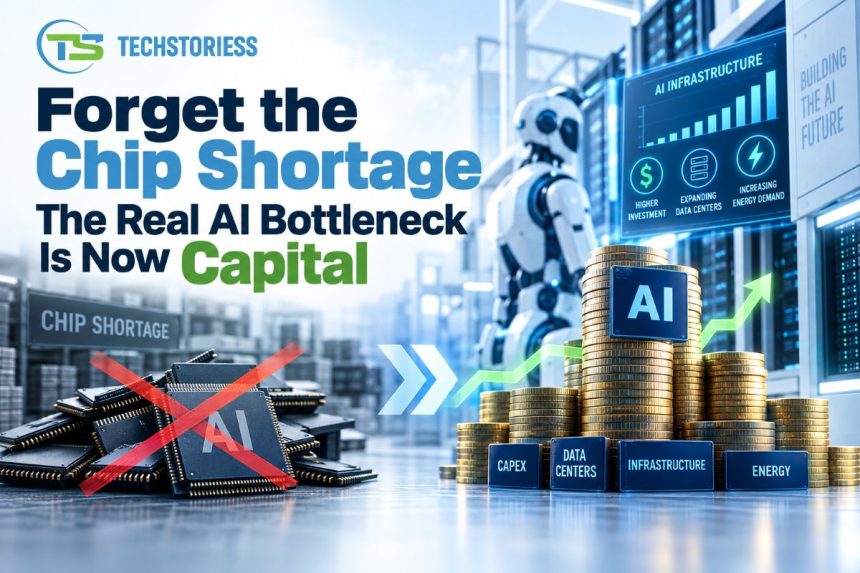
For three years, every conversation about what was slowing AI down started in the same place: chips. Not enough GPUs, not enough advanced packaging, not enough high-bandwidth memory. We don’t refute that story; it was, and still is, true – but only partially. It is no longer the story that matters most to anyone sitting in a CFO’s or CTO’s chair right now. The binding constraint on the AI buildout has shifted from what Nvidia and TSMC can physically produce to who is actually willing to put up the money – and on what terms.
That shift has happened silently, inside financing structures that often go unnoticed by most executives outside of treasury and corporate development. It is worth looking at closely now, because the structures being built to fund AI infrastructure are starting to draw the same kind of scrutiny that credit markets reserve for arrangements they don’t fully trust.
The chip story isn’t over, but it’s not the constraint it was
To be fair to the old narrative: chip supply has not been fully solved. TSMC Chairman C.C. Wei has said publicly that advanced packaging capacity – the CoWoS process that bonds logic dies to high-bandwidth memory – was sold out through 2025 and into 2026. TrendForce projects that capacity will rise from roughly 75,000 wafers per month in 2025 to somewhere between 120,000 and 130,000 by the end of 2026, and analysts still expect a supply-demand gap of around 10% even after that expansion, according to reporting from XenoSpectrum. Nvidia alone has reportedly locked in more than 70% of TSMC’s CoWoS-L capacity for its Blackwell architecture.
Separately, the bottleneck has now shifted further downstream to memory. Samsung and SK hynix have both warned that AI-driven HBM shortages could persist until 2027 or later, and a memory-focused analysis published by Value Add Pulse in September 2026 noted that TSMC’s own $64 billion capex increase “does not pull forward a single additional wafer of HBM4 capacity at SK Hynix” – the two companies’ expansion timelines aren’t coordinated by anyone with the incentive to balance them against the system-level constraint.
So the honest version of the chip story in late 2026 is: it didn’t disappear, it moved – from wafers, to packaging, to memory. Each move has been narrower and, in some ways, easier to plan around than the last. What hasn’t moved in a predictable direction is the money required to build the data centers those chips sit inside.
Where the real constraint moved: the balance sheet
The clearest evidence that capital, not silicon, has become the binding constraint is the sheer size and structure of what’s being financed. In September 2025, Nvidia and OpenAI announced a letter of intent under which Nvidia would invest up to $100 billion in OpenAI as the two companies deployed at least 10 gigawatts of Nvidia systems. That investment, as CNBC reported in July 2026, “never materialized” in its original form – Nvidia contributed $30 billion instead, and by August 2026 the companies were negotiating something different: a reported $105 billion Nvidia financing package for a single OpenAI data center campus in Pike County, Ohio, this time structured as credit backing lease and construction debt rather than direct equity.
That reshaping – from investment to credit guarantee – is itself the story. It reflects a market where even a company as central to AI infrastructure as Nvidia has moved from putting cash directly into its customers toward guaranteeing debt that customers raise from someone else. Reuters and other outlets have also reported that Nvidia teamed up with six large asset managers in August 2026 to build financing platforms aimed at deploying $500 billion in third-party capital into data center projects – a signal that even Nvidia’s balance sheet, plus its customers’ balance sheets, isn’t enough on its own.
Meta’s Hyperion data center in Louisiana is the clearest single example of how hyperscalers are now building around, rather than on top of, their own balance sheets. According to Bisnow’s reporting on the deal, Meta formed a joint venture with private-credit firm Blue Owl Capital in which Blue Owl-managed funds own 80% of the entity and Meta holds the remaining 20%, while Meta retains operational control and leases the finished campus back on a long-term basis. The special-purpose vehicle, nicknamed “Beignet,” raised roughly $27 billion in debt – arranged by Morgan Stanley, anchored by Pimco and BlackRock – plus about $2.5 billion in equity. Because Meta doesn’t consolidate the debt, none of it shows up on Meta’s own balance sheet, even though Meta is the sole tenant and the entity exists to serve exactly one customer.
This is no longer an isolated maneuver. A March 2026 client alert from the law firm Quinn Emanuel documented similar off-balance-sheet SPV structures behind Oracle’s OpenAI facility in Abilene, Texas (roughly $13 billion from Blue Owl and JPMorgan), a $38 billion debt package for two more Oracle-linked data centers in Texas and Wisconsin, and an $18 billion loan for a New Mexico site. The same alert cited Morgan Stanley’s estimate that private credit funds – chiefly Blackstone, Blue Owl, Apollo, Pimco, and BlackRock – have gone from near-zero AI-related lending a few years ago to over $200 billion in outstanding loans today, with Morgan Stanley projecting an additional $800 billion in private-credit data center financing over the next two years alone.
Put simply: the industry has run out of appetite, or capacity, to fund this buildout on-balance-sheet, out of operating cash flow, or through conventional corporate debt. It is instead routing hundreds of billions of dollars through joint ventures and special-purpose vehicles specifically designed so the debt lands somewhere other than the hyperscaler’s own credit rating.
Why that structure is drawing scrutiny, not just admiration
Financing engineering of this scale invites a harder question: what happens if the underlying demand for AI compute doesn’t grow into the capacity being built for it?
Investor Michael Burry – who built his reputation shorting subprime mortgage securities before 2008 – has spent much of 2026 arguing that a meaningful share of AI infrastructure spending is what he calls “circular financing.” In a series of posts, cited across outlets including 24/7 Wall St. and Yahoo Finance, Burry pointed to $879 billion in hyperscaler commitments that “circle through Nvidia,” and estimated that five major hyperscalers together carry $1.65 trillion in off-balance-sheet debt. He’s not alone in raising the structural question, even if his conclusions are contested: the Bank for International Settlements addressed the same dynamic directly in its late-June 2026 Annual Report, describing circular financing as “the most prominent” of the private arrangements now linking hyperscalers, chipmakers, and AI labs, and modeling a scenario involving partial dissolution of those partnerships alongside debt fire sales.
Moody’s Ratings has raised a related but distinct concern: a February 2026 report found that five major hyperscalers together carry $662 billion in signed-but-not-yet-started data center lease commitments – obligations that, under standard accounting treatment, don’t appear on balance sheets until the leases activate. Burry has argued that figure equals roughly 113% of those companies’ combined adjusted debt today, and that in a downturn it could create an incentive for several large customers to walk away from commitments at the same time – a “bullwhip effect” running back through the entire AI supply chain. Nvidia’s five-year credit default swap spread, a market-based measure of default risk, reportedly doubled over a two-month stretch in mid-2026, according to data Burry cited from his own analysis.
None of this proves AI infrastructure spending is a bubble in the way the framing invites. Nvidia still generated close to $48 billion in free cash flow in a recent quarter – real, not accounting fiction, as even skeptical commentary has acknowledged. The counter-argument from within the industry is straightforward: the financing works as long as AI adoption delivers enough real economic value to justify the spending. But that is precisely the point. The debate that used to be about whether enough chips existed has become a debate about whether enough revenue exists, or will exist in time, to service the debt built to house those chips.
What this means for the people actually buying AI
For a CFO or CTO evaluating an AI infrastructure commitment today, the practical implications are different from what they were even a year ago.
First, vendor risk now runs through financing structure, not just product roadmap. A cloud or compute contract signed with a hyperscaler or neocloud provider may sit on top of a special-purpose vehicle financed by a private-credit consortium your procurement team has never heard of. Understanding who actually bears the credit risk behind a long-term compute commitment – the vendor, or bondholders three steps removed – is now a legitimate diligence question, not a theoretical one.
Second, the industry-wide dependence on lease commitments that don’t yet appear on any balance sheet means the headline capacity numbers hyperscalers report – gigawatts planned, dollars committed – describe intentions more than delivered infrastructure. Enterprises building multi-year AI roadmaps around specific capacity availability should treat those announcements with the same skepticism they’d apply to any other supplier’s unbuilt-capacity promises.
Third, and most directly: the chip shortage narrative, to the extent it still shapes procurement timelines and pricing expectations inside enterprises, is increasingly out of date. The more relevant question for 2027 planning isn’t “will there be enough GPUs” – it’s “will the capital structures funding today’s data center buildout hold together long enough for that capacity to actually reach the market at a price anyone can afford.”
That’s a harder question to answer, because it isn’t a supply chain problem with a known fix, like adding more fabs or packaging lines. It’s a credit market question, and credit markets don’t resolve on an engineering timeline. They resolve when enough lenders, insurers, and bondholders decide, all at once, whether they still believe the story.