


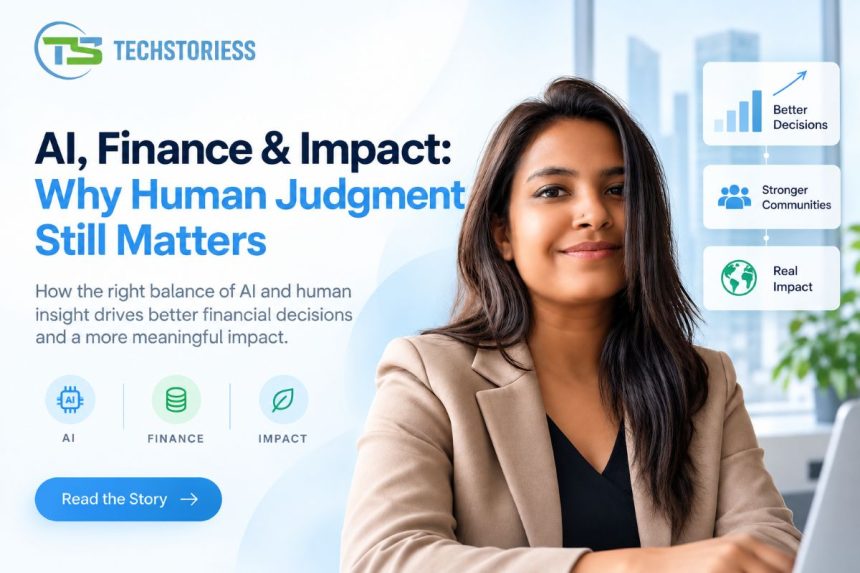
Munia Ali works at the intersection of finance, impact and organizational resilience, helping organisations build financial systems that can withstand real-world pressure. With experience managing complex, multi-donor environments, she brings a grounded perspective on where AI can strengthen financial decision-making-and where human judgment remains irreplaceable. In this conversation, she explores how AI is reshaping compliance, forecasting, reporting and access to financial expertise, particularly for resource-constrained organisations where every decision has consequences.
You have said finance systems “break not because people don’t care, but because no one built them to survive pressure.” Can you elaborate?
Finance systems rarely break because people suddenly stop caring. They fail because they were built for normal conditions, but organizations eventually have to run under abnormal ones.
A system may work perfectly when you have enough staff, stable funding, predictable deadlines, and clean data. But add an emergency response, multiple donors, staff turnover, political instability, tight reporting deadlines, or rapid expansion, and weaknesses start to show.
That is why a resilient finance system must be designed around pressure, not just process. It needs clear ownership, appropriate controls, standardized software system, documented procedures, reliable data flows, realistic approval structures, and enough automation to reduce repetitive work.
The real test of a finance system is not whether it works when everything is calm. It is whether people can still make the right financial decisions when everything is moving quickly.
You manage multi-donor portfolios where UN and non-UN funding streams carry different reporting standards. Can AI reliably reconcile compliance across those parallel systems?
To be honest in my opinion, I dont think so. In my case, I would not rely on AI alone to make a compliance judgment.
AI maybe extremely useful for the routine/repetitive task and analytical parts of compliance or simply research like:
Comparing donor rules, Identifying inconsistencies, Flagging transactions that need review, Mapping data between different reporting structures,
Checking for completeness, Spotting unusual patterns or diff research.
But, compliance is not just a rules matching exercise. Often, the real question is not Does this transaction match the rule?” but “How should this rule be interpreted in this specific program, contract, and operating context? That requires professional judgment and accountability.
I view this as AI assisted compliance, not AI owned compliance. AI acts as a very fast second pair of eyes, but the finance professional remains responsible for interpreting the rules, questioning the output, and making the final decision.
Cloud platforms like QuickBooks, Xero, and Wave are increasingly layering in AI-driven forecasting and anomaly detection. How can small businesses with a lean model can balance AI’s speed with human financial experts’ judgement?
I think, the question is not to choose between AI and a financial expert. Its about using both for what they do best.
For a lean business, AI can handle a lot of repetitive work like, Categorizing transactions, Assisting with reconciliations, Detecting anomalies,
Analyzing trends, Creating preliminary forecasts, This gives a small business access to capabilities that used to require a much larger finance team. But speed is not the same as judgment.
Let the system process predictable transactions and flag the exceptions. Then, have a human expert review those exceptions, test the assumptions, and make decisions that directly affect cash flow, profitability, tax, compliance, or business strategy.
For a small business, this actually makes expert financial advice more accessible because the expert spends less time typing in data and more time interpreting what the numbers mean.
You describe your work as making finance “a story about who gets to live better,” not a wall of numbers. As AI takes over more reporting and reconciliation, how do you make sure that human context doesn’t get lost in the automation?
I think this is one of the most important questions about AI in finance. Automation can tell us what happened much faster. But it is much less capable of understanding why it happened and what it means for people.
For example, a variance is technically just a number. But behind that number could be a delayed program, a change in beneficiary needs, a staff shortage, local inflation, or a split second decision made during an emergency.
If we automate reporting without keeping that human context, we get financial information that is technically accurate, but strategically incomplete.
The finance professional’s role increasingly becomes asking better questions, challenging assumptions, connecting financial information to operational reality and communicating what the numbers mean to people who have to make decisions.
For finance professionals early in their careers, or those navigating humanitarian and nonprofit systems where resources are already stretched, is AI closing the gap in access to sophisticated financial tooling, and how?
I think, it has the potential to help close that gap but access to technology alone does not create real capability.
Historically, sophisticated financial analysis required expensive software, large teams, or specialist skills. Cloud accounting, automation, and basic AI tools are lowering those barriers. Now, a small nonprofit or an early career finance professional can easily access tools for data cleaning, forecasting, documentation, and reporting that used to require a massive budget.
But there is a second gap technology cannot fix, knowing what to ask, how to check the answer, and when not to trust it.
That is why AI literacy must become part of basic financial literacy. Young professionals do not need to become AI engineers. They need to know how to use these tools critically how to frame a problem, test the output, spot errors, and use their own judgment.
In resource constrained environments, that combination could be particularly valuable, using technology to extend the capacity of a small finance team without outsourcing responsibility for the decisions that matter.