


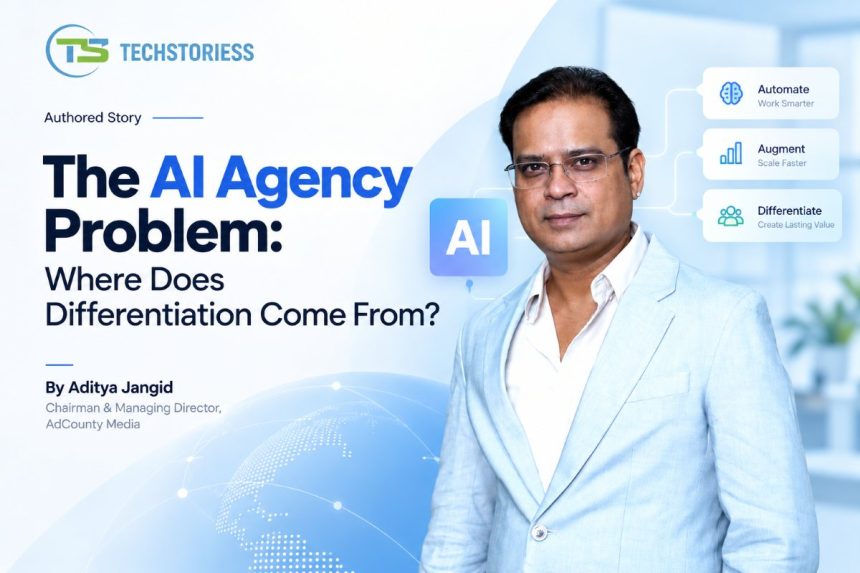
With the evolution of Artificial Intelligence (AI), agencies have been able to produce better work and to do so more quickly. AI can be utilized for copy, creative ideas, research, campaign evaluation, and sections of strategy with tools that are available to all agencies.
This change has transformed the basis for competition in the market.
Thus far, agencies have differentiated themselves using a blend of talent, experience, processes, technologies, and execution. Some agencies would have better creative teams, while others would have a great deal of expertise in media or data. Technology has always helped gain competitive advantage, but it was not often available at the same level to everybody.
AI is bridging the gap.
Two businesses can now rely on existing solution models to analyze a market, come up with the strategy plan, generate different content ideas, and discover the target audience groups. All the results can look rather similar. The difference is more about what happens before and after the use of AI today.
Take the strategy for a B2B SaaS firm as an example. AI technology can give a particular idea of the market situation and suggest ways of positioning the product, but it may not be aware of the peculiarities of the long sales cycle or the fact that the enterprise clients behave differently than the small ones or that the sales team experienced difficulties when dealing with particular objections of the potential clients. If the agency is aware of those elements, it can utilize the same technological solutions much more efficiently.
This increases the value of knowledge for the clients.
The agencies that work in a sector for many years accumulate knowledge that is not available in the regular AI model. They learn what types of messages are noticed but not converted, what audience purchases products and what just creates leads, which channels seem successful and only after the sales statistics become available and which creative ways work for a particular audience.
That knowledge becomes an asset.
The same is true for experimentation. AI has decreased the time and expenses of producing many variations of a campaign, and the agencies are able to test more ideas than before. However, more testing brings a positive effect only if it’s planned properly. Someone should still be able to define the business problem, establish the object of testing, analyze the results and make the final decision.
In this regard, seasoned teams have a distinct upper hand in being able to figure out whether a result is interesting or useful.
Moreover, client relationships will become much more important. The agency that mainly works by creating content or creative assets can now start being compared to many more alternatives. The agency that knows the client’s business, gives historical context, connects marketing to business performance, and knows when to push back on the brief provides a service that is much harder to commodify.
To clarify the implication, AI does not render agency expertise obsolete. However, it makes superficial differentiation ineffective.
Having access to the latest versions will probably not guarantee a significant competitive advantage for long. These solutions will increasingly become more available, cheaper, and more user-friendly. What cannot be imitated is the experience the agency accumulates from working in the market, its ability to use this experience to make better decisions, and its systems developed to incorporate and formalize the lessons learned from each project.
Therefore, AI is changing the economics of agency business and transforming the location of expertise.
When production becomes easier to replicate, learning and judgment acquire more significance.
Article Contributed by Authored by Aditya Jangid, Chairman & Managing Director, AdCounty Media