


India’s digital economy has shifted from the margins of national output to its core. The Ministry of Electronics and Information Technology (MeitY) estimates that digital activity now accounts for around 12% of GDP and is on course to approach a fifth of national income by 2030, expanding well ahead of the wider economy. That momentum is steadily reshaping the technology supply chain beneath it.
Investment patterns point the same way: Gartner puts India’s IT spending at roughly USD 160 billion in 2025, with growth that continues to outrun the global average and is concentrated in software and data-centre capacity as organisations pursue cloud migration, AI-ready infrastructure and stronger security. Within this expanding market, the intermediary layer connecting global technology principals to end customers has assumed a markedly more strategic character — and that shift sits at the heart of what value-added distributors do today.
From Logistics to Solution Enablement
Conventional distribution was fundamentally a logistics and credit function: moving hardware from manufacturers to resellers, managing inventory, extending financing across the channel. That model has been redefined. As enterprises and smaller organisations adopt cloud platforms, integrated security architectures, modern networking and AI-capable infrastructure, the act of procuring technology has grown considerably more sophisticated.
Customers increasingly require solutions assembled from multiple vendors, configured for their specific environments, and supported across a lifecycle rather than completed in a single transaction.
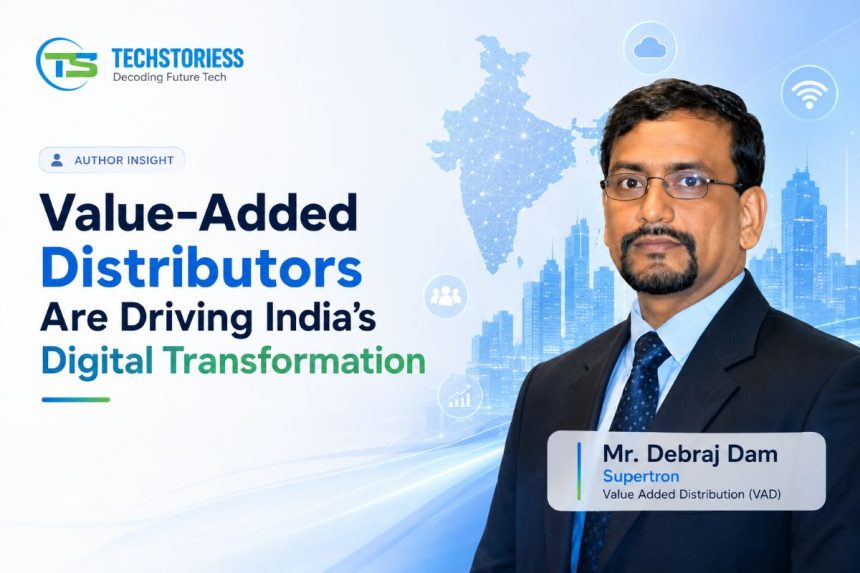
This is precisely where VADs have assumed greater importance. At Supertron VAD, the work spans pre-sales technical design, solution integration across UC, AVS, DCS and cloud domains, partner certification and enablement, financing structures aligned to subscription consumption, and structured post-sales support. The goal in every engagement is the same: translate the offerings of global principals into deployable business outcomes for a partner ecosystem that would otherwise lack the technical depth to do so independently.
The Drivers Behind an Expanding Mandate
Currently, three forces are enlarging the mandate.First, cloud adoption is accelerating at every organisational tier. Gartner forecasts end-user spending on public cloud services in India to surpass USD 17 billion in 2026, with infrastructure-as-a-service among the fastest-growing segments. Reaching the dispersed base of buyers driving this expansion, many of whom are in tier-2 and tier-3 markets, requires an enabled partner network that VADs are uniquely positioned to build and sustain.
Second, technology deployments have become inherently multi-layered. A single enterprise rollout may combine video conferencing infrastructure, physical security, data centre storage and cloud-hosted applications from different vendors. Gartner projects information security spending in India to reach USD 3.4 billion in 2026, up 11.7% year-on-year. Conventional distributors cannot fulfil the integration and assurance responsibilities this creates. VADs consolidate that complexity so that resellers and end customers are not compelled to manage it themselves.
Third, the shift from capital expenditure to subscription and as-a-service consumption models demands entirely different operational competencies — recurring revenue management, cloud marketplace operations, usage-based provisioning, orchestrating renewals—financial and operational competencies that far removed from one-time hardware sales. These are disciplines that VADs have had to build deliberately, and which now represent a genuine competitive differentiator.
Reaching the Underserved
Perhaps the most consequential contribution is geographic and structural. India’s transformation is not confined to large enterprises in metropolitan centres — it increasingly encompasses MSMEs, regional system integrators and public-sector institutions across the country. By equipping partner networks with product expertise, technical certification, demonstration capability and appropriate financing structures, VADs extend the effective reach of global principals into markets those principals cannot economically address on their own.
Future Outlook
The direction of travel is unambiguous. As India advances towards a digital economy that may represent a fifth of GDP within this decade, the intermediaries that can combine scale, technical depth and an extensive partner ecosystem will occupy an increasingly central position in the value chain. VADs like Supertron have evolved from a link in the supply chain into a genuine enabler of transformation — a measured yet consequential pillar of the nation’s digital ascent.