
Thursday, 16 Apr 2026
TechStoriess.com
  • My Feed
  • Tech News
  • Expert Stories
  • My Saves
Search
  • 🔥
  • Enterprise AI
  • Artificial Intelligence
  • GPU
  • Edge AI
  • fintech
  • API
  • Multi Cloud
  • Quantum computing
  • AI Chips
  • AI models
Font ResizerAa
TechStoriess.comTechStoriess.com
Follow US
© 2026 Foxiz News Network. Ruby Design Company. All Rights Reserved..
Expert Stories

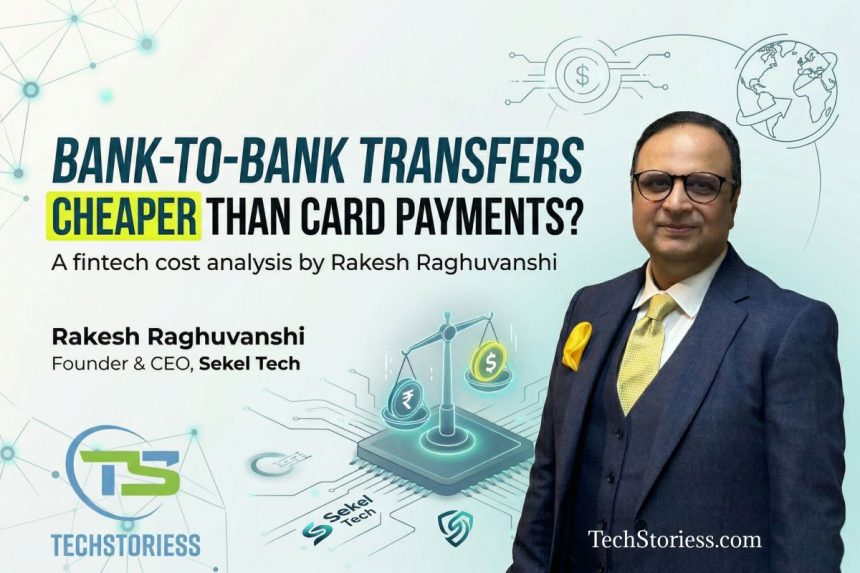
Are Bank-to-Bank Transfers Cheaper and More Secure Than Card Payments?

Srikanth
Last updated: April 4, 2026 10:42 pm
By
Srikanth
BySrikanth
Srikanth is the founder and editor-in-chief of TechStoriess.com — India's emerging platform for verified AI implementation intelligence from practitioners who are actually building at the frontier....
Follow:
8 Views
No Comments
Are Bank-to-Bank Transfers Cheaper and More Secure Than Card Payments Rakesh Raghuvanshi, Founder & CEO, Sekel Tech
SHARE


There is quite a well-known meme about dial up modems, and only a certain generation knowing what it was like to wait for it to connect to the internet, with the peculiar dial-tone sound.

At the time, it felt normal. Slow speeds, dropped connections, and waiting minutes for a page to load were simply part of how things worked. It was only after broadband arrived that people realised how inefficient and fragile the old system had been.

The same principle applies to payments today. For decades, digital payments have been defined by cards. Credit cards and debit cards became the default way to pay because they were convenient, globally accepted, and backed by large networks that made disputes and refunds familiar to consumers. Over time, however, that convenience came with complexity. Every card transaction passes through multiple intermediaries, each adding cost, delay, and exposure to sensitive data.

What is now unfolding is a shift that is taking us away from that model. Across markets, payments are beginning to move back to the bank. Account-to-account payments, better known as A2A, allow money to move directly from a customer’s bank account to a merchant’s bank account without passing through card networks like Visa or Mastercard.

Customers are redirected to their own bank’s app or website, authenticated using the same methods they use for regular banking, and approve a specific amount. The bank then transfers the money directly to the recipient, without the merchant seeing any sensitive data associated with a bank account. This sounds like a return to traditional money transfers, but the difference lies in speed, user experience, and scale.

In India, we saw an example of this in the form of Unified Payments Interface or UPI, which was launched in 2016. By 2024, UPI was processing billions of transactions every month, far outpacing card payments in volume. And all this, without merchants or customers having to share card details at every transaction.


There are parallels across the globe. In Brazil, Pix, introduced by the Central Bank of Brazil in 2020, enables instant transfers between bank accounts using phone numbers or QR codes. Within three years, Pix overtook cards and cash to become the most widely used payment method in the country. Small businesses loved it because settlement was immediate and fees were minimal, while consumers loved it because transactions were authorised directly within their own bank’s interface.

Similarly, iDEAL dominates online commerce in the Netherlands. Customers who choose iDEAL at checkout are redirected to their bank to approve the payment. There are no cards involved, no additional accounts to create, and no sensitive details shared with merchants. Today, iDEAL accounts for a majority of online purchases in the country, showing us how, when bank-based payments are designed for the consumers, the consumers adopt them willingly.

But now, this shift is becoming visible even in markets traditionally dominated by cards. In the United Kingdom, for instance, Faster Payments and open banking based “pay by bank” options are increasingly offered at online checkouts.

In the United States, services like Zelle allow users to transfer money directly between bank accounts, bypassing card networks entirely. While adoption patterns differ, the underlying direction is consistent.

There are several forces driving this change. Cost is one of them. Card transactions typically involve merchant discount rates that can range from 1.5 percent to over three percent of the transaction value. These fees accumulate quickly, especially for high-volume businesses. A2A payments, by contrast, often cost a few cents per transaction or are free for the end user.

Speed is another factor. Card payments take a certain period of time to be settled. A2A payments allow for real-time or near-real-time settlement. But the most important factor, especially in today’s day and age, is data exposure. Card payments require customers to share credentials such as card numbers and security codes. If compromised, these details can be used repeatedly across platforms.

A2A payments change this risk profile. Since customers authenticate directly with their bank, no reusable credentials are shared with the merchant. Each transaction is approved individually. From a data protection perspective, this allows for more effective data minimisation, which means collecting and sharing only what is strictly necessary. Merchants receive confirmation of payment, but not sensitive financial information of the customer.

This has broader implications beyond fraud, especially at a time when regulations around data protection are becoming stricter. In India, the Digital Personal Data Protection Act places clear obligations on organisations to justify why they collect personal data, how it is used, and how it is protected. Payment methods that inherently limit data sharing automatically reduce compliance complexity and risk. When less sensitive data flows through the system, there is less to secure, audit, and eventually delete.

For businesses, this is more of an infrastructure choice than a checkout optimisation feature. As more consumers become comfortable paying directly from their bank accounts, and as regulatory scrutiny around data handling increases, A2A payments move from being an alternative option to a strategic one.

What makes this shift remarkable, however, is how quietly it is happening. There is no single moment when cards stop working or banks suddenly take over. Instead, through systems like UPI, Pix, iDEAL, and emerging pay-by-bank frameworks, payments are gradually returning to where trust has always been strongest, which is the bank.

Article Contributed by Mr. Rakesh Raghuvanshi, Founder & CEO, Sekel Tech
TAGGED:fintechRakesh RaghuvanshiSekel Tech

Sign Up For Daily Newsletter

Be keep up! Get the latest breaking news delivered straight to your inbox.
By signing up, you agree to our Terms of Use and acknowledge the data practices in our Privacy Policy. You may unsubscribe at any globaldigest.
BySrikanth
Follow:
Srikanth is the founder and editor-in-chief of TechStoriess.com — India's emerging platform for verified AI implementation intelligence from practitioners who are actually building at the frontier. Based in Bengaluru, he has spent 5 years at the intersection of enterprise technology, emerging markets, and the human stories behind AI adoption across India and beyond. He launched TechStoriess with a singular editorial mandate: no journalists, no analysts, no hype — only verified founders, engineers, and operators sharing structured, data-backed accounts of real AI deployments. His editorial work covers Agentic AI, Robotics Systems, Enterprise Automation, Vertical AI, Bio Computing, and the strategic future of technology in emerging markets. Srikanth believes the most important AI stories of the next decade are happening in Bengaluru, Jakarta, Dubai, and Lagos — not just San Francisco — and that the practitioners building in those markets deserve a platform worthy of their intelligence.
Leave a Comment Leave a Comment

Leave a Reply Cancel reply

Your email address will not be published. Required fields are marked *

100Like
XFollow
PinterestPin
LinkedInFollow
BlueskyFollow
RSS FeedFollow

Latest News

Vertical AI Revolution Why Domain-Specific Models Command Premium Valuations in 2026Vertical AI Revolution Why Domain-Specific Models Command Premium Valuations in 2026
Agentic & Autonomous AI

Vertical AI Revolution: Why Domain-Specific Models Command Premium Valuations in 2026

Srikanth
By
Srikanth
April 15, 2026
Enterprise AI Adoption in 2026 From Pilot Purgatory to Production
Enterprise Automation

Enterprise AI Adoption in 2026: From Pilot Purgatory to Production-Scale AI Integration

Srikanth
By
Srikanth
April 13, 2026
Why Fragmented Logistics Systems Fail — and How Integration Fixes It Mr. Utkarsh Tripathi, Co-Founder & COO, Hexalog
Expert Stories

Why Fragmented Logistics Systems Fail — and How Integration Fixes It

Srikanth
By
Srikanth
April 10, 2026
AI Contestability vs. Explainability
Agentic & Autonomous AI

AI Contestability vs. Explainability: Which Framework Do Enterprises Need in 2026?

Srikanth
By
Srikanth
April 9, 2026

You Might Also Like

Agentic AI and the Next Wave of Autonomous Business Systems By- Mr. Kamlesh Dave, Vice President at Advaiya Solutions
Expert Stories

Agentic AI and the Next Wave of Autonomous Business Systems

March 25, 2026
Expert Stories

Tech in Fashion: Cutting Water and Chemical Waste in Manufacturing

February 12, 2026
Data Privacy Risks of Generative AI in Fundraising by Nikhil Parmar, Founder Impactful Pitch
Expert Stories

Data Privacy Risks of Generative AI in Fundraising

March 5, 2026
How Businesses Can Select the Right AI and Technology Solutions By Vipul Bhandari, Head Business Manager, Supertron Electronics
Expert Stories

How Businesses Can Select the Right AI and Technology Solutions

March 5, 2026
TechStoriess.com

Welcome to TechStoriess.com: – where we decode the future of technology. Explore in-depth stories on artificial intelligence, robotics systems, enterprise automation, edge AI, and breakthrough innovations. Our expert analyses, founder interviews, and technical deep-dives help tech leaders, developers, and innovators stay ahead.

Subscribe Newsletter

Subscribe to our newsletter to get our newest articles instantly!
Focus Sections
  • Agentic & Autonomous AI
  • Cloud Computing
  • Energy Tech
  • Enterprise Automation
  • Privacy, Security & Governance
  • Synthetic Data

Stay Connected

Find us on socials
FacebookLike
XFollow
PinterestPin
LinkedInFollow
BlueskyFollow
© 2026 TechStoriess. All Rights Reserved.
  • Home
  • Privacy Policy
  • Cookie Policy
  • Write For Us

Powered by
►
Necessary cookies enable essential site features like secure log-ins and consent preference adjustments. They do not store personal data.
None
►
Functional cookies support features like content sharing on social media, collecting feedback, and enabling third-party tools.
None
►
Analytical cookies track visitor interactions, providing insights on metrics like visitor count, bounce rate, and traffic sources.
None
►
Advertisement cookies deliver personalized ads based on your previous visits and analyze the effectiveness of ad campaigns.
None
►
Unclassified cookies are cookies that we are in the process of classifying, together with the providers of individual cookies.
None
Powered by
Join Us!
Subscribe to our newsletter and never miss our latest news, podcasts etc..
Zero spam, Unsubscribe if not interested.
Welcome Back!

Sign in to your account

Username or Email Address
Password

Lost your password?