


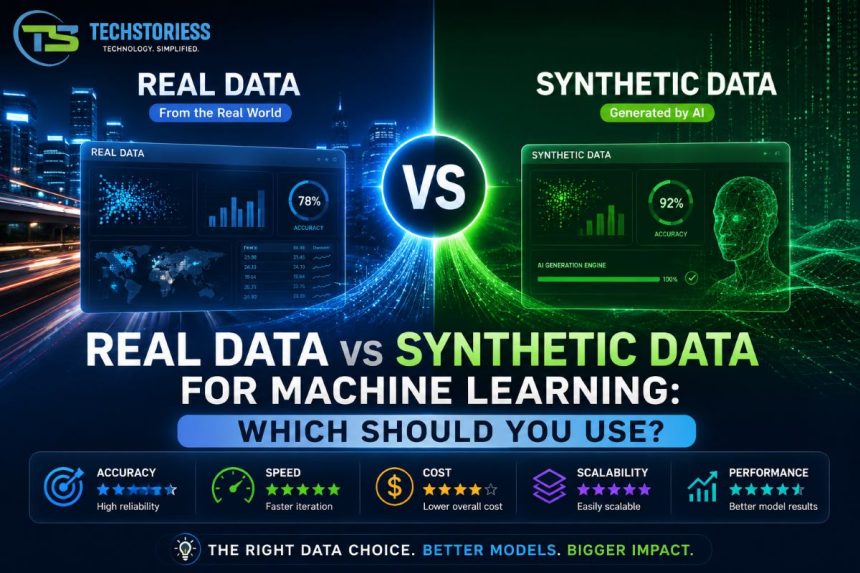
For years, the AI industry operated on a simple assumption: you need to feed more real-world data to make machines smarter. That belief led to the rise of hyperscale data pipelines, internet-scale scraping operations, enterprise data lakes, and billion-parameter training ecosystems. However, in 2026, the conversation around AI training data has turned significantly more nuanced.
- Why Training Data Has Become the New AI Battleground
- Why Real Data Still Matters for Machine Learning Systems
- Understanding Synthetic Data and How It Is Generated
- Synthetic vs Real Training Data Comparison
- When Synthetic Data Performs Better Than Real Data
- Where Real-World Data Still Remains Essential
- Data Privacy Machine Learning and GDPR Compliance
- The Hidden Challenge: AI Dataset Quality
- Why the Financial Sector Is Leading Adoption
- Conclusion
Enterprises are no longer concerned about the sole volume of data. They are concerned about its legal usability, operational reliability, sourcing ethics, privacy compliance, bias awareness, and strategic scalability.
That shift has moved real data vs synthetic data machine learning from research labs into boardrooms.
The growing pressure surrounding issues like privacy regulations, data localization laws, cybersecurity risks, and AI governance frameworks has revealed the limitations of depending solely on real-world datasets. At the same time, developments in generative AI have dramatically improved the realism and utility of synthetic datasets, enabling organizations to simulate environments, behaviors, transactions, and edge cases with greater sophistication.
There is substantial momentum behind this transition. According to industry forecasts, 75% of businesses will use generative AI to produce synthetic data, while Gartner notes that synthetic data use reduces real data needed by 70% in many enterprise AI workflows. Financial institutions – one of the most regulation-sensitive sectors – are now leading adoption at 41% of synthetic data use cases.
Microsoft trained Phi-4 on 50+ synthetic datasets, outperforming models five times its size – one of the most notable achievements in the field, proving synthetic data’s growing legitimacy. That achievement forced many AI leaders to rethink their assumptions: perhaps smarter data matters more than larger data.
However, the reality is more nuanced than the current hype cycle suggests.
Synthetic data cannot be considered a universal replacement for real-world information. Nor is real data necessarily superior simply because it originates from actual environments. Both approaches have their own set of strengths, weaknesses, operational risks, and strategic tradeoffs. To succeed with AI in 2026, organisations need to build balanced, context-aware data strategies rather than treating either approach as the definitive answer.
Why Training Data Has Become the New AI Battleground
More than algorithm strength, the reason behind enterprise AI failures today is poor data quality, fragmented governance, inaccessible datasets, or legally problematic training pipelines.
That reality has fundamentally changed enterprise thinking about AI infrastructure.
Acquiring sufficient data was the dominant challenge a decade ago. Today, enterprises have amassed enormous data but are restrained by constraints like compliance obligations, inconsistent labeling standards, privacy concerns, and operational silos. Especially in heavily regulated sectors such as banking, insurance, healthcare, and defense, it has become increasingly difficult to access high-quality real-world datasets.
In the present era of generative AI and autonomous systems, this challenge is particularly acute as models require enormous volumes of diverse, context-rich training material to learn from. Real-world datasets generally include sensitive personal information, incomplete records, demographic imbalances, or hidden biases that corrupt downstream AI systems.
So more than a technical debate, the conversation around synthetic vs real training data comparison has become operational, legal, and strategic.
Synthetic data offers enterprises controllable scalability. Organizations can generate rare scenarios, balance underrepresented categories, simulate edge cases, and remove personally identifiable information without directly exposing sensitive customer records.
But it leaves the deeper question unanswered: is it truly possible to replace the unpredictability and complexity of reality with artificially generated information?
Why Real Data Still Matters for Machine Learning Systems
While synthetic data is rapidly rising, real-world information remains extraordinarily valuable as it reflects the inconsistent, messy, and nonlinear nature of human environments.
Machine learning systems trained exclusively on synthetic datasets can struggle to capture subtle behavioral patterns, unexpected anomalies, or real-world irregularities that simulations fail to reproduce accurately. The imperfections of reality are often difficult to manufacture artificially.
This becomes especially crucial in sectors involving:
- Medical diagnostics
- Fraud detection
- Cybersecurity
- Autonomous driving
- Industrial safety systems
- Financial risk analysis
In such environments, rare deviations are often more valuable than predictable patterns.
Another key strength of real data is contextual authenticity. Human behaviors, purchasing decisions, communication styles, environmental conditions, and operational workflows evolve dynamically over time. While synthetic systems excel at replicating statistical distributions, they sometimes miss deeper behavioral complexity.
Validation credibility is another benefit of real data. Regulators, auditors, and enterprise governance teams are more likely to trust AI systems validated against actual operational datasets rather than fully simulated environments.
That trust factor matters enormously for enterprise AI adoption.
That said, exclusively relying on real-world information introduces significant limitations.
Expensive data collection, slow labeling, and significant privacy risks are the key barriers. Moreover, regulations like GDPR, HIPAA, and emerging AI governance laws increasingly restrict how enterprises gather and use personal information. In some cases, organizations simply lack enough representative data to train reliable models.
Here synthetic data positions itself not as a replacement for reality, but as a strategic augmentation layer.
Understanding Synthetic Data and How It Is Generated
In simple terms, synthetic data is artificially generated information specifically designed to simulate the statistical characteristics, patterns, structures, or behaviors of real-world datasets.
Modern synthetic data generation systems employ multiple approaches, including:
- Generative adversarial networks (GANs)
- Diffusion models
- Simulation engines
- Probabilistic modeling
- Rule-based generation
- Large language models
- Agentic behavioral simulations
These systems have grown substantially more sophisticated over the past few years.
Earlier versions of synthetic datasets often looked repetitive, artificial, or statistically shallow, limiting their practical utility. Newer generative architectures can now create highly realistic datasets for text, images, financial transactions, medical records, industrial telemetry, speech, and behavioral modeling.
That is why enterprises are increasingly exploring when to use synthetic data rather than treating it as an experimental workaround.
Among the strongest advantages of synthetic data is scalability under constraint. Organizations can produce millions of labeled samples far more quickly than manual collection processes allow. More importantly, they can also simulate scenarios that would be difficult, dangerous, expensive, or ethically problematic to recreate in real life.
For instance:
- Autonomous vehicle systems can simulate near-collision events
- Cybersecurity teams can generate attack scenarios
- Healthcare AI systems can model rare diseases
- Manufacturing systems can replicate equipment failures
- Banks can simulate fraud behaviors
These capabilities significantly accelerate AI development cycles.
Synthetic vs Real Training Data Comparison
Smart enterprise AI strategies in 2026 evaluate both through operational requirements rather than treating them as mutually exclusive options.
Real data offers crucial value in areas where machine learning systems must interact with the unpredictability of reality itself. It possesses authenticity that often can’t be reproduced synthetically. The key strengths of real datasets include human behavior, operational inconsistencies, cultural nuances, environmental noise, incomplete records, and unexpected edge conditions. That’s why real data remains essential for applications such as behavioral realism, operational validation, and understanding real-world complexity.
It also supports production readiness, as models may perform well in controlled lab environments but still fail under real-world deployment conditions.
Key strengths of real data Real data;
- Authenticity
- Behavioral realism
- Operational validation
- Real-world complexity
- Production benchmarking
Synthetic data, however, solves a different type of problems that modern AI development increasingly relies on. It facilitates massive scalability without depending on real-world collection cycles that are both slow and expensive. Organizations employ synthetic data to protect privacy, safely replicate rare or dangerous events, moderately balance underrepresented datasets, cut down labeling costs, and operate more flexibly while adhering to regulatory constraints.
In many sectors, synthetic datasets substantially speed up experimentation while avoiding exposure of sensitive customer or operational information. Instead of replacing real data, synthetic data generally acts as a strategic amplifier to expand, augment, and stress-test machine learning systems before they encounter reality itself.
Key Strengths of Synthetic data
- Scalability
- Privacy preservation
- Rare-event simulation
- Bias balancing
- Cost reduction
- Regulatory flexibility
The practical difference often comes down to model objectives.
Real-world data typically remains essential if an organization requires maximum behavioral realism for production validation. However, if you are challenged by scale, compliance, data scarcity, or simulation diversity, synthetic datasets often become highly beneficial.
This is especially true for enterprise AI teams operating under strict compliance frameworks involving data privacy machine learning requirements.
Interestingly, many sophisticated AI systems today operate on hybrid pipelines where synthetic datasets act as an augmentation layer rather than a replacement for real-world information.
That hybrid approach is fast gaining dominance across the industry.
When Synthetic Data Performs Better Than Real Data
There are specific situations where synthetic datasets can substantially outperform conventional real-world training pipelines.
One major benefit is data imbalance correction.
Real-world datasets often include problems such as underrepresented populations, skewed outcomes, or insufficient examples of rare scenarios that are operationally critical. Synthetic generation enables enterprises to artificially produce balanced datasets, improving model robustness and fairness.
Safety simulation is another crucial advantage of synthetic data.
Sectors such as autonomous robotics, aerospace, cybersecurity, and industrial automation generally need AI systems to train against hazardous or uncommon events that cannot be collected practically due to safety, cost, or ethical constraints.
Synthetic generation also significantly enhances experimentation speed. It empowers data scientists to iterate faster, test different scenarios efficiently, and assess system behavior without waiting months for new production data collection cycles.
That is precisely why Microsoft trained Phi-4 on 50+ synthetic datasets, outperforming models five times its size. By leveraging synthetic reasoning datasets, the company optimized learning efficiency rather than relying purely on raw data scale.
That achievement emphasizes a growing realization across enterprise AI: sometimes carefully curated synthetic information leads to stronger learning outcomes compared to massive volumes of noisy real-world data.
Where Real-World Data Still Remains Essential
While the momentum around synthetic generation is significant, certain domains still rely heavily on authentic operational information.
One strong example is financial fraud detection.
Fraud patterns evolve continuously as attackers dynamically adapt their methods to bypass detection systems. Synthetic simulations excel at modeling historical attack behavior but may struggle to accurately simulate emerging criminal creativity. Similar challenges exist in cybersecurity, due to unpredictably evolving adversarial behavior.
Healthcare AI presents another compelling case.
Synthetic medical datasets play a crucial role in addressing privacy concerns, but the subtle diagnostic nuances embedded in real-world clinical variability are quite difficult to reproduce synthetically. In such cases, overrelying on simulated medical data may introduce hidden performance risks if not carefully validated.
Authentic data is equally valuable for consumer behavior modeling, as human preferences shift rapidly due to factors like culture, economics, trends, and emotional influences.
This is the key reason many enterprise leaders now consider AI dataset quality more crucial than dataset origin alone.
Just as poor-quality real data can damage a model, poorly generated synthetic data can do the same.
Data Privacy Machine Learning and GDPR Compliance
Privacy regulation is one of the strongest drivers behind synthetic data adoption.
Modern enterprises face strict obligations regarding the way customer information is gathered, stored, processed, and used for AI development. Regulations like GDPR, CCPA, HIPAA, and sector-specific compliance mandates have substantially complicated unrestricted data usage.
This is precisely where GDPR compliant training data strategies become critically important.
Synthetic datasets can reduce exposure to personally identifiable information, as generated records do not directly correspond to actual individuals. This reduces certain compliance risks while enabling broader experimentation.
However, enterprises must avoid oversimplifying the privacy narrative.
Poorly designed synthetic systems can still leak sensitive patterns if the generation process memorizes source datasets too closely. Synthetic data is not automatically privacy-safe simply because it is artificial.
Responsible deployment requires safeguards like:
- Differential privacy protections
- Memorization detection
- Governance controls
- Auditability
- Lineage tracking
- Validation testing
Privacy-preserving synthetic generation is a discipline in itself, not a default outcome.
The Hidden Challenge: AI Dataset Quality
Contrary to common belief, the generation quality of synthetic data does not automatically equal training quality.
Synthetic datasets inherit the assumptions, biases, limitations, and structural decisions of the systems generating them. Flawed source data leads to synthetic output that amplifies those flaws rather than correcting them.
This introduces an important operational challenge around AI dataset quality.
High-quality synthetic generation demands:
- Representative source distributions
- Balanced sampling
- Scenario diversity
- Realistic edge cases
- Rigorous validation
- Continuous monitoring
Without these safeguards, enterprises risk training models on artificially clean environments that perform well on benchmarks but fail under real-world conditions.
This issue becomes especially dangerous in safety-critical applications where operational reliability matters more than benchmark performance.
Why the Financial Sector Is Leading Adoption
The banking and financial services industry is among the most aggressive adopters of synthetic data technologies.
The reason is relatively straightforward.
Financial institutions possess massive quantities of sensitive customer information while operating under extremely restrictive compliance environments. Sharing records like transaction histories, customer identities, or behavioral data across development teams introduces significant regulatory risk.
Synthetic generation offers a safer and more reliable pathway for AI experimentation and training.
The financial sector leads adoption at 41% of synthetic data use cases, with privacy-preserving data generation powering applications across fraud detection, credit scoring, risk simulation, anti-money laundering systems, and algorithmic testing environments.
Similar patterns are emerging in healthcare and insurance sectors.
Conclusion
The future of enterprise AI will not exclusively rely on either real or synthetic data.
It will belong to smart, well-orchestrated coordination between both.
Real-world information offers grounding, authenticity, and operational realism. Synthetic data brings scalability, flexibility, privacy protection, and simulation diversity. Together, they build robust training ecosystems that can efficiently support increasingly sophisticated AI systems.
This balanced approach is becoming standard practice across leading enterprise AI teams.
As generative AI systems continue improving, synthetic data quality will grow more realistic, adaptive, and context-aware. But organizations that entirely abandon real-world validation may accumulate operational blind spots and governance risks that undermine production performance.
In 2026, the real concern of strong AI organizations is how to coordinate both intelligently, responsibly, and strategically.
And increasingly, that question will define the next phase of enterprise machine learning itself.