


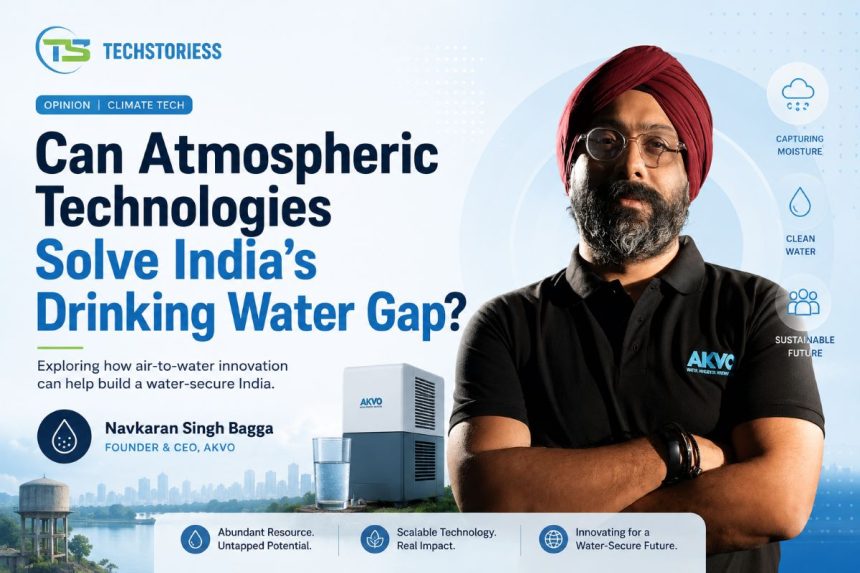
India stands at a paradox. We are among the world’s fastest-growing economies, yet home to the largest population living under severe water stress. NITI Aayog has flagged for years that nearly 600 million Indians face high to extreme water scarcity, and that roughly 70 per cent of our water sources are contaminated. Groundwater, which quietly underwrites most of our drinking water, is falling in city after city. The drinking water gap is no longer rural or urban, it is a national infrastructure issue.
As a founder who has spent years building atmospheric water generation (AWG) technology at Akvo, I am often asked whether we can really pull drinking water out of the air at a scale that matters for India. My honest answer is that AWG will not replace rivers, rainwater harvesting or municipal supply. But it is fast becoming one of the most credible decentralised options to plug the last-mile drinking water gap especially where the ground has failed us, the pipe has not yet reached, or the source itself is unsafe.
Understanding the Gap
India’s drinking water challenge has three compounding layers. Quantity per-capita freshwater availability has dropped from about 5,177 cubic metres in 1951 to under 1,500 today, well below the international water-stress threshold. Quality like fluoride, arsenic, nitrate, iron and industrial effluents contaminate drinking water across Rajasthan, Punjab, West Bengal, Assam, Bihar and Tamil Nadu. And reliability even where water is available and safe, intermittent supply, tanker dependence and packaged bottles have become the unspoken norm for millions of households and workplaces. The Jal Jeevan Mission has made historic progress on tap connections, but delivering safe, reliable, drinkable water to every Indian every day remains a generational task. Decentralised technologies that do not depend on an external water source deserve serious attention in that gap.
What Atmospheric Water Generation Actually Does?
An AWG draws humidity from ambient air, condenses it into liquid water, and filters and mineralises it to drinking standards. The atmosphere above India holds an estimated 13,000 cubic kilometres of water vapour at any given time far more than all our rivers combined. AWG taps a sliver of that renewable reservoir. Unlike bore wells, it does not deplete aquifers; unlike tankers, it does not rely on a failing supply chain; unlike bottled water, it eliminates plastic at the point of consumption. The technology performs best in warm, humid conditions, and output is strongly correlated with temperature and relative humidity communicated transparently to every customer. Performance is environment-dependent, not marketing-dependent. In coastal India, the Northeast, and most of peninsular India for most of the year, AWG can deliver drinking water reliably at the point of use.
Where AWG Genuinely Moves the Needle
The honest use case for AWG in India is not to flood cities with air-to-water units, but to target pain points where conventional infrastructure struggles: schools in fluoride- or arsenic-affected districts, primary health centres in remote blocks, defence and border posts where trucking water is punishing, factories and campuses spending crores on packaged water, peri-urban societies where groundwater has turned unusable, and disaster response where a mobile AWG unit can be airlifted and producing within hours. This is where CSR and ESG capital can play a catalytic role. A single mid-sized unit at a government school can replace tens of thousands of plastic bottles over its lifetime, deliver measurably cleaner water, and generate verifiable impact data daily through IoT-enabled dashboards. For CSR teams moving from activity-based to outcome-based reporting, decentralised water infrastructure is one of the cleanest stories available today measured in litres, not photographs.
The Economics Are Finally Turning
AWG was once an expensive novelty. Advances in compressor efficiency, refrigerant choices, heat exchanger design and IoT-led predictive maintenance have brought the cost per litre down significantly. In the right climatic zones it is now comparable to, and often lower than, packaged or tankered water in urban India once the hidden costs of plastic disposal, logistics and health externalities are counted. The commercial model has matured alongside. Water-as-a-Service, where a partner invests in the machine and the client pays only per litre consumed, removes the capital barrier for schools, hospitals, factories and municipalities the same unlock that scaled electricity and telecom in India.
The Honest Limits
AWG is not a silver bullet. Output drops sharply in cold, dry regions such as high-altitude Ladakh or peak North Indian winter. Energy consumption per litre still matters, which is why pairing AWG with rooftop solar is increasingly the default design conversation. And AWG is, at heart, a drinking water solution, its role is to deliver the most important twenty to thirty litres per person per day, safely, reliably, at the point of use. Credibility in climate technology is built on what we refuse to overpromise.
A Decentralised Water Future
India’s water future will look less like a single grand pipeline and more like a mesh: surface water where abundant, groundwater where sustainable, rainwater harvesting where possible, recycled water for non-potable use, and atmospheric water precisely where the other four fail. In that mesh, AWG is the last, intelligent layer ensuring no school, clinic, worker or family is left without a safe glass of drinking water. The question is no longer whether atmospheric technologies can solve India’s drinking water gap, but how quickly policy, CSR capital and industry will come together to deploy them where they matter most. At Akvo, we are building for that India — one decentralised unit at a time, with full honesty about what the technology can do, and deep conviction about why it must.
Contributed by Navkaran Singh Bagga is the Founder & CEO of Akvo Atmospheric Water Systems, an Indian climate-tech company manufacturing atmospheric water generators deployed across 15 countries. A second-generation entrepreneur and TEDx speaker, he writes and speaks frequently on decentralised water infrastructure, IoT-driven utilities and the future of sustainable manufacturing from India.