



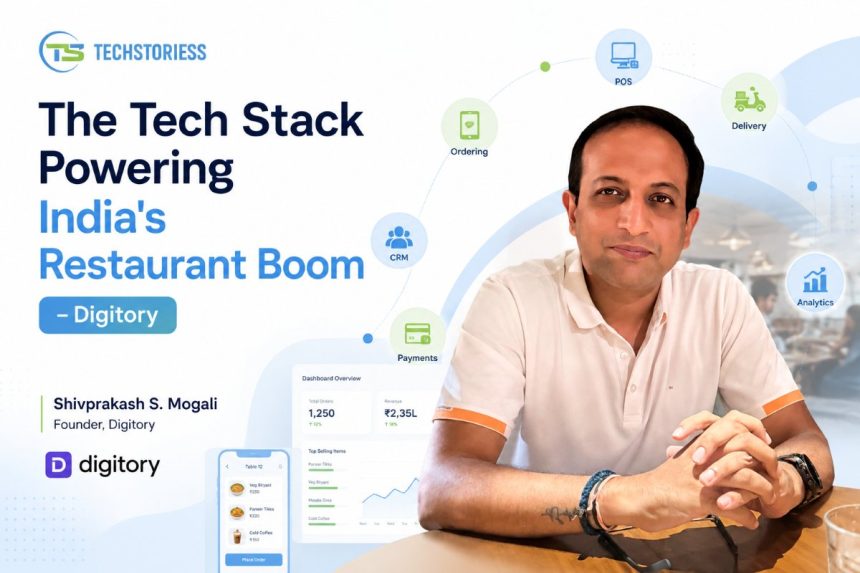
The modern hospitality industry moves fast, yet disconnected backend operations remain a critical bottleneck. Enter Digitory, an AI-powered Restaurant Operating System founded by Shivprakash S. Mogali to seamlessly connect POS, procurement, and kitchen workflows. Recently backed by $500,000 in funding, Digitory is transforming how restaurant chains leverage real-time operational intelligence.
In this exclusive TechStoriess interview, we sit down with Shivprakash to discuss his entrepreneurial journey, the rise of vertical AI, and the future of connected restaurant technology.
What motivated your shift to build an integrated SaaS platform for the hospitality sector?
We spent real time on restaurant floors. Serving tables, watching kitchens, sitting with purchase managers. What we saw was operators drowning in disconnected tools. POS in one place, inventory in another, procurement on WhatsApp and paper. Nothing talked to each other. So the margin was leaking everywhere and nobody could see it. That’s what pushed us. Restaurants don’t need ten point solutions. They need one platform where the data actually connects. Food gets you to the first ten outlets. Systems get you to the next hundred. That gap is what we set out to close.
How does Digitory move restaurants beyond traditional POS systems toward unified operational intelligence?
Most POS systems stop at billing. They record the sale and that’s it. For us the POS is the starting point, not the finish line. Every bill flows straight into inventory, so you see ingredient-level consumption in real time. That feeds procurement, costing, vendor payments, the whole chain. One sale updates nine things automatically. The operator stops chasing numbers across spreadsheets and starts reading one connected picture. That’s the shift. From a cash register that tells you what you sold, to a platform that tells you what it actually cost you and where your money went.
Why will industry-specific vertical AI outperform generic enterprise software in restaurant operations?
Generic software treats a restaurant like any other business. But a restaurant runs on recipes, wastage, spoilage, prep, and margins measured in millilitres. Horizontal tools don’t understand that language. We built ours from the floor up, so the AI works on data that’s already structured for how kitchens actually operate. Here’s the honest part though. AI can’t create margin on its own. It only surfaces margin already hidden in your operations, and only when the data is clean and the systems are connected. Vertical AI wins because it sits on that foundation. Generic tools never had it.
How does your platform shift businesses from static dashboards to real-time operational decision-making?
A static dashboard tells you what happened last month. By then the money’s already gone. We track cost of issue against revenue daily, even without a physical stock closing. So a chef or an owner can see today that food costs jumped in one category and act on it now, not at month-end. Bill consumption updates per ticket. Stock movement is logged with a timestamp the moment it happens. The point isn’t prettier charts. It’s shortening the gap between something going wrong and someone being able to fix it. That’s where real money gets saved.
Can you share how AI-driven insights are transforming back-end operations and recipe costing?
Take recipe costing. Most places guess. They set a menu price and hope the margin holds. We break every menu item down to the ingredient, with unit cost per serving, pulled straight from actual sales data. So you know exactly what each dish costs to make and which ones are quietly bleeding you. On the back end, the system flags where theoretical consumption drifts from real consumption. That gap is usually wastage, theft, or over-portioning. Once you can see it, you can fix it. The insight isn’t magic. It’s clean data made visible at the point where decisions happen.
How do multi-location brands like Toit balance customer experience with strict operational efficiency?
The best operators don’t treat these as a trade-off. Good systems on the back end are what free up the front. When your kitchen knows stock in real time and your procurement runs on templates instead of guesswork, staff spend less time firefighting and more time with guests. Our front-of-house and back-of-house work as one. The waiter app, QR ordering, and kitchen display talk to each other, so orders move cleanly. Meanwhile the inventory engine runs quietly underneath. Efficiency isn’t the enemy of experience. Done right, it’s what makes a consistent experience possible across every outlet.
How does Digitory handle data privacy and compliance within integrated CRM and analytics?
Operator data is theirs, full stop. We treat it that way. Our CRM and loyalty features collect feedback through channels customers already trust, like WhatsApp, and that data stays tied to the operator’s own account. We don’t pool it or resell it. On compliance, we work within Indian data norms and the requirements of the markets we operate in. As we move toward larger chains, we’re continuing to harden this. For an enterprise-grade platform handling sales and customer data across hundreds of outlets, trust isn’t a feature. It’s the baseline.
What remote or hybrid work challenges do distributed hospitality management teams face today?
The hard part is visibility. A brand running outlets across ten cities can’t have owners physically in every kitchen. So how do you know what’s really happening on the ground? Historically you didn’t, until the monthly reports came in. That’s the problem we solve. A regional manager can see stock, costs, and consumption across every location from a phone, in real time. The team gets distributed but the data stays central. The other challenge is consistency. Systems are what keep a dish and a margin the same in outlet fifty as they were in outlet one. People move around. Process holds.
Could you share details on Digitory’s current funding, revenue milestones, and scale objectives?
We’re eight years in, running lean, serving 500-plus outlets across India, Thailand, Trinidad, and Bhutan with a team of 40. We’ve grown largely on organic referrals from existing clients, which we’re proud of. It kept us close to customers and honest about what actually works. Dubai is coming up next, and we’re focused on scaling aggressively toward 1,000 outlets. The near-term priority is proving a repeatable go-to-market motion, especially with restaurant chains. On specific revenue numbers, I’ll keep those for direct conversations. But the direction is clear. Deepen the platform, scale the sales engine, and expand the outlet base fast.
How are you positioning Digitory to scale as a global SaaS product from India?
We’re already multi-country. India is home, but we run outlets in Thailand, Trinidad, and Bhutan today, with Dubai coming up next, so global isn’t a slide in the deck for us. It’s live. The advantage of building in India is that our market is brutally cost-conscious and operationally complex. If your product creates real margin here, it travels well anywhere. Our approach is to win chains, because one chain win is a repeatable motion across many outlets and often many geographies. Get the platform right, get the go-to-market repeatable, then follow the brands as they expand.
What is the next major milestone planned for Digitory’s future product and expansion roadmap?
The next chapter is about widening the platform. We’ve built a deep inventory and POS core, and now we’re layering on more of what operators actually run their business on. Obvvy, our event and cashless transactions product, is a big one, taking us into clubs, parties, and event-led venues. Alongside that, we’re strengthening CRM, loyalty, and reservations so the entire guest journey sits in one place. And tying it all together is an AI layer on top, turning all that connected data into decisions operators can act on daily. One platform, front to back, floor to kitchen.








Really insightful take on how connected technology is transforming restaurant operations. AI-powered POS and real-time analytics are making it easier for restaurants to manage sales, inventory, and profitability. **Foodzerv** is working toward the same vision—helping restaurants run smarter with connected, AI-driven operations.