


Manufacturing faces relentless pressure: labour shortages, rising costs, quality demands, and the need for flexibility in a volatile market. Traditional automation often falls short—it’s rigid, expensive to reprogram, and struggles with variability. AI robotics in manufacturing changes that by adding intelligence, adaptability, and real-time decision-making to physical systems.
- Why AI Robotics in Manufacturing Is Growing So Fast
- 1. BMW Uses AI-Powered Quality Inspection to Reduce Defects
- 2. Siemens Uses Predictive Maintenance AI Manufacturing Systems
- 3. Tesla Automates Battery Manufacturing with AI Robotics
- 4. FANUC Uses AI for Intelligent Factory Automation
- 5. Bosch Uses AI Vision Systems for Manufacturing Quality Control
- 6. Amazon Uses AI Robotics in Fulfilment Operations
- 7. General Electric Improves Production Efficiency with AI Analytics
- 8. Foxconn Uses AI Robotics to Scale Electronics Manufacturing
- What Makes AI Manufacturing Projects Deliver Strong ROI?
- Common Challenges When Deploying AI Robotics in Manufacturing
- The Future of AI Robotics in Manufacturing Beyond 2026
- Conclusion
- Frequently Asked Questions
- Ready to Explore More Manufacturing AI Strategies?
Rising labour costs, supply chain uncertainty, quality demands, and competitive pressure have pushed manufacturers toward intelligent automation. Traditional industrial robots have been used for decades, but modern AI robotics in manufacturing introduces a new capability: decision-making.
The result is measurable business impact. Companies are reporting reduced downtime, fewer defects, increased throughput, improved worker safety, and stronger profitability.
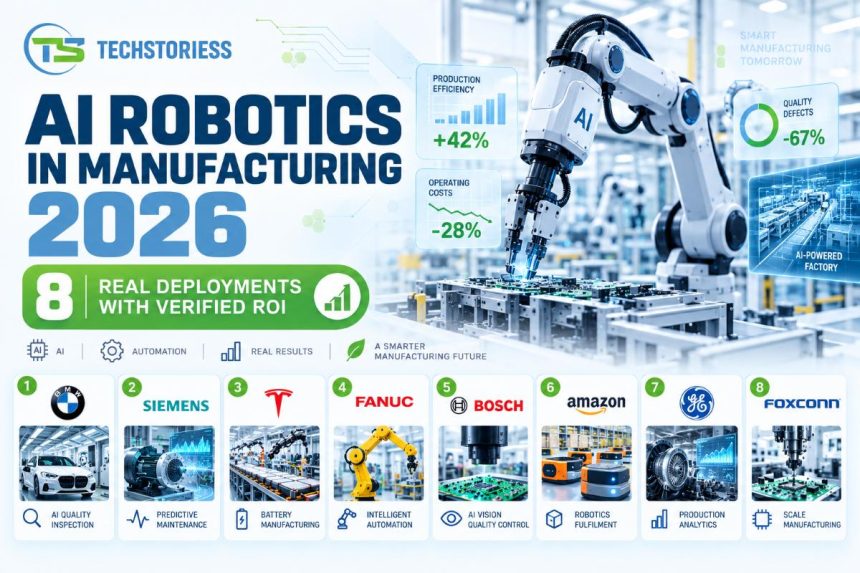
This article explores eight real-world AI robotics in manufacturing deployments with verified ROI outcomes. Along the way, we’ll examine what makes these projects successful and how manufacturers can apply similar strategies in their own facilities.
Why AI Robotics in Manufacturing Is Growing So Fast
AI robotics in manufacturing combines industrial robotics with machine learning, computer vision, predictive analytics, and real-time data processing.
Unlike traditional robots that follow fixed instructions, AI-powered robotics manufacturing systems can:
- Learn from operational data
- Adapt to production changes
- Detect quality issues automatically
- Predict equipment failures
- Optimize workflows continuously
- Improve productivity without constant reprogramming
This shift is creating a new generation of smart factories where machines not only perform tasks but also make intelligent decisions.
Key Benefits Driving Adoption
Manufacturers are investing in intelligent automation manufacturing because it delivers measurable outcomes:
- Higher production efficiency
- Lower operating costs
- Improved product quality
- Reduced downtime
- Better worker safety
- Faster decision-making
- Increased production flexibility
The strongest AI manufacturing case studies show ROI within months, not years.
1. BMW Uses AI-Powered Quality Inspection to Reduce Defects
Deployment Overview
BMW has integrated computer vision manufacturing AI systems throughout several production facilities. These systems inspect vehicle components and assembly processes in real time.
Traditional quality inspections often rely on human inspectors, who may miss subtle defects after reviewing thousands of parts daily. AI-powered vision systems eliminate much of that variability.
How It Works
High-resolution cameras capture images during production. Machine learning models analyse:
- Paint quality
- Weld consistency
- Surface defects
- Assembly accuracy
- Component placement
The system instantly flags anomalies for review.
Verified ROI
Reported benefits include:
- Faster inspection cycles
- Reduced quality-related rework
- Lower scrap rates
- Improved first-pass yield
The combination of AI-driven quality inspection, manufacturing, and robotics has helped BMW improve overall production consistency while reducing inspection costs.
Key Takeaway
Computer vision manufacturing AI performs repetitive inspections with greater consistency than manual methods, making it one of the highest-value AI investments available today.
2. Siemens Uses Predictive Maintenance AI Manufacturing Systems
Deployment Overview
Unexpected equipment failures can cost manufacturers millions annually. Siemens implemented predictive maintenance AI manufacturing solutions across critical production assets to reduce downtime and improve equipment reliability.
How It Works
Sensors continuously monitor:
- Temperature
- Vibration
- Pressure
- Energy consumption
- Motor performance
AI models analyse patterns and identify warning signs before failures occur. Maintenance teams receive alerts before breakdowns happen.
Verified ROI
Results include:
- Significant reduction in unplanned downtime
- Lower maintenance costs
- Longer equipment lifespan
- Improved production availability
Predictive maintenance consistently ranks among the most successful AI manufacturing case studies because downtime reduction directly impacts profitability.
Key Takeaway
Preventing one major production outage often justifies the entire investment in predictive maintenance technology.
3. Tesla Automates Battery Manufacturing with AI Robotics
Deployment Overview
Battery production requires exceptional precision and speed. Tesla relies heavily on AI-powered robotics manufacturing throughout battery assembly operations.
How It Works
AI-driven robots perform:
- Cell handling
- Material placement
- Welding operations
- Quality checks
- Assembly optimization
Machine learning continuously improves manufacturing accuracy.
Verified ROI
Benefits reported include:
- Higher production throughput
- Reduced labour-intensive processes
- Improved product consistency
- Lower defect rates
AI robotics in manufacturing enables Tesla to scale battery production while maintaining quality standards required for electric vehicle manufacturing.
Key Takeaway
AI-enhanced robotics is especially valuable in high-volume manufacturing environments, where even small efficiency gains yield substantial financial returns.
4. FANUC Uses AI for Intelligent Factory Automation
Deployment Overview
Industrial robotics leader FANUC uses AI technologies within its own manufacturing operations. The company is one of the strongest examples of AI factory automation because it applies its own automation technologies internally.
How It Works
AI systems optimise:
- Robot movements
- Production scheduling
- Machine utilization
- Energy consumption
- Equipment performance
Robots continuously learn from operational data.
Verified ROI
Observed improvements include:
- Increased production efficiency
- Better equipment utilization
- Reduced energy consumption
- Lower operational costs
The deployment demonstrates how intelligent automation manufacturing creates benefits across entire production systems rather than isolated tasks.
Key Takeaway
AI delivers maximum value when connected to broader factory operations rather than individual robotic cells.
5. Bosch Uses AI Vision Systems for Manufacturing Quality Control
Deployment Overview
Bosch has deployed AI quality inspection manufacturing systems across multiple facilities to improve product quality and reduce defects.
How It Works
AI vision platforms inspect products at high speed and identify:
- Surface imperfections
- Dimensional inaccuracies
- Missing components
- Assembly errors
Unlike traditional rule-based systems, AI models continuously improve detection accuracy.
Verified ROI
Results include:
- Higher defect detection rates
- Lower warranty costs
- Reduced manual inspection effort
- Faster production throughput
This is one of the most practical AI manufacturing case studies because quality control is present in virtually every manufacturing operation.
Key Takeaway
Quality inspection remains one of the fastest paths to achieving positive ROI in industrial robotics.
6. Amazon Uses AI Robotics in Fulfilment Operations
Deployment Overview
Although primarily known as a logistics company, Amazon’s fulfilment centres operate like advanced manufacturing environments. AI robotics plays a critical role in warehouse automation and order processing.
How It Works
Robots perform:
- Inventory movement
- Product transportation
- Sorting operations
- Route optimization
- Storage management
AI algorithms continuously optimise workflows.
Verified ROI
Benefits include:
- Faster order fulfillment
- Reduced operational costs
- Improved inventory accuracy
- Higher throughput capacity
These AI factory automation examples demonstrate how robotics can transform complex operational environments.
Key Takeaway
AI-powered robotics manufacturing principles often extend beyond factory floors into logistics and supply chain operations.
7. General Electric Improves Production Efficiency with AI Analytics
Deployment Overview
General Electric has invested heavily in industrial AI systems designed to improve manufacturing productivity and asset performance.
How It Works
AI platforms analyse data from:
- Production equipment
- Robotics systems
- Sensors
- Maintenance records
- Operational workflows
Insights help managers optimise production decisions.
Verified ROI
Reported gains include:
- Increased equipment availability
- Reduced downtime
- Better resource allocation
- Improved production efficiency
The integration of AI, robotics, and analytics in manufacturing creates a powerful feedback loop for continuous improvement.
Key Takeaway
The true value of AI often comes from turning operational data into actionable decisions.
8. Foxconn Uses AI Robotics to Scale Electronics Manufacturing
Deployment Overview
Foxconn manufactures millions of electronic devices annually and increasingly relies on AI-powered robotics manufacturing solutions.
How It Works
AI systems support:
- Assembly automation
- Defect detection
- Production planning
- Material handling
- Process optimization
Robots work alongside human operators to increase productivity.
Verified ROI
Benefits include:
- Reduced production costs
- Improved manufacturing speed
- Higher quality consistency
- Greater production flexibility
Foxconn’s deployment highlights how AI robotics supports large-scale manufacturing environments where efficiency gains quickly multiply.
Key Takeaway
High-volume manufacturers often achieve some of the strongest ROI in industrial robotics due to scale advantages.
What Makes AI Manufacturing Projects Deliver Strong ROI?
The most successful AI manufacturing case studies share several common characteristics.
They Solve Specific Business Problems
The best deployments target measurable challenges such as:
- Downtime
- Quality defects
- Labor shortages
- Maintenance costs
- Production bottlenecks
Technology alone is never the objective.
They Start with High-Value Use Cases
Organisations frequently begin with:
Predictive Maintenance
Predictive maintenance AI manufacturing projects often deliver rapid returns because equipment downtime is expensive.
Quality Inspection
AI quality inspection manufacturing systems can identify defects faster and more accurately than manual methods.
Production Optimization
AI helps manufacturers maximise throughput while minimising waste.
They Use Existing Operational Data
Manufacturers already collect massive amounts of production data. Successful projects leverage that data to train AI models and improve decision-making.
Organisations commonly use operational data for:
Predictive Maintenance
Equipment generates valuable performance data every second. AI analyses trends in vibration, temperature, pressure, and energy consumption to predict failures before they occur. This allows maintenance teams to fix issues proactively, reducing costly downtime and extending equipment lifespan.
Quality Inspection
Production lines generate thousands of images and inspection records daily. AI quality inspection manufacturing systems learn from this data to identify defects, inconsistencies, and anomalies with greater accuracy over time.
The more data these systems process, the better they become at detecting quality issues early in the production cycle.
Production Optimisation
Historical production data helps AI identify bottlenecks, inefficient workflows, and resource allocation problems. Manufacturers can use these insights to improve scheduling, increase throughput, reduce cycle times, and minimise material waste.
Demand Forecasting
AI models can analyse sales history, market trends, and inventory data to forecast future demand more accurately. This helps manufacturers optimise production planning, reduce excess inventory, and avoid stock shortages.
Energy Management
Factories consume large amounts of energy across machines, production lines, and facility operations. AI systems analyse energy usage patterns to identify inefficiencies, recommend adjustments, and lower overall operating costs.
Supply Chain Optimisation
Manufacturers use AI to process supplier, inventory, and logistics data in real time.
This enables faster responses to disruptions, better inventory management, and more efficient material flow throughout the production process.
Common Challenges When Deploying AI Robotics in Manufacturing
Despite the benefits, implementation is not always straightforward.
Data Quality Issues
Poor-quality data reduces AI effectiveness. Manufacturers must ensure accurate and consistent data collection.
Integration Complexity
Legacy systems can create integration challenges. New AI solutions must communicate with existing equipment and software.
Workforce Adaptation
Employees need training to work alongside intelligent systems. Organisations that invest in workforce development often achieve better outcomes.
Initial Investment Costs
Although industrial robotics ROI can be substantial, upfront investment remains a consideration. Companies should prioritise use cases with clear financial justification.
The Future of AI Robotics in Manufacturing Beyond 2026
The next phase of AI robotics in manufacturing will focus on greater autonomy.
Emerging trends include:
- Autonomous production optimization
- Collaborative robots with advanced AI
- Digital twin integration
- Self-learning manufacturing systems
- AI-driven supply chain coordination
- Real-time factory decision-making
As AI models become more capable, factories will move closer to fully adaptive production environments.
Manufacturers that invest early will likely gain significant competitive advantages in productivity, quality, and operational efficiency.
Conclusion
AI robotics in manufacturing is delivering tangible competitive advantages through these eight (and many more) real deployments. From BMW’s humanoid milestone to Raymath’s rapid productivity surge and Siemens’ factory transformation, the pattern is clear: intelligent automation drives efficiency, quality, and resilience.
Actionable Takeaways:
- Audit high-pain areas (downtime, quality escapes, repetitive tasks).
- Pilot with cobots or vision AI for quick wins.
- Measure holistic ROI: labour, scrap, energy, throughput.
- Invest in workforce training for human-AI collaboration.
- Partner with proven vendors and leverage digital twins for simulation.
The factories of 2026 and beyond will be intelligent, adaptive, and far more productive. Those who act now will lead.
Frequently Asked Questions
What is AI robotics in manufacturing?
AI robotics in manufacturing refers to industrial robots enhanced with artificial intelligence technologies such as machine learning, computer vision, and predictive analytics. These systems can make decisions, adapt to changing conditions, and optimise production processes.
What industries benefit most from AI-powered robotics manufacturing?
Automotive, electronics, aerospace, pharmaceuticals, food processing, logistics, and consumer goods manufacturing are among the biggest beneficiaries of AI-powered robotics solutions for manufacturing.
How does predictive maintenance AI manufacturing improve ROI?
Predictive maintenance uses AI to identify equipment problems before failures occur. This reduces unplanned downtime, lowers repair costs, extends asset life, and improves production availability.
How is AI quality inspection manufacturing different from traditional inspection?
Traditional inspection relies heavily on human reviewers. AI quality inspection manufacturing uses computer vision and machine learning to detect defects automatically, improving accuracy, speed, and consistency.
What is the average industrial robotics ROI?
Industrial robotics ROI varies by use case, industry, and deployment size. Many manufacturers achieve payback periods of 12 to 36 months, with quality inspection and predictive maintenance often yielding the fastest returns.
Ready to Explore More Manufacturing AI Strategies?
AI adoption is accelerating across every sector of manufacturing. If you’re evaluating automation opportunities, start by identifying your highest-cost operational challenges and mapping them to proven AI use cases. The sooner you begin, the faster you can unlock measurable efficiency gains, stronger quality performance, and long-term competitive advantage.