


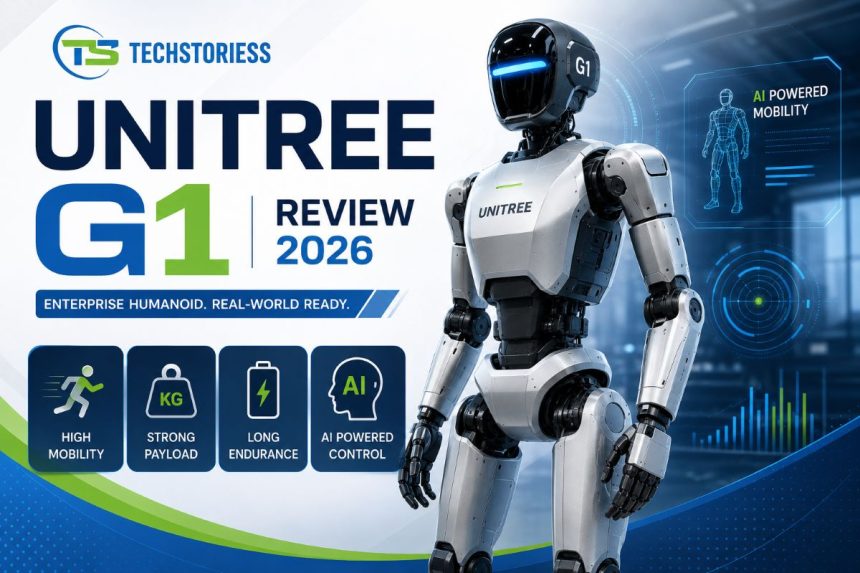
TL;DR
The Unitree G1 is a commercially available bipedal humanoid robot starting at $13,500 for a non-programmable demo unit, or $43,900–$73,900 for the EDU research configurations that actually unlock SDK access. It’s a strong fit for robotics research, AI development, and demonstration work in 2026 — not for unsupervised factory labor. Battery life is a real 2 hours, not the 5–10 hours some marketing implies, and buyers should be aware of an unresolved Bluetooth security flaw before connecting one to a network. Details below on Unitree G1 Enterprise Review
- TL;DR
- Introduction
- What Is the Unitree G1?
- Verified Specifications
- Design and Hardware
- Battery, Power, and Maintenance
- Security: The Consideration Most Reviews Skip
- Real-World Deployments (2026)
- Pricing: What You’re Actually Paying
- How the Unitree G1 Enterprise Review Compares to Tesla Optimus
- How to Evaluate the G1 for Your Organization
- Pros and Cons
- Who Should Buy the Unitree G1
- Conclusion
- FAQs
Introduction
Humanoid robots spent decades as a film trope and a lab curiosity. The Unitree G1 is one of the first to leave the lab on commercial terms — a bipedal, dexterous, sensor-equipped platform that ships today for a fraction of what earlier humanoids cost.
Enterprises are watching closely. Automation buyers who’ve maxed out what fixed industrial arms can do are now asking whether a mobile, human-scale robot can work in warehouses, labs, classrooms, and demo floors. This review evaluates whether the G1 delivers real business value in 2026 or remains, for most buyers, an impressive but limited research tool — covering verified specifications, real-world deployments, pricing, security posture, and who should (and shouldn’t) buy one.
What Is the Unitree G1?
The G1 is a bipedal humanoid robot built by Hangzhou-based Unitree Robotics, first launched in May 2024. It walks, balances, and manipulates objects using an articulated body and three-fingered dexterous hands, with onboard AI compute for perception and control.
A quick definition: in robotics, “degrees of freedom” (DOF) means the number of independent ways a joint or system can move. A human arm has roughly 7 DOF; the G1’s EDU hand alone has up to 7 DOF per hand, on top of the body’s 23–43 total DOF depending on configuration. More DOF generally means more natural, human-like movement — and more that can go wrong mechanically.
Unlike a fixed industrial robotic arm bolted to a factory floor, the G1 is a free-standing, mobile platform — it walks itself into position rather than having parts brought to it. That mobility, combined with onboard sensing and manipulation, is the core of its enterprise pitch: one platform that can navigate a space and then do something once it gets there.
Key capabilities (varies by configuration)
- Bipedal walking, running, and dynamic balance recovery
- 23–43 degrees of freedom depending on tier
- AI-powered 3D perception (LiDAR + depth camera)
- Three-fingered dexterous hands with force-position hybrid control
- Voice interaction and remote-control modes
- Developer SDK access (Python, C++, ROS 2) — EDU tier only
Verified Specifications
The G1 isn’t one product — it’s a line spanning a non-programmable demo unit through full research platforms. The table below reflects manufacturer-published specs and cross-checked third-party sources as of mid-2026.
| Spec | Value | Source |
|---|---|---|
| Height | ~1.27–1.32 m (varies by config) | Unitree official, New Atlas |
| Weight | ~35 kg | Unitree official |
| Degrees of freedom | 23 (Standard) up to 43 (EDU Ultimate) | RBTX |
| Walking speed | ~2 m/s nominal | RobotsGuide |
| Peak knee torque | 90 N·m (Standard) / 120 N·m (EDU) | CnEVPost, RobotsGuide |
| Arm payload | ~2 kg (Standard) / ~3 kg (EDU) | RobotsGuide |
| Battery | 9,000 mAh, hot-swappable | RBTX |
| Real-world runtime | ~2 hours of active use — not the 5–10 hr standby figure seen in some marketing | ZMProbots |
| Compute | 8-core CPU; optional NVIDIA Jetson Orin (~100 TOPS) on EDU | RBTX |
| Sensors | 3D LiDAR, depth camera, IMU, joint encoders | RobotsGuide |
| IP rating | None published — indoor use only | ZMProbots |
Note on the torque figures: you’ll see 88–139 N·m quoted in some older reviews and promotional recaps. Multiple independent sources converge on 90 N·m (Standard) and 120 N·m (EDU) at the knee joint, which is what we’ve used above. If a spec sheet you’re reviewing shows different numbers, ask the reseller which configuration they’re quoting from — the spread across 16 SKUs is the single biggest source of confusion in G1 coverage.
That 120 N·m EDU torque figure is why the G1 can handle stairs, uneven ground, and running gaits despite its compact size. In February 2026, Unitree took that a step further: a G1 completed a fully autonomous walk of more than 130,000 steps across a snowfield in China’s Altay region at temperatures down to −47.4°C, tracing a 186 m × 100 m Winter Olympics emblem using BeiDou satellite navigation (CnEVPost, eWeek). The robot wore custom insulation for the test — its published IP rating is still “indoor use only” — but the demo shows the mechanical ceiling is higher than the default use case suggests.
Design and Hardware
Form Factor and Mobility
At roughly 1.3 m tall and 35 kg, the G1 folds down to about 0.69 m for transport (RoboStore) — small enough to move between a lab, a conference booth, and a client site without a freight crate. Higher-tier EDU models add DOF at the wrist and waist on top of the base leg and arm joints, enabling squats, rotational movement, and human-like gestures.
Hands and Manipulation
The G1’s standout hardware feature is its three-fingered dexterous hand, using hybrid force-and-position control rather than a simple open/close gripper. EDU configurations extend this to up to 7 DOF per hand plus wrist articulation. In practice, this supports small-object manipulation, delicate handling, and human-like gesture — not heavy-duty lifting. Arm payload tops out around 2–3 kg per hand, which is enough for pick-and-place research and light demonstration work, not production-line loads.
Compute and AI
The base 8-core CPU handles control and perception. EDU tiers add an NVIDIA Jetson Orin module delivering roughly 100 TOPS, enough to run vision models and reinforcement- or imitation-learning policies onboard rather than depending on a cloud connection. (One correction worth flagging: some G1 coverage cites a 275 TOPS figure — that number belongs to a different chip class and doesn’t apply to the G1’s Orin NX module (ZMProbots).)
Battery, Power, and Maintenance
Real-world runtime is about 2 hours under normal load from a 9,000 mAh battery — a figure Unitree’s own marketing has sometimes blurred by citing longer standby windows rather than active-use time. The battery is hot-swappable, so teams running longer sessions typically keep a second charged pack on hand rather than waiting out a full charge cycle.
Treat the G1 as lab-grade equipment, not a plug-and-play appliance: budget for routine joint and sensor inspection, firmware updates, and a trained operator, not casual use by untrained staff.
Security: The Consideration Most Reviews Skip
Any enterprise evaluating a networked robot should look past the spec sheet at its security posture — and the G1’s history here is a real factor in a purchasing decision, not a footnote.
In September 2025, independent researchers disclosed UniPwn, a wormable exploit affecting the G1, H1, Go2, and B2 platforms. The flaw sits in the robot’s Bluetooth Low Energy Wi-Fi setup process: hardcoded encryption keys and a trivial authentication bypass let an attacker within Bluetooth range gain root-level control — and an infected robot can automatically compromise other Unitree robots nearby, forming what researchers described as a robot botnet (Hackaday, Interesting Engineering). Unitree acknowledged the issue publicly and said it had begun rolling out fixes; independent researchers tracking the issue had not confirmed a full resolution as of the most recent reporting available at the time of writing.
Practical takeaway for buyers: disable Bluetooth when it’s not actively needed for setup, keep G1 units on an isolated network segment separate from sensitive systems, and confirm firmware version and available patches before deployment — standard practice for any new networked robotics platform, and non-negotiable here given the wormable nature of the flaw.
Separately, a May 2025 U.S. congressional review examined Unitree’s corporate ties as part of broader scrutiny of Chinese robotics suppliers (TechTimes). No purchasing restrictions had been confirmed as of the most recent reporting, but organizations in regulated sectors — government, defense-adjacent, critical infrastructure — should track this before committing budget, not after.
Real-World Deployments (2026)
The strongest evidence the G1 works outside a demo booth comes from live pilots already underway:
- Japan Airlines / Haneda Airport: From May 2026, JAL and integrator GMO AI & Robotics began a multi-year trial (running through 2028) using G1 units for baggage and cargo handling and cabin cleaning on the tarmac at Haneda — one of the world’s busiest airports at 60+ million passengers a year. Human supervisors retain control over safety-critical functions (Interesting Engineering, New Atlas).
- Research and education: Universities and corporate labs use EDU configurations for locomotion, whole-body control, manipulation research, and embodied-AI experimentation — the platform’s most mature use case today.
- Facility services and public-sector pilots: Additional deployments in facility cleaning and early law-enforcement trials have been reported, generally as supervised pilots rather than autonomous, unsupervised operation.
The pattern across every live deployment is the same: humans stay in the loop for safety-critical decisions. That’s consistent with what the hardware supports — a capable pilot platform, not yet a drop-in worker.
Pricing: What You’re Actually Paying
This is where G1 coverage gets confused, because “Unitree G1” spans a $13,500 demo unit and a $73,900 research platform that share a name and little else.
| Tier | Price (verified, 2026) | What you get |
|---|---|---|
| G1 Basic | $13,500 official (manufacturer-verified, checked July 2026); street price often $16,000–$21,600 with import/warranty | 23 DOF, locked joint limits, no SDK, not programmable — demo/display only |
| G1 EDU Standard | ~$43,900 | Full Python/C++/ROS 2 SDK, Jetson Orin compute — the real entry point for research |
| G1 EDU Pro | ~$51,900–$56,900 | Expanded DOF, dexterous hands |
| G1 EDU Ultimate | ~$63,900–$73,900 | Up to 43 DOF, 7-DOF dexterous hands, maximum compute |
Sources: BotInfo, theresarobotforthat.com (official price checked against Unitree’s site July 14, 2026).
The decision that actually matters: if your use case involves any programming, simulation, or model deployment, your real entry point is the ~$43,900 EDU Standard tier, not the $13,500–$16,000 Basic price that gets quoted in headlines. The Basic model cannot be programmed at all.
Budget beyond hardware for: spare batteries, shipping and import duties, extended warranty, developer time, and operator training. Total cost of ownership still lands well below most legacy industrial humanoids — but “$16K humanoid robot” undersells what a working research deployment actually costs.
How the Unitree G1 Enterprise Review Compares to Tesla Optimus
This comparison gets asked constantly, and the honest 2026 answer is that the two aren’t really competing for the same purchase decision yet:
| Unitree G1 | Tesla Optimus | |
|---|---|---|
| Can you buy one today? | Yes — ships now | No — internal Tesla deployment only as of mid-2026 |
| Price | $13,500–$73,900, available now | No public sale price; long-term consumer target $20,000–$30,000; first B2B customers targeted late 2026 at an estimated $100,000+ |
| Current status | Commercially shipping since May 2024 | ~1,000 units deployed internally at Tesla factories for R&D and data collection |
Sources: RoboticsCenter.ai, theresarobotforthat.com.
For teams that need a humanoid platform this year, the G1 wins by default — it’s the only one of the two you can actually order. Optimus may eventually compete on manufacturing scale and price at volume, but that’s a 2027+ conversation, not a 2026 purchasing decision.
How to Evaluate the G1 for Your Organization
- Define the job first. Research/prototyping, demonstration, or early industrial pilot are the three viable 2026 use cases — pick one before pricing anything.
- Match the tier to the job. If the job requires any custom code, simulation, or AI model work, start your budget at EDU Standard (~$43,900), not Basic.
- Price the full deployment, not the sticker. Add spare batteries, import/duties, warranty, and engineering time to the base hardware cost.
- Assess your security posture before day one. Plan for network isolation and Bluetooth lockdown given the unresolved UniPwn exploit, and check current firmware guidance from Unitree.
- Pilot before you scale. Every credible G1 deployment in 2026 — including Japan Airlines’ — runs as a supervised, multi-year pilot with humans retaining control of safety-critical functions. Plan yours the same way.
Pros and Cons
Advantages
- Lowest-cost commercially available humanoid platform on the market today
- Genuine SDK access and AI compute headroom on EDU tiers
- High DOF and dexterous hands support real manipulation research
- Compact and foldable — easy to transport between sites
- Already proven in a live, multi-year commercial pilot (Japan Airlines/Haneda)
Limitations
- Basic tier is a non-programmable demo unit — the “real” G1 starts around $43,900
- ~2-hour real-world battery life requires spare packs for extended sessions
- 2–3 kg per-arm payload rules out heavy-duty industrial work
- Unresolved Bluetooth vulnerability (UniPwn) requires active network mitigation
- No published IP rating — indoor use only unless custom-weatherproofed
- Requires in-house robotics/engineering expertise to extract any value
Who Should Buy the Unitree G1
Good fit: robotics research labs, universities, AI/embodied-AI development teams, corporate innovation centers, and organizations running supervised industrial pilots (following the Haneda model) with in-house technical staff.
Poor fit: businesses expecting immediate, unsupervised labor replacement; organizations without robotics or AI engineering capacity; buyers in regulated sectors who haven’t yet cleared the procurement/security review this platform currently warrants.
Conclusion
The Unitree G1 is a genuine milestone — the first humanoid robot most organizations can actually buy and start developing on this year, at a price that doesn’t require board approval. It is not, in 2026, a factory worker you unbox and deploy. The Japan Airlines pilot shows what serious enterprise adoption actually looks like: multi-year, human-supervised, and narrowly scoped — not a robot replacing a shift on day one.
For research teams, universities, and enterprises building internal robotics capability, the G1 is a legitimate, well-priced platform to start on now. For anyone expecting a production-ready employee, the honest answer is: not yet, and the security and procurement questions above are worth resolving before the purchase order, not after.
FAQs
How much does the Unitree G1 actually cost in 2026?
The official base price is $13,500 for the non-programmable Basic unit (street price often $16,000–$21,600 with import and warranty costs). EDU research configurations with full SDK access run $43,900–$73,900 depending on tier.
What’s the real difference between G1 Basic and EDU?
Basic is a locked demo unit with no SDK access — it cannot be programmed. EDU unlocks Python/C++/ROS 2 development, NVIDIA Jetson Orin compute, and (on higher tiers) dexterous hands with up to 43 total degrees of freedom.
Can the G1 work in real factories or warehouses today?
In supervised pilots, yes — Japan Airlines is running a multi-year G1 trial for baggage and cargo handling at Haneda Airport starting May 2026. It’s not yet suited to unsupervised, 24/7 production work; battery life and payload limits keep current deployments in a human-supervised pilot mode.
How does the G1 compare to Tesla Optimus for businesses?
Optimus isn’t commercially available as of mid-2026 — Tesla is running roughly 1,000 units internally for R&D. The G1 wins by default for any business that needs a humanoid platform this year, since it’s the only one you can actually purchase.
Is the Unitree G1 secure enough for enterprise deployment?
Approach with caution. A wormable Bluetooth exploit (UniPwn) disclosed in September 2025 allows root-level takeover within wireless range; independent researchers had not confirmed a full fix as of the most recent reporting. Isolate the robot’s network and disable Bluetooth when not needed for setup.
Are there export or procurement restrictions to know about?
A May 2025 U.S. congressional review examined Unitree’s corporate ties as part of broader scrutiny of Chinese robotics suppliers. No purchasing restrictions were confirmed as of the most recent reporting, but regulated-sector buyers should monitor this before committing budget.