


Once a part of science fiction, humanoid robots are fast making their way to factory floors, lifting car parts, navigating cluttered assembly lines, and can even autonomously swap their own battery pack before returning to work. For decades, roboticists have been predicting that this moment has quietly arrived. Though still in its nascent stage and far from expected perfection, it promises a fundamental shift in industrial automation.
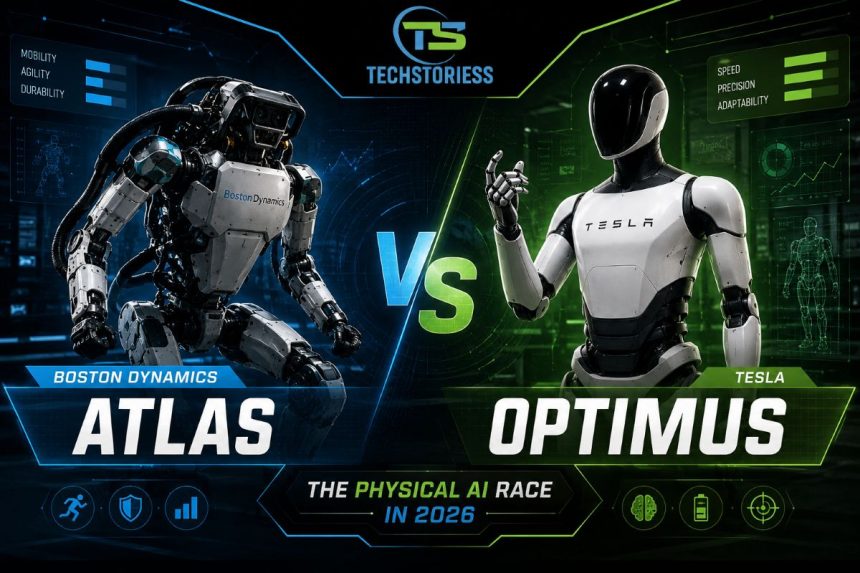
However, there is a vast radical difference between humanoid robots in terms of capabilities and utility value. For instance, a robot that can efficiently perform multiple backflips in a controlled lab cannot be compared to one that can deliver a phenomenal production uptime rate to justify its six-figure price tag. In 2026, this narrative is dominated by two prominent models: Boston Dynamics’ Atlas and Tesla’s Optimus. Then there is Figure 02 by Figure AI, which is steadily earning its way to commercial relevance.
Instead of a superficial comparison, this is an engineering and strategic analysis of the winning approach to physical AI, and its possible impacts on industries betting on these machines.
The Philosophical Divide: Capability vs. Scale
Before diving directly into hardware, let us start by understanding why these robots look so different in their approach. Their divergence is not just stylistic but deliberately strategic.
Originally backed by DARPA funding, Boston Dynamics spent over three decades focused on a single challenge – how to make machines move efficiently. Atlas has a number of viral videos performing remarkable stunts: parkour, sticking backflips, and navigating rough terrain. More than a marketing exercise, it was data collection demonstrating what bipedal locomotion could theoretically achieve. The hydraulic Atlas introduced in the late 2010s was a rolling research laboratory. Compared to that, the fully electric Atlas debuted at CES 2026 is the product of over 13 years of that data being industrialized.
Tesla, on the other side, took the opposite approach. In 2021 on AI Day, Elon Musk announced Optimus – infamously represented by a human in a robot costume. From day one, he positioned it more as a mass-production problem than a research problem. The logic was Musk-ian in its ambition: Tesla already had a vast, well-scaled assembly line that now builds over 1.8 million vehicles per year. It has all the prerequisites – supply chains, actuator manufacturing, battery expertise, and neural network training infrastructure. The robot is just another product eventually coming off that line.
That “eventually” is where the story gets complicated.
Boston Dynamics Atlas: The Engineer’s Robot
Boston Dynamics has built impressive capabilities over recent years making it an ideal choice for engineering enterprises looking for sophisticated models.
Going Fully Electric Was a Turning Point
Boston Dynamics retired its hydraulic Atlas in April 2024 and committed entirely to an electric platform – a significant engineering decision. Hydraulic systems deliver exceptional force density – the old Atlas could perform feats that are beyond the capabilities of electric actuators – but they are loud, prone to fluid leaks, require intensive maintenance, and are fundamentally incompatible with clean industrial environments.
The new electric Atlas leverages custom Hyundai Mobis actuators and offers 56 degrees of freedom, giving it a motion range that not only matches but deliberately exceeds the constraints of the human body. It can rotate its waist and head joints to a full 360 degrees – moving “beyond human limits” as described by Boston Dynamics – rather than mimicking them. The production version launched at CES 2026 is capable of lifting 50 kilograms, stands 7.5 feet tall, and operates in temperatures from -20°C to 40°C. Being dustproof and waterproof as certified by its IP67 rating, it is engineered for the realities of industrial deployment. In industrial environments where coolant, metal shavings, and humidity are routine, this capability is crucial.
Autonomous Battery Swap
The autonomous battery swap is perhaps its most operationally significant feature. Atlas can reach a charging station under its own power, replace its own battery pack, and return to the task without requiring any human intervention. In continuous manufacturing operations, this is not merely a feature – it is a fundamental operational advantage that directly impacts uptime economics.
AI Partnership With Google DeepMind
Boston Dynamics partnered with Google DeepMind to develop Atlas’s intelligence layer. Integrating Gemini Robotics foundation models into its control systems enables fleet-wide learning. It promises to offer immense benefit – still under validation – but the architecture is consequential: once a single Atlas unit learns a new assembly task, that skill is propagated across the entire fleet through Boston Dynamics’ Orbit™ software platform. To ensure a safe hybrid working environment, the robot is equipped with 360-degree vision to detect human workers and pause operations before a person enters its hazard zone. This supports compliance requirements from regulators and insurance carriers across industrial sectors.
Alongside DeepMind, Atlas also partnered with Toyota Research Institute – pointing to a well-calculated strategy to gain first-mover advantage by embedding the robot in the most demanding manufacturing ecosystems across the globe. At scale, it will position itself to outpace the competition and establish a near-monopoly position in the premium industrial humanoid market.
The BMW and Hyundai Deployments
Until recently, these capabilities were largely theoretical, but in 2026 what actually matters is real-world deployment – and here Atlas has verifiable numbers. In BMW factory trials, Atlas demonstrated it is a capable industrial platform for tasks involving car part sequencing and component handling. Hyundai – the outright 100% owner of Boston Dynamics – has committed to deploying Atlas at its Robot Metaplant Application Center (HMGMA) and is planning to scale to tens of thousands of units every year. Hyundai’s massive $26 billion U.S. manufacturing investment includes a robotics factory with capacity for 30,000 robots per year, with a substantial portion expected to be Atlas units.
Hyundai represents a vertical integration advantage that is difficult to overstate. It is simultaneously the customer, the parent company, the actuator supplier, and the manufacturing investor. Such structural alignment cannot be matched by any competitor.
The Price Problem
Priced at approximately $420,000, Atlas is prohibitively expensive for most buyers. Enterprise investment at this scale is justifiable for a Fortune 500 automotive manufacturer with global presence and an extensive workforce – the calculus works when they calculate labor costs across thousands of shifts. But it does not work for a mid-market logistics company or a Tier 2 supplier with limited footprint, a fractional workforce, and fewer shifts.
Tesla Optimus: The Manufacturer’s Bet
Tesla Optimus is fast equopping itself with advanced, purpose-specific capabilities to gain prominence as the go to choice for manufacturing industry.
The Scale Argument Is Real – But Still Theoretical
Tesla’s Optimus thesis has always centered on manufacturing scale. Its Gigafactories span four continents, with the company constantly manufacturing vehicles. Over years, Tesla has built a strong supply chain for brushless electric motors, battery packs, and power electronics directly applicable to humanoid robot actuation. It targets price competition with Atlas through its vision to price Optimus in the range of $20,000–$30,000 per unit – roughly one-fifth the cost of Atlas. When achieved, it would begin attracting significant orders from the industry, not only expanding its customer base but also creating recurring service and software revenue opportunities.
The walking speed of Optimus Gen 2 is 5 mph (8 km/h), significantly faster than Atlas’s operational gait. At approximately 57 kilograms, it is much lighter than most competitors. Its tendon-driven hand system has 50 actuators and, based on its demonstrated flexibility, represents some of the most mechanically elegant robotic hand engineering in the industry. As opposed to the extreme strength targets of Atlas, Optimus’s design philosophy focuses on energy efficiency and long operating cycles, making it better suited for sustained, repetitive workflows.
Tesla’s Full Self-Driving (FSD) neural network program has produced an asset that simply cannot be replicated by pure-play robotics companies: billions of miles of real-world visual training data. The perception systems, edge-case handling, and real-time decision-making architectures powering FSD meaningfully translate to Optimus’s navigation and object recognition capabilities.
The Deployment Gap Is Widening
One truth that cannot be avoided in honest reporting is this: as of Q1 2026, Tesla confirmed that its Optimus units in its factories are still in an “R&D and learning phase” and have not begun performing productive autonomous work. Milan Kovac, the program lead heading Optimus since 2022, resigned in June 2025, with Ashok Elluswamy, the head of Tesla Autopilot, assuming that position. The company failed to meet its earlier production target of 5,000–10,000 units for 2025.
Almost all fully autonomous public demonstrations of Optimus have been accompanied by subsequent controversy about the degree of remote human control involved. The CES 2026 demonstration of Atlas, by contrast, was openly remote-operated – but Boston Dynamics explicitly stated its commercial version is engineered for full autonomy. That transparency about current capabilities builds more trust than unverified claims of readiness.
By 2030, Tesla targets one million Optimus units per year – an enormous figure that, if achieved, would represent the single largest physical AI deployment in history. The company already has the manufacturing credibility to make that scale plausible. However, it still needs to demonstrate sufficient robotic autonomy to justify that timeline.
Boston Dynamics Atlas vs Tesla Optimus : Head-to-Head Benchmarks
Here are the key benchmarks that prospective clients must seriously consider to inform their decision:
Physical Capability
On raw physical specifications, Atlas leads. Its 56 DoF, 50 kg payload, waterproofing, and extreme temperature tolerance are unmatched among current production units. Its 360-degree joint rotation at the waist offers manipulation geometries that cannot be replicated by Optimus or Figure 02.
AI and Autonomy
Both platforms have made substantial AI partnership decisions in the past 18 months:
- Atlas integrated Google DeepMind’s Gemini Robotics foundation models, with fleet-wide skill propagation via Orbit software
- Optimus leverages Tesla’s FSD neural network training infrastructure and camera-based perception systems
The honest assessment: Atlas has secured the most technically prestigious AI partnership. Optimus claims the largest proprietary training data pipeline.
Commercial Readiness
This is where the comparison is most consequential. As of May 2026:
- Atlas is already in production, shipping to commercial partners including Hyundai and Google DeepMind, with additional enterprise customers planned for 2027
- Optimus remains in an R&D phase without any verified autonomous production deployments
This represents a categorical gap between Atlas and Optimus on commercial readiness in 2026.
Price and Accessibility
- Tesla Optimus: $20,000–$30,000 (long-term manufacturing cost target, not current price)
- Boston Dynamics Atlas: ~$420,000 (enterprise deployment pricing)
Tesla’s price target is highly aspirational and should not be treated as a current specification. At current volumes, the Gen 3 hands alone are estimated to cost $30,000–$80,000 to manufacture. The $20K figure requires a volume of production that simply does not yet exist.
The Physical AI Paradigm: Why This Race Matters
The term “physical AI” – embodied intelligence that perceives, decides, and acts in the physical world – is becoming the organizing concept for the next generation of industrial automation. The machines discussed here are not arms on a fixed rail performing a pre-programmed motion. They are agents that can, in theory, receive a general instruction and figure out the motor control to execute it.
What makes 2026 genuinely different from every previous year of humanoid robotics hype is that the AI piece is no longer the bottleneck it once was. Foundation models trained on massive datasets – whether DeepMind’s Gemini Robotics, Tesla’s FSD network, or Figure’s Helix VLA – can now generate motor policies for tasks they were not explicitly trained on. The hardware has also crossed a threshold: electric actuation, roller screw joints, and modern sensor arrays are capable enough that the question has shifted from “can the robot move?” to “can the robot learn fast enough to justify deployment?”
The answer, in constrained industrial environments with well-defined tasks and minimal dynamic variation, is increasingly yes.
Who Should Buy What: A Practical Guide for 2026
For the clients the thing that matters most is the relevance. So here are some suggestions to determine the relevance of each model for enterprises:
For a Tier 1 automotive or aerospace manufacturer:
Atlas is the clear choice. The IP67 rating, -20°C to 40°C operating range, 50 kg payload, autonomous battery swap, and DeepMind AI integration are engineered for exactly such environments. While the $420K price may give pause, the 30-year deployment pedigree and Hyundai manufacturing backing justify the investment for operations at sufficient scale.
For enterprises planning automation at scale who can wait 24–36 months:
Watch Optimus closely. Tesla’s two unmatched assets are manufacturing infrastructure and the FSD data pipeline. It has enough engineering depth to close the autonomy gap. Once mass production begins, Optimus could achieve lower pricing, making it the most affordable platform in the category.
For enterprises evaluating long-term strategy
Avoid betting on a single platform. The robots that dominate the 2030s will likely be the ones that established deployment relationships, built maintenance contracts, and accumulated real-world task data in 2026 and 2027. The best way to move forward is to deploy one unit in a controlled facility and start learning.
Conclusion
From pure technical capability in 2026, Atlas has emerged as the winner. Equipped with 56 degrees of freedom, an IP67 rating, superhuman joint geometry, autonomous battery swap, and Google DeepMind AI integration, it represents the most complete industrial humanoid platform currently available.
On commercial readiness for the broadest market, both Atlas and Optimus remain inaccessible to most buyers – each for different reasons. Atlas is priced for a narrow enterprise tier. Optimus is not yet commercially deployed. The industrial humanoid market in 2026 is real, but it remains early – and the companies that invest in understanding these platforms today will be best positioned when the economics shift.