


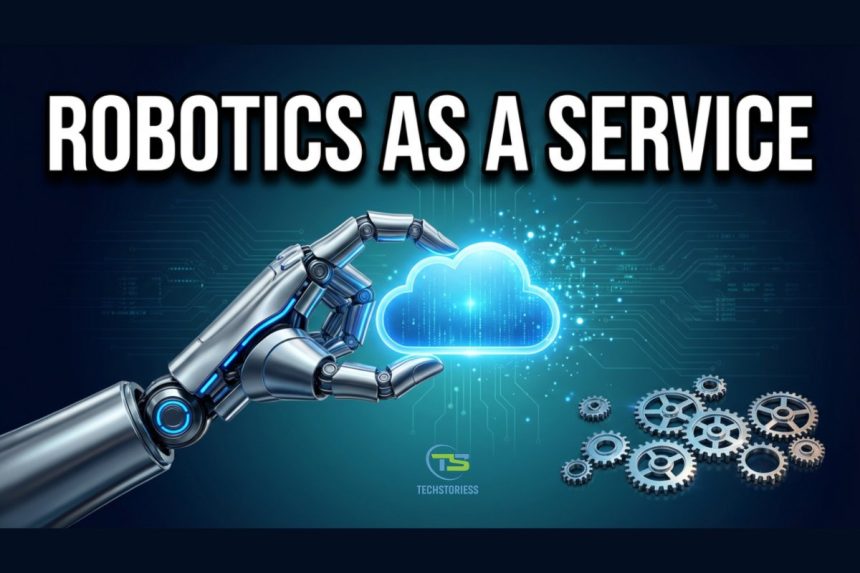
Robotics as a Service (RaaS) is redefining the way global businesses adopt and operationalize robotic technology. Through this subscription-based service, enterprises can lease robotic systems while accessing cloud-based platforms for centralized management, maintenance, and performance analytics. Along with allowing large companies to rapidly scale automation across operations, RaaS also empowers startups and SMEs to experiment, deploy, and grow without heavy financial or technical barriers. In this capacity, RaaS plays a vital role in democratizing industrial automation and robotics adoption.
What is Robotics as a Service (RaaS)?
The Robotics as a Service (RaaS) model refers to a comprehensive business and technology framework that delivers robotic capabilities through a subscription-based model. RaaS includes the entire automation stack needed to deploy and operate robotic solutions, including hardware, software, and ongoing services required to ensure continuous performance and optimization. All these services are provided at a single fee based on usage or service-level agreements. Along with reducing costs, it also relieves businesses from complex operational challenges such as integration, installation, obsolescence, and lifecycle management, allowing them to focus on core business operations.
The Scale and Speed of RaaS Adoption
From a market standpoint, the global RaaS market is projected to expand from USD 1.79 billion in 2024 to approximately USD 6.22 billion by 2032, representing an absolute increase of nearly USD 4.43 billion over the period. This growth reflects an overall market expansion of about 247%, or a 3.5× increase compared to 2024 levels. On a year-over-year basis, this trajectory implies a compound annual growth rate (CAGR) of roughly 16–17%, substantially higher than the historical growth rates of traditional industrial robotics markets. Together, these figures highlight a strong and sustained shift toward service-based, consumption-driven automation models.
Where RaaS Creates the Strongest Operational Impact
RaaS can significantly impact industries with highly volatile demands and seasonal or fluctuating workloads, such as e-commerce fulfillment, logistics, and warehousing. Due to its usage-based cost structure, RaaS allows these businesses to dynamically scale their robotic capabilities up or down based on real-time demand and operational intensity.
Beyond these sectors, industries that require precision and repeatability such as manufacturing, healthcare, and agriculture also stand to benefit, as RaaS lowers adoption barriers and accelerates automation-driven efficiency across diverse operational environments.
Major Benefits of RaaS
The real value of Robotics as a Service lies in the way it translates into day-to-day business benefits. At its core, RaaS reframes robotics as a flexible, service-driven capability that adapts to the evolving operational needs of modern enterprises. It enables organizations to respond quickly to changing market conditions, manage operational and financial risks more effectively, and gain measurable value from automation at every stage of adoption.
Cost Efficiency: Reduced Upfront Costs, Enhanced Flexibility
Due to the huge capital investment required, conventional robotics often remains out of reach for startups and small and medium-sized enterprises (SMEs). RaaS helps them overcome this challenge by offering an affordable subscription-based or PAYG (pay-as-you-go) model. It turns capital expenditure into operational expenses, thus allowing small businesses to adopt automation without large upfront investments.
By implementing a RaaS model, businesses can leverage robotic capabilities to automate workflows while preserving capital reserves that can be channelled into core business growth and innovation initiatives.
Scalability to Adapt to Changing Demands
In industries like logistics, manufacturing, or retail, fluctuating workloads often demand flexible automation solutions that can scale up or down seamlessly. RaaS models enable businesses to scale the number of robots in use in alignment with demand, without straining or overcommitting budgets.
Always Access the Latest Technology
With rapidly evolving technology, equipment and applications can quickly become obsolete. RaaS helps businesses overcome this challenge by periodically updating hardware and software through cloud-based systems, ensuring continuous access to the latest capabilities and performance improvements.
Accelerated Deployment and Faster ROI
The time required for robotic adoption often extends due to lengthy exploration and approval cycles, complex installation requirements, and integration challenges. RaaS speeds up this process by providing streamlined, plug-and-play solutions that can be deployed quickly, shortening implementation timelines and enabling faster returns on investment.
Risk Mitigation with Outsourced Maintenance and Support
Maintaining sophisticated robotic systems is often too expensive and complex to manage in-house. The RaaS model lowers this barrier by offering managed solutions where the vendor handles updates, repairs, and troubleshooting. This relieves businesses from technical burdens while ensuring high uptime, optimal performance, and predictable operating costs.
Empowering Innovation
RaaS empowers businesses to implement robotics without long-term ownership or capital lock-in. Organizations can choose from multiple subscription models, evaluate performance metrics, and explore innovative use cases with limited financial risk.
Typical RaaS Deployment Model
Robotics as a Service is generally deployed through a structured, outcome-driven approach designed to minimize risk while creating measurable business value. RaaS providers work closely with organizations to evaluate processes, validate performance through pilots, and align expectations using clearly defined metrics.
Operational analysis involves evaluating daily workflows and reviewing cycle times, material flows, error rates, ergonomics, throughput levels, and safety conditions.
Pilot tests are designed as targeted and quantifiable deployments with defined timelines and scope.
KPI monitoring focuses on performance indicators such as uptime, throughput, cycle time reduction, and error rates.
Once targets are met, both parties enter a formal subscription governed by a Service Level Agreement defining responsibilities and KPIs.
Integration Models
Depending on use cases and operational requirements, organizations can choose from several RaaS integration models.
Subscription-Based RaaS Integration Model
RaaS is delivered through a recurring subscription that allows businesses to rent robots rather than own them outright. Pricing is fixed and predictable, while vendors manage deployment, updates, and lifecycle operations. This model is widely used in logistics, manufacturing, healthcare, and hospitality where workloads are stable.
Usage-Based / Pay-Per-Use RaaS Model
In this model, clients pay only for the robotic services consumed. Billing is based on metrics such as hours operated, tasks completed, or physical area covered. Telemetry and analytics track real-time usage, making this model ideal for seasonal or demand-variable environments like agriculture and fulfillment centers.
Outcome-Based RaaS Integration Model
Outcome-based RaaS ties payments to business results such as throughput improvements or fulfilled orders. Fees fluctuate based on achieved performance, aligning incentives between provider and client. This model works best in mature operations with clearly defined KPIs.
Hybrid RaaS Integration Models
Hybrid models combine subscription, usage-based, and outcome-based elements. Pricing may include base fees with performance incentives, supported by flexible APIs and mixed edge–cloud performance tracking. These models suit complex manufacturing and large-scale logistics environments.
Platform-Centric / API-First RaaS Models
Platform-centric RaaS delivers robotics as part of an API-driven ecosystem. Standardized APIs and event-driven architectures enable seamless integration with enterprise systems, supporting multi-vendor robot fleets and deep operational visibility.
Fully Managed “Black-Box” RaaS
In this hands-off model, providers manage the entire robotics lifecycle. Clients interact mainly through dashboards and outcome reports, making it ideal for organizations seeking automation benefits without building internal robotics expertise.
RaaS Pricing Models
RaaS pricing structures vary by vendor and use case. Fixed recurring fees typically cover hardware, maintenance, and support. Pay-per-use models are linked to measurable operational metrics such as operating hours or completed tasks. Hybrid models combine a base level of capacity with the flexibility to scale when needed.
Examples of Robot as a Service
RaaS solutions automate a wide range of tasks across industrial and logistics environments.
Storage and Internal Transport
RaaS supports autonomous mobile robots (AMRs) and automated storage and retrieval systems that handle load shuttling and pallet movement. Businesses can scale robot fleets to match site-specific requirements.
Assembly
Through RaaS, vendors deploy robotic assembly cells for tasks such as painting, sealing, and coating without large upfront investments, reducing long payback periods.
Quality Inspections
Robotic inspection systems perform frequent and consistent quality checks across multiple metrics such as dimensions and surface defects. RaaS enables rapid deployment and scaling as regulatory and compliance requirements evolve.
Palletizing
Palletizing robots stack and organize goods with precision, supported by conveyors, grippers, and control systems. RaaS makes these solutions accessible by bundling equipment with integration expertise.
Conclusion
RaaS will play a critical role in democratizing automation by making advanced robotics accessible through flexible, usage-based delivery models. It lowers cost barriers, reduces technical complexity, and minimizes long-term operational risk. Industries most impacted include manufacturing, logistics, e-commerce, healthcare, and agriculture.
To transform automation initiatives into sustainable competitive advantages, vendors must deliver reliable uptime, seamless integration, and transparent pricing. As a service-driven technology, the future success of RaaS lies in continuous innovation across robotics hardware, AI-driven orchestration, and cloud-based analytics. Ultimately, RaaS success is measured not by robotic capability alone, but by consistent and measurable business outcomes.