


The system of care is “under great stress”. Hospitals are seeing more severe patients and narrower clinical margins, while healthcare staff are burned out. Today’s medical needs are too demanding to be met by current diagnostic processes that rely on human stamina and paper charts.
- The Evolution of Diagnostic Intelligence in Hospitals
- The Current Landscape of FDA Approvals
- How Hospitals Deploy Clinical Decision Support AI: Step-by-Step
- Radiology AI Accuracy and Impact
- EHR AI Integration: Reducing Burnout and Improving Care
- AI for Sepsis Prediction and Critical Care
- Overcoming Barriers to Clinical AI Physician Adoption
- Real-World Examples of Hospital Deployments
- The Synergy of Human-AI Collaboration
- Conclusion
- FAQs
Doctors face a growing, increasingly complex body of data and a steady burden of imaging diagnostics, with consequences that become immediately apparent. This is the core problem
driving the rapid transformation of clinical workflows globally.
The solution has materialised as intelligent, integrated algorithms designed to augment
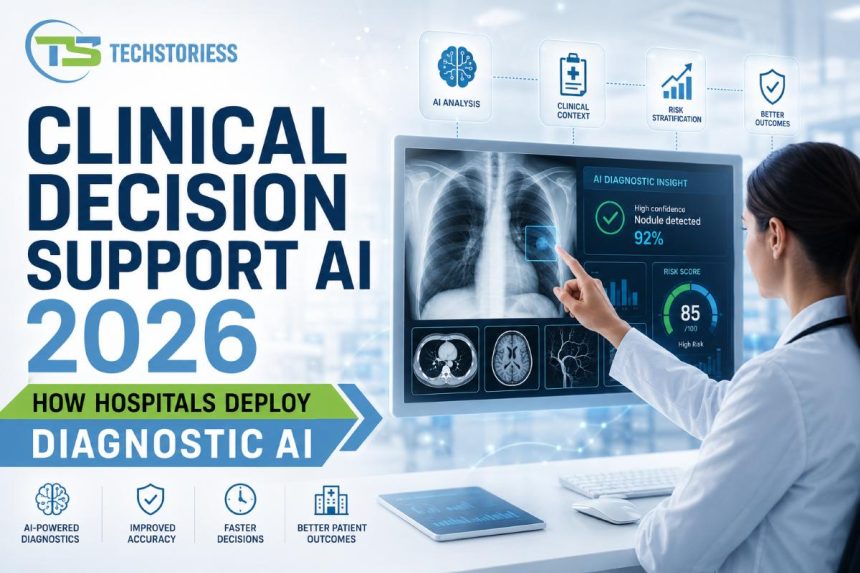
medical professionals at the point of care. The landscape of clinical decision support AI 2026
represents a fundamental shift in how hospitals operate.
These systems are not a substitute for physicians, but rather a constant cognitive net that can detect, read millions of data points, identify outliers, forecast deterioration, and more. They act in a timely, near-exhaustive manner, before it turns lethal.
Health systems can integrate predictive analytics directly into clinicians’ workflows to close the loop by translating medical data into actionable, lifesaving insights.
Today, in the technology landscape, deployment is no longer a future need but a core requirement for competitiveness. Hospitals are investing in these technologies not only to improve patient outcomes but also to reform the clinical work environment.
We will discuss the practical use of diagnostic intelligence in hospitals, the regulatory environment that affects these technologies, the financing of their integration, and the measurable clinical outcomes that serve as the benchmark for care today.
The Evolution of Diagnostic Intelligence in Hospitals
What is Clinical Decision Support AI?
Clinical decision support AI is an AI system that processes medical data such as patient records, lab results, vital signs, and images, and assists healthcare professionals with decision-making. In 2026, these tools will leverage advanced machine learning and multimodal models as well as real-time access to EHRs for actionable insights, in the context of the point of care.
Improve performance over rule-based systems. Their aim is unchanged: Futurismo helps doctors make better decisions more quickly.
Consider a busy emergency department where multiple patients await triage. A modern AI system passively monitors incoming lab results and vital signs in the background. If a patient’s delicate biomarker changes, then subtle changes will be detected, and the medical doctor on the ward will be alerted immediately.
This shift from reaction to prevention by AI is saving lives and transforming health systems’ practices around the globe.
The Current Landscape of FDA Approvals
An FDA-cleared AI medical device or algorithm that has undergone rigorous medical device review to ensure its safety and effectiveness, and to validate it prior to marketing. The clearances mean that the device is robustly capable of performing the diagnostic or predictive task without unnecessarily putting the patient at risk.
In the past several years, there have been significant strides in the regulatory landscape, with a strong framework to ensure safe implementation. Today, there are 700+ FDA-cleared AI/ML medical devices available across cardiology, neurology, oncology, and more.
Now that they have some of this certainty, hospital administrators can invest in enterprise-wide deployment strategies.Typically, AI governance committees are established when hospitals introduce FDA-cleared AI medical devices that assist doctors and patients in clinical decision-making.
These algorithms are carefully evaluated by committees composed of IT experts, clinicians, and legal experts to review the algorithms’ performance data, strategies for reducing bias, and their intended applications.
How Hospitals Deploy Clinical Decision Support AI: Step-by-Step
Successful deployment follows a structured path.
1. Assessment and Use Case Selection
The teams begin by determining the area to work with—such as emergency imaging or intensive care monitoring—that is most significant for the hospital. They then assess the level of data readiness, workflow fit and ROI potential.
2. Vendor Selection and FDA Compliance
Hospitals prioritise FDA-cleared AI medical devices with proven track records. They review clinical validation studies and integration capabilities with existing EHR systems.
3. Technical Integration
One of the many breakthroughs poised to transform EHR AI integration. Integrated connections enable real-time data integration and distribution of recommendations, supporting seamless workflows. This helps minimise friction and enhance usability.
4. Pilot Testing and Scaling
Initial rollouts target specific departments. Key metrics include accuracy, speed, and clinician feedback. Successful pilots then scale enterprise-wide.
5. Governance and Monitoring
In hospitals, drift and bias, along with outcomes, are constantly monitored, with humans involved in all stages of the process.
Radiology AI Accuracy and Impact
Radiology has seen the biggest gains from Clinical decision support AI 2026. AI tools excel at pattern recognition in complex images.
The Radiological Society of North America (2025) reported that AI radiology tools can detect lung nodules 94.5% of the time, whereas the average rate achieved by human radiologists was 88%.
In dermatology, it selects melanoma with 91% accuracy, compared to 86% for dermatologists on average (Stanford 2025). The importance of these differences is in screening and triage for tangible patient benefits.
AI cannot operate on its own. Harvard Medical School (2025) showed that a human-AI combined diagnosis is 8% superior to AI alone and 14% superior to a human-only diagnosis. This combination is the hybrid model.
EHR AI Integration: Reducing Burnout and Improving Care
EHR AI integration transforms administrative burdens. By summarising records, drafting notes, and capturing surface-level insights, the tools save a physician’s time.
A recent study cited by The New England Journal of Medicine (NEJM) found that in a NEJM 2025 longitudinal study, EHR AI integration cut by 23% the scores of physician burnout. This left clinicians with more time with patients and less time spent on documentation.
Ambient scribes and smart alerts integrate directly into Epic and other major systems. Many hospitals report saving 2-3 hours per physician daily.
AI for Sepsis Prediction and Critical Care
Sepsis continues to be a major death threat in hospitals. Clinical decision support AI 2026 is set to alter the game with its warning capabilities.
In hospitals with an intensive care unit (ICU) in 2025, AI sepsis prediction resulted in an 18% reduction in hospital mortality at UCSF Medical Centre. Analysis of vital signs, laboratory results, and medical history flags risks hours before traditional analysis.
At Johns Hopkins, among other hospitals, several systems have been utilised, with good results. This early intervention brings fewer problems and shorter hospitalisations.
Overcoming Barriers to Clinical AI Physician Adoption
There are challenges in adopting Clinical AI for physicians. The most common barriers for physicians, as cited in the AMA survey (2025), are those of Trust (61%). Successful programmes tackle these head-on with clear models, training, and iterative pilots to review performance.
Physicians want involvement in adoption decisions. When involved, acceptance rises significantly. Clear liability frameworks and post-market monitoring further build confidence.
Real-World Examples of Hospital Deployments
- Mayo Clinic and Cleveland Clinic: Partnership leaders in imaging and pathology need to be ready for AI.
- Advocate Health: Enables use of AI imaging for fractures, aneurysms and more, with benefits to thousands of patients per year.
- UCSF and UCSD: Produce prospective studies to evidence the role of sepsis AI at UCSF and UCSD.
A proper installation has a positive impact on productivity, accuracy and employee satisfaction, ademonstrated by these pioneers.
The Synergy of Human-AI Collaboration
Why Combined Diagnosis is the Future
The Human-AI combined diagnosis model is a collaboration between humans and AI, in which the AI system serves as an intelligent analytical instrument, while the human system brings clinical care awareness and empathy.
Using AI diagnostic tools in hospitals should not be to replace doctors, but to enhance care by giving them tools to collaborate. Machines excel at handling large volumes of information and identifying very fine patterns, but they do not interpret a patient’s values, social surroundings, or subtle bodily characteristics.
This is a partnership approach, and the data tell us it is the one we need to take to accomplish this. According to research, the combination of human and AI diagnosis is 8% superior to AI-only diagnosis and 14% superior to human diagnosis (Harvard Medical School 2025).
Conclusion
The AI era in clinical decision making will be a turning point for hospitals with the launch of Clinical Decision Support AI 2026. Whether they enhance radiology AI accuracy, enable predictions of life-threatening sepsis, or support seamless EHR AI integration, these tools prove invaluable when utilised wisely.
The most successful implementations combine powerful AI diagnostic tools in hospitals with strong human oversight. They cut down a physician’s burnout, enhance quality of care and enable the physician to concentrate on patient care.
Actionable Takeaways:
- Identify pain points in the current situation, and list one use case that is having a big impact.
- Choose AI medical device solutions approved by the FDA or that have proven integration.
- Engage physicians on the ground, but not so late or rarely.
- Carefully monitor clinical and operational indicators.
FAQs
1. What is clinical decision support AI 2026?
It includes sophisticated technologies using real-time patient information to guide diagnosis, risk assessment, and treatment in hospitals.
2. How accurate are AI diagnostic tools in hospitals, especially in radiology?
Lung Nod Incidents reports an average sensitivity of 94.5% for AI radiology tools (versus 88% for humans). When it comes to overall performance, it is best to combine humans with AI.
3. How many FDA-cleared AI medical devices exist?
Over 700 as of 2026, with radiology leading. These provide a safer entry point for hospital adoption.
4. Does EHR AI integration really reduce physician burnout?
Yes. Research indicates that 4 out of 5 burnout scores decreased by 23%, and that substantial time was saved in documentation.
5. What are the main barriers to Clinical AI physician adoption?
The top three are lack of explainability, integration challenges and trust issues—all rounding out to 61% of physicians. Transparent tools and clinician involvement help overcome them.
6. Can AI sepsis tools lower mortality rates?
Yes—reductions of around 18% in ICU settings through earlier detection and intervention.