


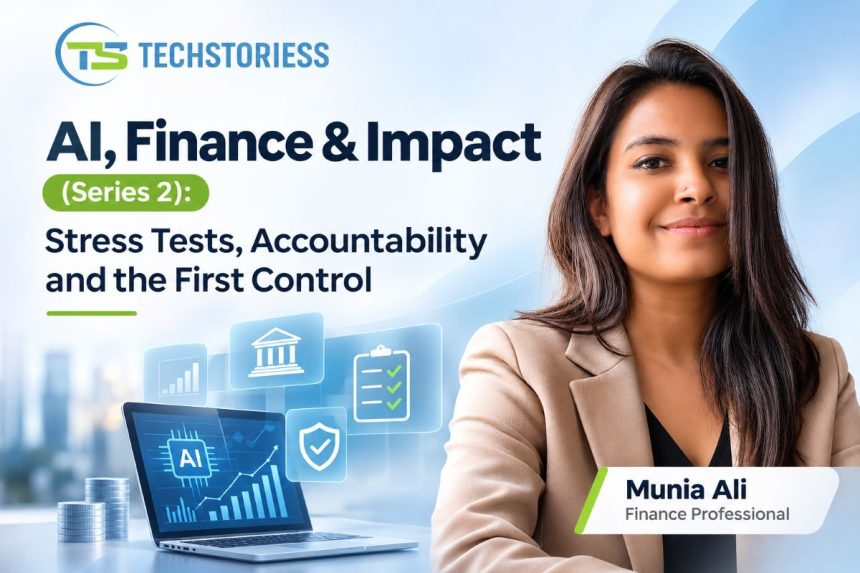
When Munia Ali first spoke to TechStoriess, she made a case that stayed with readers: finance systems fail not because people stop caring, but because nobody built them to survive pressure, and AI should assist compliance, never own it. Read Series 1 here. That raised an obvious follow-up: what should an organization actually do on Monday morning? In Series 2, Munia moves from principle to practice. Drawing on her work in multi-donor, resource-constrained environments, she names three stress tests, says who is accountable when AI misses an issue, and shares the one control a small team can start with.
Interview
You said the real test of a finance system is not whether it works when everything is calm. What three stress tests should every organisation run?
I would like to test cash, people and evidence. First, delay an expected donor payment by 30 days in the cash forecast. Which commitments can we still cover with funds available for that purpose, and which activities would have to wait? Second, take the main approver and the person who prepares the payment runs out of the process for a week. Can payroll and critical supplier payments still go through with proper approvals? Third, pick a shared cost from a submitted donor report and give someone outside the original team a day to trace it back to the invoice, the allocation basis and the approval. Each test should end with a decision about what needs fixing and who will fix it.
You call it “AI assisted compliance, not AI owned compliance.” Where should accountability sit when an AI misses a compliance issue?
The organisation remains accountable to the donor. Internally, the person who signs the report is responsible for what goes out, and the person who owns the control is responsible for finding out why the check failed and fixing it. If AI misses an issue, I would look at what the system was given, what it was asked to check and what the reviewer could actually verify. A sign-off carries little weight if the reviewer cannot see the evidence behind it.
Should donors and funders set rules for how AI is used in grant reporting?
Yes. I think donors should be clear about what information can go into an AI tool, when its use should be disclosed and what evidence must be retained. The level of scrutiny should depend on what the tool is doing. Tidying the wording in a draft and assessing whether a cost is eligible carry very different risks.
What should count as basic AI literacy for a finance professional?
I would give someone a real task with sample data and ask them to show how they checked the result. Can they tell which information is safe to share, trace a claim back to the source, recalculate a figure and spot when the tool has filled a gap with a plausible answer? They should also know when to stop and ask for a human decision.
Automation tells us what happened faster. Who should explain why, and how do you train people to do that?
The person closest to the activity should explain what changed, and Finance should test that explanation against the records and show what it means for the forecast. For example, if training costs are below budget, the Programme lead may know that two sessions were postponed. Finance can check the commitments and work out when the cash will be needed. I would train people using real variances and ask them to write three things in plain English. What changed, what evidence supports it and what decision is needed now?
Across multi-donor environments with different rules, how do you stop AI from quietly choosing one donor’s rules over another’s?
I would start with the grant ID. Give the tool access to the signed agreement and applicable amendments for that grant, and ask it to show the clause and document version behind each flag. For a shared cost, check each grant’s share against its own terms. If a clause is missing or unclear, the tool should flag it for review by the person responsible for that grant. I would test this with the same transaction under two grants that treat it differently. The reviewer should be able to see why the results differ.
For an impact organisation with a small finance team, what is the first AI-enabled control you would add to build resilience?
I would start with a check for missing payment evidence before approval. Use AI to read the invoice and supporting documents, pull out the key details and point the reviewer to anything it could not find, such as evidence that the goods were received. Start with one payment type and check a sample of payments the tool passed as well as the ones it flagged. For a small team, the value is catching a missing document while the people who can resolve it are still close to the transaction.
Conclusion
Across both conversations, Munia’s message holds steady: AI can speed up checking, but evidence, ownership and a human decision must stay in place. Her advice for small finance teams is modest and doable: begin with one payment type, review what the tool passed as well as what it flagged, and fix gaps while the right people are still close to the transaction. In a sector where every decision has consequences, that discipline matters more than the tool.