


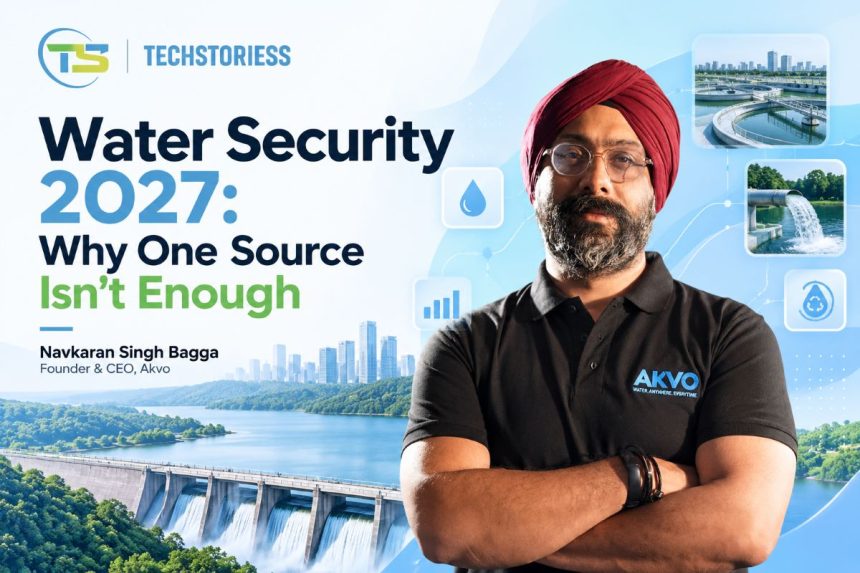
It might rain a lot in a city, but there might be a water shortage. A factory can have working pipes but still run out of water due to contamination. A hospital can have enough water supply, but it will be vulnerable if all the deliveries depend on just one supplier.
The lesson is a bit unpleasant: just water infrastructure is not enough to ensure water security.
For years, the water planning took place logistically: find a reliable source of water, build capacity, and grow according to the demands. However, the climate variability plays a crucial role in challenging this rule.
The Single-Source Belief is Failing
As indicated in the 2025 report from the World Meteorological Organization (WMO) on Global Water Resources, global river discharge has been at its lowest in over three decades. Since seven years, normal flow has been observed in just 34-38% of river basins indicating that normal flow has become rare and more or less non-existent.
A separate but related pressure is being faced by India. According to the report of Central Ground Water Board (CGWB) in 2025, extraction of groundwater will average 247 billion cubic meters each year. However, this national average might not be factual as it varies greatly across different water basins.
This does not mean that traditional sources will no longer exist but rather indicates the need for improvement in managing water supply disruptions.
The idea of diversification must not be confused with the idea of duplication.
Electricity systems never rely on a single source of power for tackling power cuts – rather their system is based on various connecting creating a network of supply sources abilities. The same engineering discipline could be applied to water planning.
A commercial campus may have municipal supply supported by rainwater harvesting, grey water usage, groundwater if sustainable, as well as a system of decentralized production of drinking water. In a coastal city, the use of desalination is an additional option.
However, having two pumps of one source or two trucking companies operating in the same watershed does not necessarily imply transferability of the sources.
A real viability strategy is focused on the question if backup supplies respond in a similar way to problems. If one of the sources fails during the drought does the backup also fail at the same time? Does the failure of the primary source mean that the backup plant will not be able to function?
Assign water according to its use
One of the errors that people make is to think that every type of water needs to attain the same quality. Water for drinking, for use in cooling systems and for gardens, or washing needs different levels of purity. Use of one high-quality water source in this case means uneconomical use of the scarce commodity and higher costs of water provision.
Reclaimed water subjected to treatment can fulfill various non-potable purposes helping to save high-quality water sources for drinking and other sensitive needs. Using rainwater harvesting technology saves water flow peaks and brings water to areas where it is needed, but the issue of storing water and its seasonality is still relevant. Aquifer recharge, leak detection, and proper demand management can maximize the use of water resources.
The process of creating water-use map must start any diversification of water sources.
Where water from air fits
The sphere of water has been expanded with the advent of atmospheric water generation technology. By utilizing the moisture found in the air and treating it accordingly, these systems make it possible to use them to get drinking water when the conditions are appropriate.
My experience of working on atmospheric water systems projects made me believe that the main value of these systems lies not in their ability of being a substitute to pipelines but in their capacity to mitigate concentration risk at the point of use. When producing part of its own drinking water, a site may have more opportunities in case of restrictions on conventional supply provision.
Apart from prospects, the limitations are also very important. The output and energy consumption are determined by the humidity, temperature, design and maintenance of the equipment used. Although the atmospheric water has been produced, it is still necessary to treat and store it and test to meet the standards of drinking water. The system that performs well in humid conditions may not be suitable for dry conditions without proper assessment of the site.
The right question is not, “Can this technology make water?” It is, “How reliably, safely and efficiently can it contribute to this location’s wider water strategy?”
Make resilience measurable
It is vital that engineers and decision makers get metrics on their varied water portfolio instead of vague sustainability claims. The quantity of critical demand that each source fulfills during an outage should be determined, as well as how many hours or days the facility would operate without the availability of water. In addition, the costs and energy consumption each liter entails should be assessed; and also, the risks concerning quality have to be analyzed at each stage of the move and storage of the letters.
Digital technologies can aid in determining whether there are diminishing returns from wells, whether water is used inappropriately, whether leakages occur, with treatment not performed in the correct way, or with decentralised facilities not working properly. However, sensors cannot resolve an issue with the technology that is inherently fragile. Monitoring is valuable in pinpointing the system failure. Diversity, however, enables it to circumvent failures.
Next-gen water infrastructure should not only be evaluated regarding ordinary days but many liters of water produced on exceptional days.
Contributed by Navkaran Singh Bagga, Founder & CEO, Akvo Atmospheric Water Systems