


In 1989, the first known ransomware attack was reported when the AIDS Trojan (PC Cyborg) encrypted file names on infected computers and demanded payment for restoration. Over time, ransomware joined the list of the most financially damaging cyberattacks. Attackers used to look for vulnerable systems and use phishing emails or software exploits to deliver malware, encrypt valuable data, and demand “ransom” to restore access. To protect critical data from these attacks, security teams strengthened firewalls, fortified endpoint protection, and educated employees to identify phishing and social engineering attempts. This technological approach was, however, largely designed for human-speed attacks, which proved effective against conventional ransomware campaigns.
- The Industrialisation of Modern Ransomware
- Why AI Ransomware Attacks 2026 Look Different
- The Economics Behind a $10.5 Trillion Cybercrime Industry
- Autonomous Ransomware Defence Enterprise Strategies
- AI Threat Detection Ransomware: From Reactive Security to Predictive Security
- Rewriting the Ransomware Playbook Enterprise Security Teams Relied Upon
- Building Resilience in the Age of AI
- Conclusion
However, the emergence of AI changed the scenario.
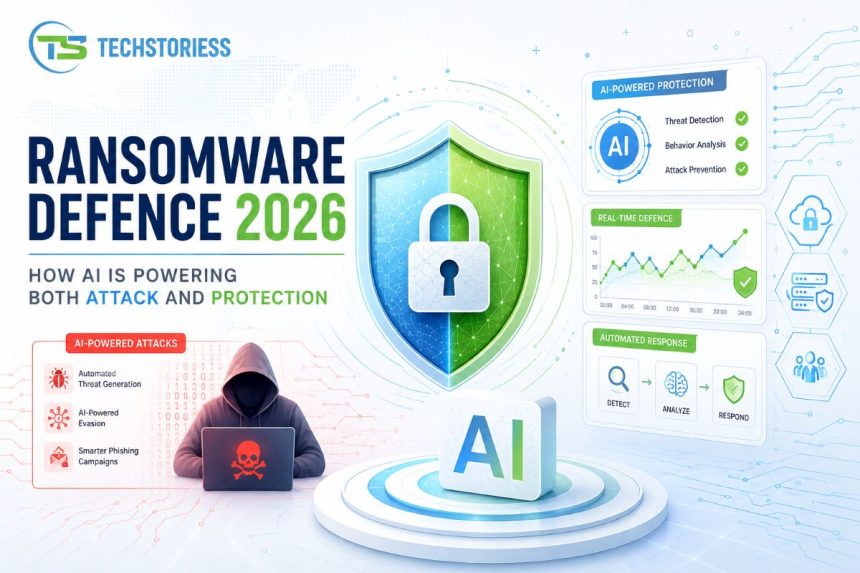
Today, AI has ventured beyond merely another cybersecurity tool to become a proactive participant that can actively influence both sides of the cybersecurity conflict.
Sophisticated cybercriminals leverage machine learning models to streamline their entire attack lifecycle by automating reconnaissance, generating highly convincing phishing campaigns, identifying vulnerabilities, and even adapting their attack techniques in real time to their advantage. At the same time, defenders are responding with advanced AI capabilities that can effectively detect anomalies, correlate millions of events within seconds, and enhance incident response through intelligent automation.
It brings us to a new reality where ransomware defence AI enterprise 2026 not only secures networks from malware but actively defends organisations against adaptive, intelligent adversaries that are increasingly semi-autonomous and highly scalable.
It presents a substantial challenge. Cybersecurity Ventures states that global cybercrime now costs approximately $10.5 trillion per year, which is equivalent to the world’s third-largest economy by GDP if cybercrime were measured as a nation. Simultaneously, AI-powered security platforms also empower organisations to substantially reduce detection and response times. It presents an interesting paradox; both attackers and defenders are using the same technology to gain a strategic advantage.
During the next decade, enterprise cybersecurity will be defined by this dual role of AI in cybersecurity.
The Industrialisation of Modern Ransomware
Cybercrime is no longer about random attackers individually launching isolated attacks. In recent years, cybercrime has evolved into a well-organised industry with specialised business models and defined operational structures. In modern times, ransomware operations closely resemble legitimate businesses. They hire development teams, operate customer support teams, maintain sophisticated supply chains, and even establish revenue-sharing agreements and ransomware-as-a-service (RaaS) affiliate programs. This industrialisation has largely changed the threat landscape, normalising cybercrime as a scalable business model.
This transformation is further accelerated by artificial intelligence.
Earlier, conducting effective reconnaissance required highly skilled attackers capable of manually investigating targets, detecting exposed services, mapping organisational structures, and discovering exploitable weaknesses. Today, much of this work is automated by AI systems. The technology simplifies and accelerates operations with capabilities such as open-source intelligence gathering, employee profiling, attack path identification, and vulnerability assessment at scale. It allows criminal groups to operate with greater efficiency and scale.
Current ransomware statistics 2026 reflect this growing efficiency.
The IBM X-Force Threat Intelligence Index 2026 states that active ransomware groups achieved 49% growth during 2025, indicating that entry barriers have significantly lowered.
Even attackers with limited experience can now employ AI-assisted tools to improve targeting, automate research, and produce highly professional social engineering campaigns.
Industry analysts agree that approximately 80% of ransomware attacks are powered by AI tools at some point in the attack lifecycle-from reconnaissance through delivery. This means AI ransomware attacks 2026 are no longer theoretical future threats. They are actively reshaping how ransomware campaigns are planned and executed.
The implications are not limited to volume alone. As the number of groups increases, experimentation also rises. Different operators can simultaneously test new techniques, accelerating innovation within criminal ecosystems and increasing the overall threat level.
What This Means for Enterprise Leaders
- Unlike traditional cyberattacks, the potential of threat actors is no longer limited by headcount alone. By leveraging AI, even smaller ransomware groups can become disproportionately dangerous.
- Rather than focusing only on well-known ransomware brands, threat intelligence programs should actively monitor emerging groups.
- Supply chain partners with weaker security controls may become attractive targets for AI-powered attackers.
- Security teams should expect attack methodologies to evolve much faster than traditional annual risk assessment cycles.
- When assessing organisational risk, an increasing number of cyber insurance providers actively evaluate AI readiness to ensure adequate cyber resilience and incident response preparedness.
Why AI Ransomware Attacks 2026 Look Different
Conventional cybersecurity controls and strategies assumed that humans tend to make mistakes, especially when executing repetitive tasks at scale.
That is why traditional phishing emails were often identified by obvious grammatical errors, awkwardly written phrases, or other clear indicators of fraud. With minimal training, employees could often identify these warning signs and block or delete suspicious emails before any damage occurred.
Artificial intelligence has largely eliminated this challenge.
According to research, as many as 82.6% of phishing emails are now generated with AI. Unlike traditional campaigns that relied on a hit-or-miss approach, these messages can be hyper-tailored for specific industries, departments, events, or individuals. They frequently mimic internal communications, vendor communications, or executive messaging with remarkable accuracy, making them highly convincing.
Picture this: you attend a conference and shortly afterward receive an email referencing that event, mentioning colleagues by name, and matching your company’s writing style. Creating such a message manually would be time-consuming and prone to missing critical details. AI can generate the same message accurately and at scale within seconds.
That is why AI ransomware attacks 2026 are increasingly focused on precision. Volume comes naturally with AI.
Instead of casting wide nets and hoping for a few victims, attackers increasingly focus on high-value targets through meticulously crafted campaigns that improve success rates.
Generative AI extends beyond email into voice cloning, synthetic video generation, and automated chatbot interactions. These technologies create entirely new opportunities for deception. Security awareness programs built around spotting poor grammar and suspicious attachments are rapidly becoming outdated.
What This Means for Enterprise Leaders
- Instead of focusing solely on obvious scams, security awareness training must focus on validating trust and identity.
- As AI enables hyper-personalised attacks, executive teams are becoming primary targets.
- Business email compromise powered by deepfakes may become as disruptive as traditional ransomware campaigns.
- Multi-factor authentication alone is insufficient against attacks that manipulate employees into granting access.
- Human verification procedures are no longer administrative formalities; they have become strategic security controls to counter identity-based attacks and social engineering threats.
The Economics Behind a $10.5 Trillion Cybercrime Industry
Cybersecurity discussions often focus on technical risks without considering the economics that drive cybercriminal activity.
The key reason behind the continued growth of cybercrime is the significant financial rewards it offers relative to operational costs. Artificial intelligence has further strengthened this economic advantage.
Cybersecurity Ventures estimates annual global cybercrime costs at $10.5 trillion. This figure includes direct and indirect costs such as ransomware losses, fraud, intellectual property theft, business interruption, incident response expenses, legal costs, and reputational damage.
To understand the magnitude of this figure, consider that it is comparable to the combined GDP of major economies such as Japan and Germany.
For ransomware operators, AI has substantially reduced costs while increasing productivity. AI-driven reconnaissance, scalable phishing campaigns, accelerated malware development, and automated vulnerability discovery enable criminal groups to target more enterprises with fewer personnel.
It creates a powerful economic incentive explaining why ransomware continues to expand despite growing investments in cybersecurity defences.
Even with occasional successes, attackers can generate substantial returns. By contrast, defenders must secure every critical asset every day without failure.
While AI is helping both sides, attackers often retain the strategic advantage of choosing when and where to strike.
What This Means for Enterprise Leaders
- Rather than relying solely on compliance requirements, cybersecurity budgets should increasingly be evaluated against business continuity risks.
- Indirect costs such as operational disruption and reputational damage often substantially exceed the immediate financial impact of ransomware.
- Boards should evaluate ransomware resilience through financial impact modelling rather than relying exclusively on technical metrics.
- AI is reducing operational costs for cybercriminals, potentially increasing attack frequency.
- Recovery speed may become a more important competitive differentiator than prevention alone in the modern threat landscape.
Autonomous Ransomware Defence Enterprise Strategies
By leveraging AI-powered autonomous ransomware defence enterprise strategies, organisations can effectively manage massive volumes of security telemetry across multiple attack surfaces, including cloud, endpoint, network, and identity environments. Going beyond the limitations of static rule-based systems, AI can continuously analyse user behaviour, detect anomalies, and initiate automated investigations. It helps identify and contain activities such as unusual data downloads or lateral movement attempts before significant damage occurs. Research suggests AI can reduce detection and response times by approximately 80 days, enabling organisations to stop ransomware at the intrusion stage rather than after encryption begins.
What This Means for Enterprise Leaders
- Alongside prevention, prioritise response speed to minimise operational disruption.
- Strategically address cybersecurity skills shortages through AI-driven automation.
- Reduce analyst fatigue through intelligent workflows.
- Focus on detection precision and accuracy rather than alert volume.
- Mature AI-driven SOCs can provide significant incident-response advantages.
AI Threat Detection Ransomware: From Reactive Security to Predictive Security
AI threat detection ransomware technologies shift security operations from reactive approaches to predictive security. Technologies such as machine learning-based behavioural analysis continuously evaluate millions of events and detect patterns associated with early-stage ransomware activity. They can correlate unusual authentication attempts, privilege escalation events, and network anomalies to enable earlier intervention, often before attackers complete their objectives. Intervening at this early stage can significantly reduce business impact and recovery costs.
What This Means for Enterprise Leaders
- Invest in predictive security capabilities.
- Ensure visibility across cloud, endpoint, network, and identity systems.
- Prioritise data quality over tool quantity.
- Early detection reduces breach impact.
- Emphasise behavioural analysis over traditional signatures.
Rewriting the Ransomware Playbook Enterprise Security Teams Relied Upon
Conventional ransomware playbooks were designed for human-speed attacks. However, modern adversaries increasingly use AI technologies to operate faster and more intelligently, reducing the effectiveness of static controls. That is why progressive organisations are rapidly adopting zero-trust architectures to strengthen identity security, implement continuous monitoring, and improve resilience through rapid detection, containment, and recovery.
Building Resilience in the Age of AI
Future ransomware defence AI enterprise 2026 success can only be achieved by strategically combining AI, governance, training, monitoring, tested backups, strong identity controls, and executive oversight. Enterprises must increasingly view resilience as a business capability rather than a purely technical objective.
Conclusion
Ransomware defence AI enterprise 2026 reflects a rapidly evolving cybersecurity landscape characterised by increasing automation and sophistication. During 2025, active ransomware groups grew by 49%, and approximately 80% of attacks now use AI at some stage of the attack lifecycle. Threat actors are extensively using AI for tasks such as generating phishing emails, conducting reconnaissance at scale, and improving social engineering effectiveness. With annual cybercrime costs reaching $10.5 trillion, the stakes continue to rise. At the same time, autonomous ransomware defence enterprise strategies and AI threat detection ransomware technologies are helping organisations detect threats faster and take proactive defensive actions. To succeed in this environment, businesses must adapt, learn, and respond faster than their adversaries.