


Encryption is the foundation of digital trust. From online transactions and financial exchanges to cloud workloads and secure government communications, everything relies on cryptographic systems designed decades ago. These systems-especially RSA and elliptic curve cryptography-were built on mathematical assumptions that classical computers cannot efficiently break. Quantum computing challenges those assumptions at their core. With accelerating quantum research, quantum-safe cybersecurity is no longer just an academic concern; it has become a strategic imperative.
- The Quantum Threat Timeline: When Could Encryption Break?
- What Is Quantum-Safe Cryptography? A Clear Enterprise Definition
- NIST Post-Quantum Standards: The 2024 Breakthrough
- Enterprise Adoption Trends: Market Signals Are Clear
- Cryptographic Inventory & Discovery: The Discipline That Determines Whether PQC Migration Succeeds or Fails
- Enterprise Risk Assessment: Where Are You Most Vulnerable?
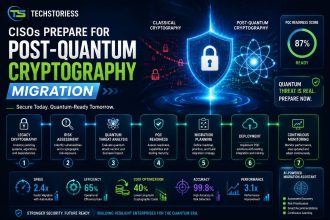
- Migration Strategy: What Enterprises Must Do Now
- Technical Considerations: Performance, Scalability & Integration
- Business Impact: Cost of Delay vs Strategic Advantage
- The Road to Post-Quantum Encryption 2026 and Beyond
- Hybrid Cryptography Deployment Models: Engineering the Bridge to a Post-Quantum Future
- Immediate Executive Actions for Next 12 Months
- Conclusion
The mid-2020s represent a practical inflection point for enterprise planning cycles.
Key context
- RSA-2048 underpins global TLS, VPN, and PKI infrastructures.
- Quantum computing offers exponential speedups for integer factorization and discrete logarithm problems, thereby threatening widely deployed public-key systems.
- In large enterprises, encryption migration cycles often take 5–10 years.
- Regulatory signals are compressing transition timelines.
This sets the stage for understanding the threat timeline.
The Quantum Threat Timeline: When Could Encryption Break?
Credible projections about cryptographic disruption caused by quantum computing have created urgency around quantum-safe cybersecurity. + Industry projections — including research modeling by IBM and academic quantum hardware benchmarks — signal that breaking RSA-2048 would need fault-tolerant quantum systems with millions of logical qubits. This is a threshold that is not yet achieved but actively researched.
The “harvest now, decrypt later” model further intensifies this risk. Instead of waiting for quantum capabilities to mature, threat actors can collect encrypted data today and store it in repositories for future decryption. This approach could result in large-scale retroactive data exposure.
Enterprise implications
- Sensitive data with long lifecycles is exposed to retroactive decryption.
- Migration timelines may exceed projected quantum maturity timelines.
- Delays can significantly increase compliance and operational risk.
- Strategic planning must begin well before “Q-Day.”
This urgency creates the need for post-quantum cryptography.-
What Is Quantum-Safe Cryptography? A Clear Enterprise Definition
Quantum-safe cryptography refers to cryptographic algorithms designed to defend against the impact of quantum attacks. Unlike RSA or elliptic curve cryptography (ECC), post-quantum cryptography (PQC) is based on mathematical problems believed to be resistant to quantum algorithms such as Shor’s algorithm. These include lattice-based, hash-based, code-based, and multivariate cryptographic constructions.
For enterprises, deploying quantum-resistant algorithms is more than simply replacing one encryption algorithm with another signature scheme. It requires rethinking key exchange mechanisms, digital signature frameworks, firmware validation processes, and cloud authentication architectures. The shift to post-quantum encryption in 2026 signals a structural modernization of cryptographic infrastructure rather than a routine software upgrade.
Core principles
- PQC is designed to protect against both classical and quantum attacks.
- Cryptographic agility is a critical capability for long-term adaptability.
- Enterprise cryptography is deeply embedded across applications, networks, hardware, and supply chains.
Migration requires phased, hybrid implementation models to maintain interoperability and minimize operational disruption.
To successfully transition, enterprises must align cryptographic modernization with emerging standards, governance frameworks, and long-term compliance mandates.
NIST Post-Quantum Standards: The 2024 Breakthrough
The first set of NIST post-quantum cryptography standards was released in 2024, marking the first formal standardization of quantum-resistant algorithms for wider deployment.These included CRYSTALS-Kyber for key establishment and CRYSTALS-Dilithium for digital signatures. This marked the transition from research experimentation to enterprise-ready deployment
Standardization provides clear guidance on which quantum-resistant algorithms organizations should implement. It enables vendors, governments, and enterprises to align roadmaps, product development, and security architectures with a common framework. The NIST process has matured over years of rigorous peer review, global cryptanalysis, and performance benchmarking-positioning these standards as the foundation of quantum-safe cybersecurity strategies worldwide.
Regulatory & National Security Mandates Accelerating Change
Government directives are reshaping enterprise timelines. The U.S. National Security Agency has defined quantum-resistant cryptography adoption milestones for national security systems by 2030. Such mandates directly affect defense contractors, federal suppliers, and global technology ecosystems connected to critical infrastructure.
Compliance requirements and national security modernization programs are transforming post-quantum encryption in 2026 into a supply chain obligation rather than an optional upgrade. Organizations that support federal systems or operate within regulated sectors must align with PQC standards or risk exclusion from procurement frameworks and strategic partnerships.
Policy impact
- The 2030 adoption mandate establishes firm compliance deadlines.
- Defense and aerospace sectors face accelerated migration expectations.
- Supply chain security requirements extend beyond federal agencies to private-sector partners.
- Regulatory signals are influencing global cybersecurity norms and standards alignment.
To respond effectively, enterprises must integrate regulatory mandates into enterprise-wide risk assessments and long-term cryptographic transition strategies.
Enterprise Adoption Trends: Market Signals Are Clear
Gartner research indicates that a significant share of global enterprises initiated PQC migration planning in 2025. Cryptographic upgrades require long-term planning, capital allocation, and cross-functional budget alignment. Meanwhile, major technology vendors are embedding hybrid PQC capabilities into TLS libraries, operating systems, and cloud platforms.
Industry forecasts suggest that quantum-safe cybersecurity has moved from strategic foresight discussions to operational execution planning across large enterprises. Organizations that continue to delay risk being forced into reactive migrations under compressed regulatory or competitive deadlines that increase cost and operational disruption.
Adoption drivers:
- Board-level risk governance discussions are increasing in frequency and urgency.
- Vendor roadmaps are aligning with NIST post-quantum standards.
- Industry pilots are integrating hybrid classical + PQC encryption models.
- Competitive differentiation is emerging through proactive security modernization.
Regulatory mandates are expected to formalize migration requirements in key industries. This anticipation is further accelerating enterprise readiness initiatives.
Cryptographic Inventory & Discovery: The Discipline That Determines Whether PQC Migration Succeeds or Fails
In most enterprises, cryptography does not represent a neatly governed control layer. Instead, it reflects the accumulated reality of years of digital transformation, which has embedded encryption deeply into identity systems, API gateways, DevOps pipelines, mobile applications, firmware, load balancers, cloud services, and third-party platforms. The result is that only a fraction of cryptographic implementation is centrally managed, while the majority is distributed across operational domains.
This decentralized distribution is precisely why cryptographic inventory must be the first serious step in post-quantum migration. Replacing RSA or elliptic curve cryptography is not a single configuration change; it is a systemic transition. Without clear visibility into where public-key mechanisms are deployed – and how they integrate into authentication, digital signing, and key exchange workflows – migration planning becomes speculative and operationally risky.
The post-quantum transition guidance of the National Institute of Standards and Technology (NIST) explicitly reinforces this sequence: organizations must identify and document cryptographic assets before initiating algorithm transitions. The logic is straightforward: modernization cannot occur where enumeration has not first been achieved.
The Visibility Gap Is Larger Than Most CISOs Assume
Even mature enterprises tend to underestimate their cryptographic exposure. Large organizations frequently manage thousands – sometimes tens of thousands – of certificates across internal and external trust chains. This complexity is further compounded by hybrid cloud expansion. Each Kubernetes cluster, API endpoint, SaaS integration, and VPN tunnel introduces additional cryptographic dependencies.
More critically, encryption is often embedded in systems not directly governed by security teams: legacy ERP platforms, vendor-supplied appliances, firmware on network devices, or hard-coded libraries within custom applications. In a quantum migration scenario, these blind spots become material liabilities.
Industry research on certificate lifecycle management consistently shows that organizations underestimate certificate sprawl and key dependencies. During quantum readiness assessments, many leadership teams discover they lack a consolidated map of public-key usage across the enterprise. That visibility gap alone can delay a realistic migration program by years.
What a Credible Cryptographic Inventory Must Capture
A meaningful inventory goes beyond listing certificates; it establishes technical and business context.
Enterprises should document at minimum:
Algorithm Exposure
Where RSA, ECC, Diffie-Hellman, or DSA are used, including key lengths and configuration parameters. This defines the measurable scope of quantum-vulnerable components.
Protocol Dependencies
TLS configurations, SSH deployments, VPN authentication methods, secure email systems, code-signing workflows, and identity federation mechanisms. These represent operational control points where algorithm changes can introduce compatibility and trust-chain risk.
Hardware Constraints
Hardware security modules (HSMs), trusted platform modules (TPMs), smart cards, and embedded cryptographic accelerators may not support post-quantum algorithms without firmware updates or hardware replacement. Hardware limitations frequently dictate transition pacing across large enterprises.
Data Longevity Mapping
Systems protecting data with confidentiality requirements extending five, ten, or twenty years must be prioritized. Long-lived intellectual property, regulated financial records, and classified materials are particularly exposed under harvest-now, decrypt-later threat models.
Absent this layered mapping, migration sequencing becomes reactive rather than risk-based.
Inventory as a Governance Instrument – Not Just a Technical Exercise
Framing cryptographic discovery as routine engineering housekeeping understates its strategic significance. It is, in fact, a governance control. Boards and audit committees increasingly expect demonstrable awareness of quantum exposure, particularly in sectors such as financial services, healthcare, defense, and critical infrastructure.
By properly documenting cryptographic inventory, enterprises achieve three strategic outcomes:
- Evidence-based risk assessment tied to specific systems and data classifications.
- Vendor accountability, by identifying where third-party platforms must align with NIST-approved post-quantum standards.
- Realistic budgeting and timeline forecasting grounded in measurable scope rather than informal assumptions.
In effect, the inventory becomes the quantitative baseline for enterprise-wide quantum readiness.
From Enumeration to Execution
Enterprises that approach cryptographic discovery with discipline gain operational clarity rather than a mere catalog of certificates. They can stage hybrid deployments intelligently, negotiate upgrade commitments with vendors from a position of data-backed authority, and align infrastructure refresh cycles with post-quantum implementation goals.
Without a comprehensive inventory, post-quantum migration risks remaining theoretical. With one, it becomes executable architecture. In the context of quantum-safe cybersecurity, discovery is not a preliminary exercise – it is the structural foundation that supports every subsequent decision.
Enterprise Risk Assessment: Where Are You Most Vulnerable?
+Despite growing awareness, many enterprises still don’t have consolidated, enterprise-wide cryptographic inventory. This a gap materially delays quantum migration execution.
Organizations must identify systems that store long-lived data, especially within crucial sectors such as healthcare, finance, intellectual property, and government operations. NSA’s 2030 mandate reinforces the urgency of identifying and remediating cryptographic vulnerabilities before quantum systems mature.
Risk priorities
- Identify RSA and ECC dependencies across infrastructure.
- Assess data retention horizons exceeding 5–10 years.
- Evaluate third-party cryptographic dependencies.
- Prioritize high-value and high-impact systems for early PQC deployment.
A thorough assessment establishes the foundation for an execution strategy that is risk-based, phased, and aligned with regulatory timelines.
Migration Strategy: What Enterprises Must Do Now
Quantum safety is far more than a routine software upgrade. It requires structured transformation across architecture, governance, procurement, and vendor ecosystems.
Conduct a Cryptographic Inventory
Identify:
- All public-key cryptography implementations
- Certificate authorities in use
- Hardware dependencies (HSMs, TPMs)
- Third-party vendor cryptographic dependencies
Adopt Crypto-Agility
Crypto-agility means designing systems that can replace cryptographic algorithms without redesigning entire architectures.
A lack of crypto-agility locks enterprises into rigid infrastructures, increasing the cost and complexity of every future cryptographic transition.
Pilot NIST-Approved Algorithms
- Initiate controlled testing of:
- CRYSTALS-Kyber
- CRYSTALS-Dilithium
Assess:
- Performance impact
- Key sizes and bandwidth usage
- Latency overhead
- Compatibility with legacy systems
Update Vendor Contracts
- Ensure vendors commit to:
- Compliance with NIST post-quantum standards
- Clear timelines aligned with post-quantum encryption 2026 objectives
- Transparent PQC implementation roadmaps
Develop a Phased Roadmap (2025–2030)
A typical enterprise roadmap may include:
- 2025: Assessment and pilot testing
- 2026–2027: Hybrid cryptographic deployments
- 2028–2029: Gradual deprecation of RSA and ECC
- 2030: Broad PQC implementation aligned with regulatory mandates
Technical Considerations: Performance, Scalability & Integration
Performance & Practical Challenges
PQC algorithms typically involve larger key sizes and signature payloads, which can increase computational overhead compared to classical cryptography. While CRYSTALS-Kyber and CRYSTALS-Dilithium are engineered for practical efficiency, enterprises must rigorously test scalability across distributed cloud and hybrid environments to validate real-world performance impact.
CRYSTALS-Kyber key sizes are considerably larger than classical ECDHE parameters, which increases handshake message size and bandwidth consumption. This trade-off needs to be measured in high-throughput environments to ensure performance and reliability remain within acceptable thresholds
Several integration challenges must also be addressed, including certificate lifecycle management updates, hardware acceleration compatibility, and interoperability between classical and PQC systems during hybrid phases. To validate performance impact under realistic conditions, testing environments should simulate production-scale workloads and peak enterprise traffic scenarios.
Technical checkpoints
- Evaluate key size and bandwidth implications.
- Test cryptographic performance under enterprise traffic loads.
- Ensure compatibility with hardware security modules (HSMs).
- Conduct phased pilot deployments before full-scale rollout.
These technical efforts directly influence cost efficiency, user experience, and business continuity outcomes.
Business Impact: Cost of Delay vs Strategic Advantage
Encryption failure could lead to severe financial and reputational consequences. A sudden compromise of RSA-based systems could disrupt critical digital services such as banking platforms, e-commerce ecosystems, and digital identity verification frameworks at scale. Early adoption of quantum-safe cybersecurity mitigates systemic risk while strengthening stakeholder confidence.
Investors, regulators, and cyber insurers increasingly evaluate long-term cyber resilience as part of enterprise risk profiling. Organizations demonstrating proactive PQC adoption may benefit from reduced compliance friction, improved audit outcomes, and stronger trust positioning in competitive markets.
Strategic benefits
- Reduced risk of emergency cryptographic overhauls.
- Improved investor and customer confidence.
- Alignment with evolving cyber insurance expectations.
- Competitive differentiation through proactive security modernization.
The journey culminates in long-term preparedness rather than reactive crisis management.
The Road to Post-Quantum Encryption 2026 and Beyond
The path to post-quantum encryption requires structured milestones and disciplined governance. By the end of 2026, enterprises should complete cryptographic inventories, initiate hybrid deployments across critical systems, and align vendor ecosystems with NIST-approved standards. Full compliance with national security mandates should be achievable before the end of the decade.
Quantum computing research and hardware capabilities will continue to advance unpredictably. Therefore, quantum-safe cybersecurity must not be treated as a one-time migration project. It must evolve into a permanent architectural discipline embedded within enterprise security strategy and IT modernization programs.
Milestone outlook
- 2026: Hybrid PQC deployment across mission-critical systems.
- 2027–2028: Enterprise-wide crypto-agility maturity and automation.
- 2030: Alignment with NSA quantum-resistant cryptography mandates.
- Beyond 2030: Continuous adaptation to emerging quantum and cryptographic developments.
Hybrid Cryptography Deployment Models: Engineering the Bridge to a Post-Quantum Future
Enterprises cannot replace RSA or elliptic curve cryptography overnight. Public-key systems underpin TLS handshakes, certificate chains, VPN authentication, identity federation, secure email, and software signing. Abrupt substitution would fracture interoperability and introduce significant operational risk.
For this reason, both NIST transition guidance and the U.S. National Security Agency’s CNSA 2.0 framework advocate a phased migration strategy built around hybrid cryptographic models. These models combine classical algorithms with post-quantum algorithms within the same cryptographic operation. Rather than relying on a single primitive, enterprises depend on two independent security assumptions. If either remains secure, the session key or digital signature remains protected.
Hybridization reflects disciplined engineering in response to ecosystem complexity.
What Hybrid Cryptography Means in Practice
Operationally, hybrid deployment most commonly appears in two areas:
Hybrid Key Exchange in TLS
During a TLS handshake, both a classical key exchange mechanism (such as ECDHE) and a post-quantum key encapsulation mechanism (such as CRYSTALS-Kyber) are executed. The resulting shared secrets are cryptographically combined into a single session key. If one method is compromised by future advances, the other continues to protect session confidentiality.
In TLS 1.3 implementations, hybrid key exchange mechanisms combine classical ECDHE with post-quantum KEMs during the handshake process. This preserves compatibility while extending forward secrecy guarantees.
Hybrid Digital Signatures
Classical signatures (for example, ECDSA) may be paired with post-quantum signatures (such as CRYSTALS-Dilithium) for authentication and code signing. Verification requires validating both components. This preserves compatibility with existing trust anchors while introducing quantum resistance.
These patterns allow organizations to introduce quantum-safe mechanisms without breaking existing systems or excluding partners that have not yet transitioned.
Interoperability as the Primary Constraint
- Hybrid cryptography is as much about ecosystem coordination as mathematics.
- Enterprise environments operate across:
- Multiple certificate authorities
- Diverse operating systems
- Cloud providers and SaaS platforms
- Legacy hardware appliances
- Third-party integrations
Each participant must interpret handshake negotiations, certificate extensions, and signature validation rules consistently. A unilateral shift to purely post-quantum algorithms could disrupt compatibility with customers, suppliers, or regulated partners.
Hybrid models mitigate this risk by preserving backward compatibility while incrementally introducing quantum resistance. They provide time for vendors, standards bodies, and infrastructure providers to mature and optimize implementations.
Performance and Engineering Trade-Offs
Hybrid deployments introduce measurable trade-offs. Post-quantum algorithms generally involve larger key sizes and signature payloads compared to classical counterparts. Combining both increases handshake message sizes and, consequently, bandwidth utilization – potentially affecting latency in high-volume environments.
In most enterprise contexts, the impact is manageable with careful optimization. However, it must be validated under production-scale traffic conditions. Security architects should model peak transaction volumes, API throughput, and load balancer behavior to ensure hybrid overhead remains within acceptable thresholds.
Used responsibly, hybrid deployment strengthens resilience without materially degrading user experience. Achieving that balance requires deliberate engineering discipline.
Aligning Hybrid Strategy with Regulatory Timelines
Hybrid cryptography is not a permanent endpoint. It is a transitional architecture aligned with regulatory and national security milestones extending toward 2030 and beyond. Organizations that adopt hybrid models early gain:
- Operational familiarity with post-quantum primitives
- Time to validate interoperability across ecosystems
- Reduced exposure to harvest-now, decrypt-later threats
- Flexibility when deprecating classical algorithms
Hybridization therefore bridges theoretical readiness and enterprise-grade implementation. It recognizes that cryptographic ecosystems evolve gradually – and that resilience depends not only on advanced mathematics, but on coordinated, system-wide execution.
Immediate Executive Actions for Next 12 Months
- Boards must oversee and guide risk management to:
- Provide a formal cryptographic inventory report.
- Present a 3–5 year PQC migration roadmap with clear capital implications.
- Quantify long-lived data at risk under harvest-now, decrypt-later scenario.
- Document and verify vendor compliance with NIST post-quantum standards.
- Integrate quantum risk into enterprise risk registers and audit reporting cycles
Regulatory compliance
- Cyber insurance underwriting and policy terms
- Mergers and acquisitions (M&A) risk evaluations
- Long-term digital trust and brand credibility
- National security alignment and supply chain eligibility
Conclusion
Quantum computing may not immediately break RSA-2048, but strategic indicators are converging toward eventual disruption. NIST post-quantum standards were finalized in 2024. IBM projects potential cryptographic vulnerability within the next decade. Gartner forecasted widespread enterprise migration planning by 2025. The NSA’s CNSA 2.0 framework establishes 2030 transition milestones for National Security Systems. It impacts defense contractors and adjacent supply chains
Post-quantum encryption in 2026 represents an operational checkpoint that separates proactive enterprises from reactive ones. By acting early, organizations can transition deliberately and methodically. Those that delay risk reactive disruption under regulatory and competitive pressure.