


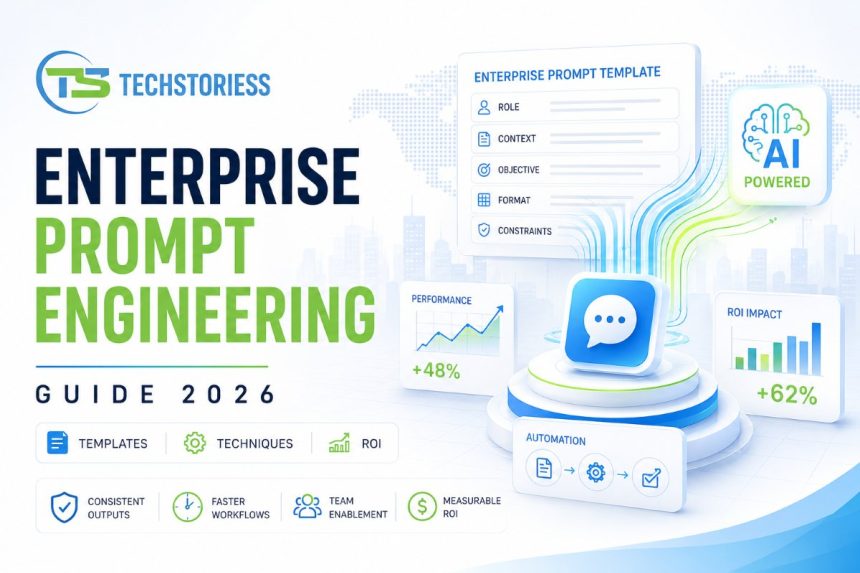
It’s no longer just an experimental toy; Generative AI has become a key enterprise capability. The core thesis is that client-side prompt engineering is the key to an AI implementation that delivers a high return on investment (ROI) and avoids token waste.
While conversational prompts are intended to generate a bit of unique content per request, enterprise prompt engineering is about creating scalable, reliable, and cost-efficient instructions for a large language model (LLM) to carry out a complex business task.
Despite LLM deployments across many organisations, inconsistent answers, slow response times, and unpredictable costs remain problematic. The root cause is often the lack of an effective, institutionalised approach to prompt control and optimisation.
Forrester (2025) reports that 73% of enterprise AI teams are still not formally governed and versioned for their prompts. This leads to wasted resources and untrustworthy AI capabilities in production.
The answer is a problem-solving and engineering-oriented approach to prompts. In this approach, prompts can be treated as code, versioned, tested, and optimised for efficiency, helping businesses reduce costs and improve performance.
In fact, a LangSmith case study (2026) revealed that the average ROI of a prompt optimisation program is $2,300 per team per month, from reduced inference costs alone.
This guide breaks down the essential techniques, templates, and measurement strategies you need to master enterprise prompt engineering in 2026.
The Financial Impact of System Prompt Optimisation
System prompt optimisation is the process of refining the foundational instructions given to an LLM to dictate its behaviour, constraints, and output format. It’s the most critical layer of prompt engineering, setting the boundaries for all subsequent interactions.
If you have the system prompt right, everything will be easier. By optimising the system prompt for your model, you can ensure it remains aligned with the brand voice you’ve established, stays within your safety guidelines, and produces structured data for your APIs in the precise format you need.
The OpenAI cookbook benchmarks (2025) demonstrate that system prompt tuning reduces the output error rate by 35% for structured business tasks. This reduction in errors means less time spent on manual review and fewer broken downstream processes.
Furthermore, optimised prompts directly impact the bottom line by reducing the amount of data processed per request. Anthropic’s engineering blog (2025) notes that optimised prompts reduce token consumption by 20–40% compared to unstructured prompts.
If you have millions of API calls per month, then saving 40% on your tokens adds up to significant savings. In that context, even small improvements can create meaningful cost reductions.
Advanced Techniques: Chain of Thought Prompting
One prompting strategy is the “chain of thought” method, in which you ask the LLM to provide a rationale for the solution, step by step, before giving the answer. This simulates human problem-solving and, in turn, instructs the model to generate logical steps for solving complex problems.
You don’t just ask for a final answer or a step-by-step summary; you include phrases such as “Let’s think step by step” or demonstrate how you work through each step of the reasoning. This is especially important for logical tasks, Maths, or tasks that require several stages of analysis.
Building on that, the chain-of-thought prompting model was widely adopted in enterprise settings in 2025, helping to enhance accuracy by 40% for complex multi-step tasks, as demonstrated in seminal research by Wei et al. (2022).
For instance, if you instruct an LLM to review a legal contract and assess any specific violation, you might prompt it to make a wrong call. The chain-of-thought approach requires the model to recognise the relevant clause, to determine the conditions set out for the breach, to determine whether the circumstances meet the conditions determined, and then conclude whether there is a breach.
Scaling Accuracy with Few-Shot Prompting Enterprise
Few-shot prompting enterprise is when only a few examples (typically 3 to 5) of a desired input-output format are given in the prompt. If you have a specific pattern or tone that you want, this will “teach” that pattern to the model without having to narrow down the underlying model.
In an enterprise, few-shot prompting will be vital to streamlining the results of different teams/environment. It acts as an in-context training manual for the LLM. Providing just 3–5 examples has been shown to outperform zero-shot prompting (providing no examples) by 22–28% on classification tasks.
Consider a customer support routing system. Instead of simply describing how to route tickets, you provide five examples of past customer emails, each paired with its correct department tag (e.g., “Input: ‘My screen is cracked.’ Output: Hardware Support”). This significantly reduces misrouting and improves the customer experience.
Building Prompt Templates for Business
Prompt Templates are pre-designed templates that include fixed text and placeholders for variables. They enable business users to leverage advanced AI without needing to know the nitty-gritty of prompt engineering.
Having a library of approved prompt templates for business scenarios (such as summarising meeting notes, drafting marketing messages, or analysing financial reports) ensures consistency, compliance, and efficiency throughout the organisation. According to a 2025 survey of Portkey usage, the average enterprise prompt library will contain 47 production prompts.
A strong template might look like this:
“Summarise the following [Meeting Transcript] into three key takeaways and a bulleted list of action items assigned to [Specific Team Member]. Maintain a [Tone of Voice] tone.”
This allows anyone in the company to generate a high-quality summary just by filling in the brackets, ensuring the output always meets the company’s standards.
Measuring Prompt ROI and Ensuring Reliability
You cannot improve what you cannot measure. Prompt ROI measurement involves tracking the performance, cost, and efficiency gains of your prompt engineering efforts. This is not just about A/B testing, but about having comprehensive, longitudinal data-monitoring capabilities for tokens, latency, and output quality.
They are used in a production environment only after they have been checked against historical data to make sure that they will not cause issues in “corner cases”. This is known as regression testing. Implementing prompt regression testing catches 60% of performance degradations before production rollout, as noted by Braintrust (2026).
By tracking token consumption and error rates before and after optimising a prompt, you can clearly demonstrate the financial value of the work.
Explore the impact of different optimisation strategies on your token costs with this interactive tool:
Conclusion
A central part of enterprise prompt engineering guide 2026 is to be a mainstay in enabling the growth of AI in 2026. Organisations can use these methods, including system prompt optimisation, chain-of-thought (COT) prompting, and few-shot examples, to achieve more accurate and reliable results from their AI applications.
While valuable, these content-creation tools should be used safely. There is no better way to build a library of prompt templates for business than to build it together.
Lastly, these efforts must undergo rigorous testing and an effective ROI measure to ensure that the outcomes will add business value, mitigating inference costs and avoiding costly inference in the production process.
FAQs
What is the main goal of system prompt optimisation?
System prompt optimisation aims to establish clear, robust baseline instructions that govern the LLM’s behaviour, reducing output error rates (often by up to 35%) and ensuring consistent adherence to business rules and formatting requirements.
How does chain of thought prompting improve accuracy?
Chain-of-thought prompting forces the model to break down complex problems and explain its reasoning step by step before answering. This structured approach reduces logical leaps and has been shown to improve accuracy on multi-step tasks by up to 40%.
Why is the few-shot prompting enterprise essential?
Few-shot prompting provides the model with specific examples of desired inputs and outputs within the prompt. This “in-context learning” significantly improves performance on classification and formatting tasks compared to providing no examples, standardising outputs across the enterprise.
What are the benefits of using prompt templates for business?
Prompt templates for business ensure consistency, quality, and compliance across an organisation by providing standardised, reusable structures with dynamic variables. This allows users to generate high-quality AI outputs without requiring deep prompt-engineering expertise.
How is prompt ROI measurement conducted?
Prompt ROI measurement involves tracking key metrics such as token consumption, latency, and error rates before and after optimisation. By calculating the reduction in inference costs (which can average $2,300/month per team) and the time saved from reduced errors, businesses can quantify the financial impact of their prompt engineering efforts
Ready to take control of your enterprise AI costs and performance? Start by auditing your top 5 most frequently used prompts today and apply the optimisation techniques outlined in this guide to see immediate improvement.