


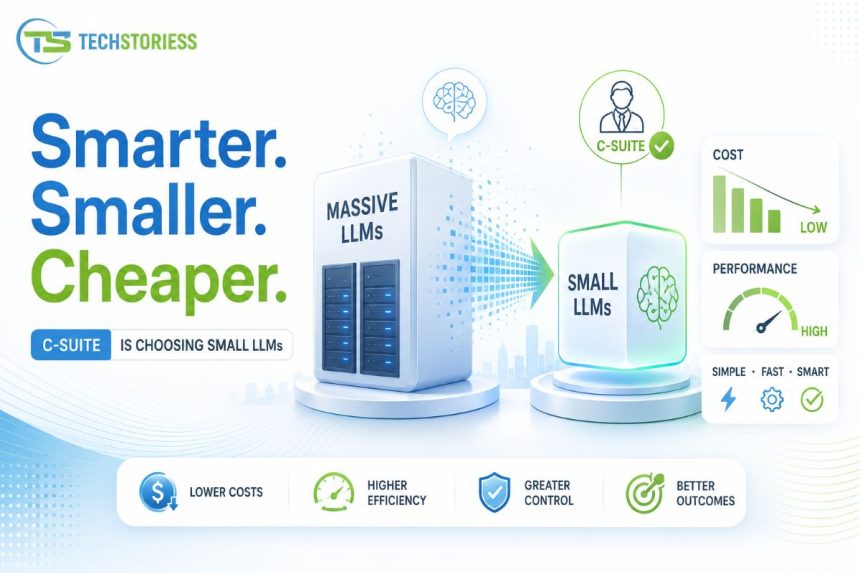
In early 2026, a deliberate structural shift is remaking enterprise technology strategy. Enterprises have recalibrated their evaluation criteria – moving away from raw model capability toward operational economics: the cost-per-inference ROI, and where data resides once it enters an inference pipeline.
During AI adoption’s first wave, many organizations routinely exposed sensitive corporate workflows to third-party frontier model APIs in 2023 and 2024, often with limited visibility into how that data was handled downstream. IBM’s Institute for Business Value 2026 CEO Study – surveying nearly 2,000 executives across 30+ countries – found that nearly 50% of respondents are now actively replacing single-model AI strategies with hybrid, multi-model architectures. That number signals something deeper than vendor diversification: it reflects a fundamental reassessment of where and how AI value is actually realized at enterprise scale.
Once the dominant default, trillion-parameter frontier models are being displaced as the primary enterprise AI layer – not because they failed at capability, but because they introduced unsustainable inference costs and compliance friction that compound sharply at operational scale.
The Doctrine of Appropriate Scale
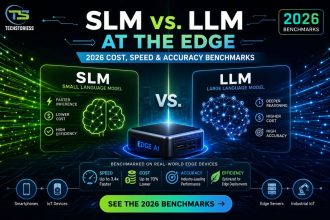
Instead of a single frontier model handling every workload, organizations are deploying purpose-fitted model ensembles: coordinated stacks where specialized smaller models handle high-volume, well-defined tasks – document classification, intent routing, structured data extraction – while frontier models are reserved for complex reasoning and synthesis where their scale is actually justified. This is the doctrine of appropriate scale: deploy the smallest model that can reliably execute the task, at the lowest possible total inference cost, while retaining full control over sensitive data residency, lineage, and governance. Financial services firms and healthcare systems are already operationalizing this architecture – routing compliance queries and clinical documentation workflows through on-premise SLMs, with Microsoft’s Phi-4 and Google’s Gemma 3 emerging as early reference deployments on Azure and Vertex AI respectively. Small Language Models – ranging from 1 billion to 15 billion parameters – are the defining instrument of that doctrine, and their adoption is accelerating across regulated industries, mid-market firms, and global enterprises that can no longer justify the operational overhead of one-size-fits-all frontier deployments.
The Economics That Changed the Boardroom Conversation
The financial case for SLMs is now quantifiable – and the numbers are difficult for enterprise CFOs and CTOs to ignore. Gartner’s June 2026 Infrastructure & Operations report estimates that running a purpose-built small model costs 10 to 30 times less than operating a frontier LLM at equivalent query volume. The same analysis determined that 40 to 70 percent of current enterprise LLM workloads – ticket classification, invoice field extraction, sentiment tagging – involve no cross-domain reasoning and could be handled by models a fraction of the size. These queries are being routed, unnecessarily, to the most expensive inference infrastructure in the stack.
At scale, that misalignment becomes a budget liability. Per-token API pricing converts unpredictable query volume into unpredictable spend – and a single traffic spike can produce an invoice that bears no relationship to the business value delivered. SLMs deployed within a private cloud or on-premises environment replace that exposure with a flat, forecastable operational expenditure. Finance teams can model it, defend it in quarterly planning cycles, and hold it to a cost-per-outcome standard. That predictability is converting AI infrastructure from a cost-control problem into a governed, scalable capability.
Compliance Is Now an Infrastructure Decision
For regulated sectors, the economics carry a second, non-negotiable dimension: compliance cost avoidance. Routing patient records, proprietary trading signals, or classified procurement data through an external frontier model API creates legal exposure under the EU AI Act, HIPAA, and a growing body of regional data residency regulation. SLMs eliminate that exposure by running inference entirely within the organization’s own infrastructure perimeter – no data crosses an external network boundary. In financial services, healthcare, and defense contracting, that single capability is sufficient to justify the architectural transition on its own terms.
From Chatbots to Orchestrated Swarms
The implications for enterprise workflows extend beyond inference cost optimization. CIO.com’s May 2026 examination of enterprise SLM deployments uncovered a recurring pattern: rather than deploying AI as a single conversational endpoint, organizations are deploying what practitioners term agentic swarms – orchestrated networks of specialized small models, each tuned for a discrete task, passing outputs between one another in a coordinated pipeline.
Workflow Design Is Becoming Multi-Model
A real world example illustrates the architecture concretely: a financial services firm handling thousands of contracts each day no longer needs to route the entire document through a single large model. Instead, it employs a purpose-built extraction model that captures structured contract data, feeds structured output into a validation model that verifies against regulatory requirements, and routes anomalous cases to a summarization model that prepares an executive brief for human review. The entire pipeline runs faster, operates at a fraction of the cost of the single-model equivalent, and is significantly easier to debug, audit, and upgrade one module at a time.
Low Latency Is Reshaping AI Architecture
DEV Community’s February analysis of LLM evolution recognized this paradigm shift – from single-model architecture to agent-orchestrated workflow – as the defining architectural movement of early 2026. The single-model assistant is becoming a legacy pattern. The emerging standard is orchestrated, domain-specific, and latency-optimized. Mission-critical environments – clinical settings, manufacturing floors, real-time customer service operations – demand near-instant inference in milliseconds, and only models with a compact mathematical footprint can consistently meet that bar.
Choosing the Right Instrument: A Decision the Hardware Makes for You
Within the SLM category, every model choice is an infrastructure decision. Performance is determined by infrastructure fit.
Phi-3: The Edge-First Architecture
Microsoft’s Phi-3 Mini, at 3.8 billion parameters, represents the edge-computing benchmark. Built around high-quality synthetic training data instead of raw token volume, Phi-3 punches significantly above its parameter count on structured reasoning, code generation, and document analysis tasks. Its standout enterprise feature is a 128,000-token context window, which allows an entire corporate quarterly report or a dense legal contract to be processed in a single prompt without losing contextual continuity.
At optimized INT4 quantization, Phi-3 runs in approximately 3.2 gigabytes of memory – meaning it operates natively on standard office server hardware, reduces dependence on scarce GPUs, and requires no specialized data center retrofitting.
Llama 3: Built for High-Throughput Workloads
Meta’s Llama 3 at 8 billion parameters addresses a different deployment profile. Trained on more than 15 trillion tokens, it carries wider linguistic coverage, stronger multilingual capability, and a conversational coherence that makes it the more appropriate instrument for customer-facing applications where tone, intent recognition, and multi-turn dialogue coherence matter. Its Grouped-Query Attention architecture enables high-volume throughput, making it well-suited for organizations handling large volumes of customer support interactions or bulk document queues. The hardware requirement – approximately 6.5 gigabytes at INT4 quantization – necessitates GPU-equipped enterprise servers rather than general-purpose servers, but scales cleanly across multi-GPU clusters under sustained load.
The procurement implication is equally clear: Phi-3 aligns with organizations prioritizing edge deployment, CPU-first infrastructure, and low-cost inference; Llama 3 is the GPU-cluster, high-throughput play optimized for scale and conversational depth. Neither is universally superior. What determines relevance is workload context.
The Router Architecture: 2026’s Most Practical AI Framework
The most AI mature enterprises are moving beyond treating SLMs and frontier LLMs as competing choices. They are deploying intelligent routing systems that use both, strategically and asymmetrically.
Why Intelligent Routing Changes the Economics
The emerging architectural pattern – observed across the IBM CEO study, the ACTGSYS mid-market implementation analysis, and CIO.com’s enterprise workflow reporting – is intelligent routing architecture: a lightweight decision layer that intercepts every AI request before inference and makes a binary routing decision before any model is invoked.
Approximately 80 percent of incoming enterprise queries – the structured, high-volume, routine enterprise workloads – are directed to on-premises small models running at minimal cost. The remaining 20 percent, characterized by genuine ambiguity, multi-domain reasoning requirements, or high-stakes creative complexity, are processed by a frontier cloud LLM. This asymmetry is where the economics of enterprise AI finally begin to close.
The Mid-Market Adoption Story
For small and mid-sized enterprises (SMEs), the ACTGSYS April 2026 implementation guide highlights a compelling pattern: firms that reduced dependence on frontier AI APIs with localized 1 billion to 14 billion parameter models eliminated token-cost volatility, resolved cloud data residency compliance gaps, and significantly reduced per-query AI costs to levels that allowed deployment across every department rather than rationing access to technical teams alone.
AI Has Entered Its Infrastructure Era
The shift from frontier-scale models to precision-engineered SLMs does not signal reduced AI ambition. It reflects how enterprise AI matures when it moves beyond proof-of-concept deployments into the operational discipline of a mature technology cycle. Organizations adopting intelligent routing architectures today are not hedging on AI. They are treating AI as enterprise infrastructure rather than experimental spend.