


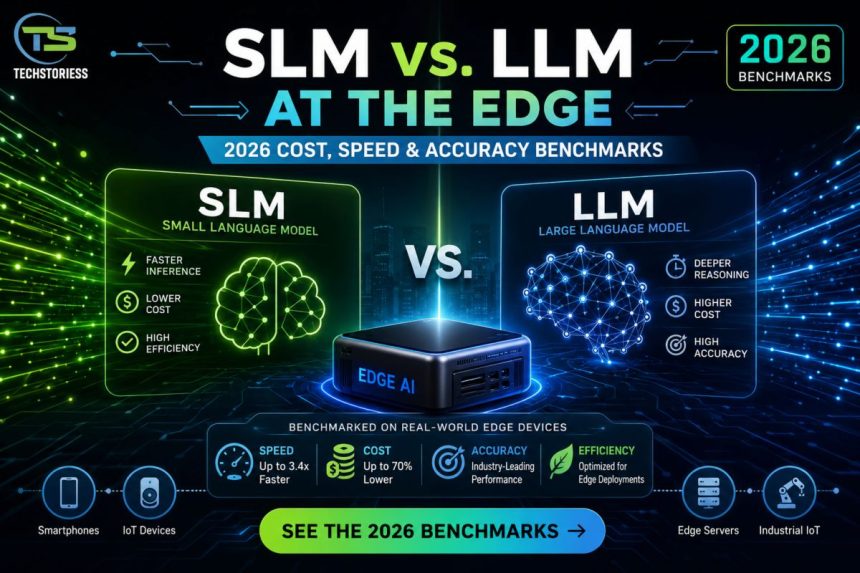
In the landscape of enterprise AI, a silent shift is underway. It is not about hyperscale data centers. This shift is happening at the edge SLM vs. LLM – inside devices such as IoT gateways, industrial controllers, retail systems, and handheld endpoints. Instead of scale efficiency, this shift is driven by practical deployment needs.
- The Benchmarking Gap: Lab Performance vs Deployment Reality
- Speed Is No Longer Defined by Raw Compute
- Cost Moves From Infrastructure to Efficiency
- Quantization Is No Longer an Optimization-It Is Foundational
- Hardware Defines the Ceiling
- Accuracy: The Misunderstood Trade-Off
- Real Deployment Patterns Are Driving Adoption
- Toward a Practical Architecture for Edge AI
- Conclusion — SLM vs. LLM
Along with shaping the conversation, large language models have also surfaced their limits. Practical constraints such as cost, latency, and deployment complexity have compelled organizations to reconsider where intelligence should reside. We can see this reconsideration in the numbers behind small language models edge deployment benchmarks 2026, revealing a different set of trade-offs-and advantages.
Along with the rise of smaller models, the context in which they are evaluated makes this shift important. A majority of benchmark narratives still originate in GPU-heavy environments, which are optimized for scale rather than constraint. In the real world, however, deployments often operate under practical constraints such as limited power budgets, specialized hardware, and strict latency requirements.
At this point, the story takes a new route.
The Benchmarking Gap: Lab Performance vs Deployment Reality
The current wave of benchmarking literature largely reflects how models behave in controlled environments-high-end GPUs, abundant memory, and stable throughput. These conditions are useful for research, but they do not reflect how enterprise systems actually run.
Edge environments impose constraints that fundamentally alter performance characteristics:
- Limited memory footprints
- Power-efficient processors
- Dedicated accelerators (NPUs, TPUs, ASICs)
- Intermittent connectivity
Under these conditions, the question is no longer how large a model can scale, but how efficiently a model can operate within boundaries.
This is the gap that small language models edge deployment benchmarks 2026 begin to address. They shift the focus from theoretical capability to practical viability-how models behave when deployed on actual hardware used in manufacturing, retail, and enterprise automation.
And the findings are not incremental. They are directional.
Speed Is No Longer Defined by Raw Compute
In GPU-centric benchmarks, performance is often measured in tokens per second, with larger models optimized through parallelism. At the edge, that framing breaks down.
Here, latency is influenced by:
- Model size and architecture
- Memory access patterns
- Hardware acceleration capabilities
- Quantization techniques
Measured across modern edge devices, small language models consistently deliver inference latencies in the range of 20 to 150 milliseconds for task-specific outputs. Larger models, even when compressed, struggle to achieve similar responsiveness without offloading to more powerful hardware.
This is where the comparison between SLM vs LLM edge performance becomes meaningful. It is not simply a matter of smaller models being faster. It is that they align more naturally with the constraints of edge hardware.
The result is not just improved speed, but predictable responsiveness-an attribute that becomes critical in real-time applications.
Cost Moves From Infrastructure to Efficiency
The economics of AI deployment change significantly at the edge. In cloud environments, cost is tied to compute consumption-GPU hours, memory usage, and data transfer. At the edge, the cost model shifts toward efficiency.
This is reflected in on-device AI inference cost, which is influenced by:
- Power consumption
- Hardware utilization
- Model optimization
Small language models reduce these costs in multiple ways. Their lower memory requirements allow them to run on less expensive hardware. Their reduced compute demands translate into lower energy consumption. And their ability to operate locally eliminates recurring cloud inference charges.
When evaluated over time, particularly in high-frequency inference scenarios, these savings compound.
What benchmarks reveal is that cost efficiency is not achieved through a single factor, but through the interaction of model size, hardware capability, and deployment architecture.
Quantization Is No Longer an Optimization-It Is Foundational
One of the most significant enablers of edge AI performance is the maturation of quantization techniques. What was once considered a trade-off-reduced precision for improved efficiency-has become a core design principle.
Modern quantized models in edge computing approaches allow small language models to operate at 8-bit or even 4-bit precision with minimal impact on accuracy for many enterprise tasks. This reduction in precision leads to:
- Lower memory usage
- Faster inference
- Improved compatibility with edge accelerators
Benchmarks show that quantized SLMs can achieve performance gains of 2–4x compared to their full-precision counterparts, while maintaining acceptable accuracy levels for domain-specific applications.
This shift is particularly important because it aligns model design with hardware capabilities. Edge devices are no longer forced to accommodate large models; models are being adapted to fit the devices.
Hardware Defines the Ceiling
The performance of small language models at the edge is inseparable from the hardware on which they run. Unlike cloud environments, where resources can be scaled, edge deployments are constrained by fixed hardware configurations.
The emerging landscape of edge AI chip comparison 2026 highlights a diverse ecosystem:
- NPUs integrated into mobile and embedded processors
- Dedicated AI accelerators in industrial gateways
- Custom ASICs optimized for inference workloads
Benchmarks across these platforms reveal a key pattern. Performance is not solely determined by raw compute power, but by how well the model aligns with the architecture of the chip.
For example:
- NPUs excel at low-power, parallel inference tasks
- ASICs deliver high efficiency for specific model types
- General-purpose CPUs lag in both speed and energy efficiency
This reinforces an important principle:
Model selection and hardware selection must be co-designed.
Accuracy: The Misunderstood Trade-Off
A common concern with smaller models is accuracy. Larger models, by virtue of their scale, tend to perform better on generalized tasks. However, enterprise use cases rarely require generalization at that level.
In domain-specific applications, small language models can achieve comparable accuracy when properly fine-tuned. Benchmarks show that for tasks such as:
- Document classification
- Intent recognition
- Structured data extraction
SLMs often reach accuracy levels within a narrow margin of larger models, while delivering significantly better performance in terms of latency and cost.
This is where small language model enterprise use cases gain traction. The focus shifts from universal capability to targeted effectiveness.
In practice, accuracy is not sacrificed-it is contextualized.
Real Deployment Patterns Are Driving Adoption
The growth in developer adoption of smaller models is not theoretical. It is driven by deployment realities.
Enterprises are increasingly prioritizing:
- Data privacy (keeping data local)
- Reduced latency (real-time interaction)
- Cost control (avoiding cloud inference expenses)
These priorities align naturally with edge deployments.
What benchmarks make clear is that the adoption curve is being shaped not by what models can do in ideal conditions, but by what they can sustain in operational environments.
Toward a Practical Architecture for Edge AI
As organizations move from experimentation to deployment, a consistent architectural pattern is emerging.
Small language models handle:
- Real-time inference
- On-device decision-making
- Context-aware processing
Cloud systems remain responsible for:
- Model training
- Large-scale analytics
- Cross-system coordination
This division reflects a broader shift toward distributed intelligence. It acknowledges that not all computation belongs in the cloud, and not all intelligence needs to be centralized.
Conclusion — SLM vs. LLM
When viewed in isolation, individual metrics about Small language models like latency, cost, or accuracy offer limited insight. When viewed together, they reveal a more coherent picture.
Small language models are not simply lighter versions of larger models. They are better suited to environments where constraints are not exceptions, but the norm.
The benchmarks clearly indicate that architectural alignment directly drives speed advantages, which allows systems to maintain efficiency even under specific workloads. Cost efficiencies are largely rooted in local processing, thus lowering dependency on centralized infrastructure and reducing operational overhead. At the same time, accuracy levels remain sufficient for targeted use cases. It makes these models practical despite not always matching large-scale systems.
More importantly, these benchmarks reveal that in the space of AI deployment the center of gravity is shifting from centralized systems to distributed architectures, where processing happens closer to the point of use. It also shows a clear shift from general-purpose models toward task-specific solutions with higher efficiency and practical applicability. The focus is also transitioning from theoretical capability to operational reliability, where uninterrupted and consistent real-world performance matters most.
And that, ultimately, is what makes small language models edge deployment benchmarks 2026 worth paying attention to.