


The real numbers behind AI power consumption – and what they mean for your electricity bill, the climate, and the future of the internet.
Have you ever wondered what happens in the background every time you type a question into ChatGPT? Let us take you behind the scenes: A data center somewhere draws a meaningful jolt of electricity to generate your response. That query – which takes a few seconds to complete – uses roughly ten times more energy than a standard Google search. The difference sounds abstract. But when you start multiplying it across millions of users asking millions of questions every hour of every day, you can understand the real significance of its impact.
AI query energy consumption is the defining infrastructure challenge of the decade. For many years, the environmental cost of AI generally remained hidden inside corporate sustainability reports and academic papers. However, with data centers topping 1,000 terawatt-hours of global electricity consumption annually, the numbers have grown too large to ignore. This article breaks down exactly where that energy goes, what it costs, and whether the industry is doing anything meaningful about it.
Each ChatGPT query roughly consumes 10× More energy than a Google search
Each AI query consumes as much energy as 20 min runtime of a LED bulb
Global data centers consume 1,000+ .. Terawatt-hours of energy
In the US 60% data centers still use fossil fuel for power
AI vs. Google Search: An Unequal Energy Exchange
Let’s compare the conventional search engine with AI queries to understand the real energy consumption by AI. A traditional Google search is extraordinarily efficient by design as Google spent years optimizing its index and retrieval systems. So, a search query on Google typically consumes somewhere in the range of 0.3 watt-hours of electricity – roughly the equivalent of leaving a small LED lamp on for a couple of seconds.
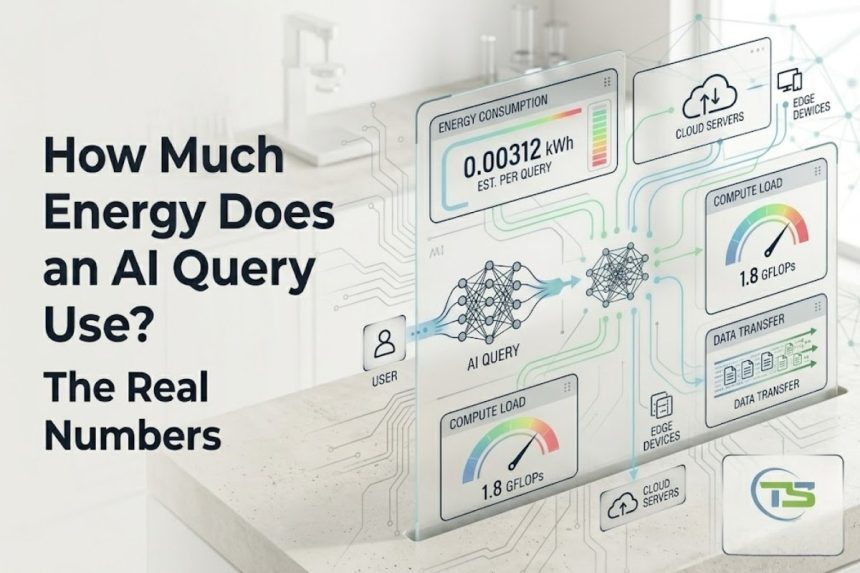
An AI language model inference request is entirely different. A large language model like ChatGPT doesn’t use pre-indexed results, but performs billions of matrix multiplications across specialized GPU hardware to generate each token in its response. The result: a single ChatGPT query uses approximately ten times more electricity than a Google search. According to some estimates it is placed around 2.9 to 10 watt-hours depending on query length, model size, and infrastructure efficiency.
Relative energy use per query
Google ~0.3 Wh which is equivalent to 20 minutes of led bulk runtime
As opposed to this ChatGPT consumes 3–10 Wh
Generating a single AI response consumes the energy equivalent to running a standard 10-watt LED bulb for 20 minutes. In isolation it is a small number, but consider this: ChatGPT alone reported over 100 million active weekly users as of early 2024. Even conservative estimates of query volume quickly scale that single-bulb figure into something that rivals the electricity consumption of entire nations.
A single AI query is the energy equivalent of running an LED bulb for 20 minutes. Multiply that by hundreds of millions of daily queries, and the scale becomes staggering.
Inside the Data Center: Where the Power Goes
By exploring the data centers we can understand the environmental cost of AI. These are not simple server closets – they are enormous, purpose-built facilities with cooling systems, power distribution infrastructure, and row upon row of GPU clusters drawing continuous, substantial loads.
In a modern AI data center, approximately 60% of electricity is consumed by the servers themselves – the processors and storage systems that handle computation and data retrieval. The remainder goes to cooling (which is substantial, given how much heat GPU clusters generate), power conversion losses, networking infrastructure, and facility overhead. This metric, known in the industry as Power Usage Effectiveness (PUE), has improved over time, but even the most efficient hyperscale facilities still see meaningful overhead losses.
The fast increasing demand for data center power per AI request has driven an unprecedented construction boom. Microsoft, Google, Amazon, and Meta have each announced multi-billion-dollar investments in new data center capacity over the next five years. The International Energy Agency projects that data centers could account for up to 4% of global electricity consumption by 2026 – a figure that was closer to 1–2% just a decade ago.
The Fossil Fuel Problem That Renewables Haven’t Solved
As environment responsible firms large Tech companies have spent years building reputations. They frequently pledge ambitious renewable energy targets and carbon neutrality by various dates. The reality on the ground is considerably more complicated. Despite years of renewable procurement announcements, over 60% of US data center power still comes from fossil fuel sources – primarily natural gas – when accounting for actual grid supply rather than purchased renewable energy credits.
The distinction significantly matters. Buying a renewable energy certificate does not mean that the electrons powering your servers came from a wind farm. It means a wind farm somewhere on the grid generated an equivalent number of kilowatt-hours. When AI inference workloads run at 2 AM drawing enormous bursts of power, they are drawing from whatever the grid is producing at that moment – and in most US regions, that still includes significant natural gas generation.
Accountability Watch
Google, Microsoft, and Meta have all quietly walked back or delayed their near-term climate commitments in recent years, citing the explosive growth in AI infrastructure demand as a primary reason. Carbon neutrality pledges that once had firm 2025 or 2030 targets have been restructured, extended, or reframed – a pattern advocates and analysts have called “greenwashing by recalibration.”
The more honest accounting framework gaining traction among serious researchers is 24/7 carbon-free energy (CFE) – matching electricity consumption to clean generation on an hourly basis, in the same grid region where consumption occurs. This is a far more demanding standard than annual renewable matching, and only a small minority of large operators are currently committed to it. It is, however, increasingly recognized as the only credible measure of genuine decarbonization.
What AI Energy Costs Mean for Your Electricity Bill
The AI energy consumption surge is not just an environmental abstraction – it is beginning to translate into concrete costs for ordinary households. As AI data centers multiply and existing facilities expand, the grid infrastructure required to serve them must be upgraded: new transmission lines, upgraded substations, additional generation capacity, and expanded distribution networks. These are capital-intensive investments that utilities recover through rate increases.
Industry analysts estimate that AI-driven grid upgrade requirements could add $15 to $25 per month to the average US household electricity bill beginning in the latter half of this decade. The timeline varies by state and utility, with regions that have become data center hubs – Northern Virginia, Arizona, Texas, and parts of the Pacific Northwest – likely to see the earliest and steepest increases.
For enterprise customers directly purchasing AI inference services, the cost trajectory is similarly upward. As power costs rise for hyperscale operators, those costs will increasingly be passed through to business customers. Analysts at several research firms project that AI inference costs will begin rising measurably for enterprise customers starting in late 2026, reversing a multi-year trend of declining per-token pricing driven by efficiency gains.
Can Technology Solve the Problem It Created?
The AI industry is not sitting still on the efficiency question. A significant and growing body of research focuses on reducing the energy cost of inference – the process of running an already-trained model to generate responses – through techniques that do not sacrifice meaningful capability.
Efficiency Techniques Gaining Traction
Model distillation: Training smaller “student” models to replicate the behavior of larger models, achieving similar outputs with a fraction of the compute.
Quantization: Reducing the numerical precision of model weights from 32-bit floating point to 8-bit or 4-bit integers, dramatically cutting memory bandwidth and compute requirements.
Sparse activation: Architectures that only activate relevant portions of a model for any given query, rather than running the full network for every request.
Speculative decoding: Using a small draft model to predict multiple tokens ahead, verified by the larger model in parallel, increasing throughput without proportional energy increases.
The results of these approaches are meaningful. Model distillation and quantization together can reduce inference energy consumption by up to 40% compared to running full-precision models – a significant gain, though one that is being rapidly absorbed by the overall growth in query volume. Efficiency improvements in AI have historically followed a pattern similar to Jevons Paradox in economics: as costs per query fall, total usage increases faster than efficiency gains, resulting in higher absolute energy consumption even as the energy intensity per query declines.
The New Standard: 24/7 Clean Energy
The shift from annual renewable offset matching to 24/7 carbon-free energy as the meaningful accountability benchmark is perhaps the most important structural change happening in how the tech industry approaches its environmental footprint. Annual matching allows a company to purchase solar credits generated on summer afternoons to offset electricity consumed during winter nights – a temporal mismatch that obscures the actual carbon intensity of operations.
Hourly matching requires that for every hour of the day, the clean energy generated on the same grid covers the electricity consumed. Google has been the most prominent advocate of this approach, committing to operate on 24/7 clean energy by 2030 across all its data centers globally. Microsoft has made similar commitments, though with varying specificity by region. The growing adoption of this standard – pushed by advocacy from energy researchers and the UN-backed 24/7 Carbon-Free Energy Compact – represents a genuine shift toward more honest accounting.
For AI specifically, the challenge is particularly acute. Unlike many data center workloads that can be scheduled during periods of clean energy availability, AI inference is largely demand-driven – users expect near-instant responses at any hour, making load-shifting difficult. This makes the buildout of dispatchable clean energy (hydro, geothermal, long-duration storage, and eventually next-generation nuclear) more critical than intermittent solar and wind alone can provide.
What Should Informed Users and Businesses Do?
For individual users, the honest answer is that personal consumption choices have limited aggregate impact on a problem of this scale. The energy cost of AI is structural – it is baked into model architecture, data center geography, and grid composition in ways that individual query habits cannot meaningfully shift. That said, awareness has value: understanding that AI queries carry real energy costs encourages more intentional use and creates informed demand for transparency from AI providers.
For businesses integrating AI into products and workflows, the calculus is more consequential. As enterprise inference costs begin rising in late 2026, organizations that have built high-volume AI workflows without efficiency consideration will face meaningful cost pressure. Investing now in model selection (choosing appropriately sized models for tasks rather than defaulting to the largest available), query batching, caching strategies, and output length management can yield both cost and environmental benefits. Asking AI vendors for emissions data – and taking those numbers seriously in procurement decisions – also sends a market signal that has historically proven effective in pushing corporate behavior.
The broader picture on AI query energy consumption is one of genuine tension between transformative technological capability and substantial environmental and infrastructure cost. The numbers are large, the trends are accelerating, and the solutions are partial. What the evidence does not support is the comfortable fiction that AI’s energy footprint is someone else’s problem – it is increasingly a shared one, priced into grids, embedded in bills, and measured in carbon that will need to be accounted for one way or another.