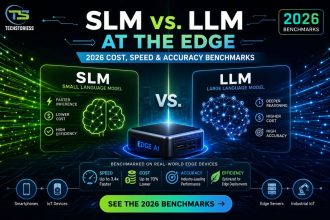



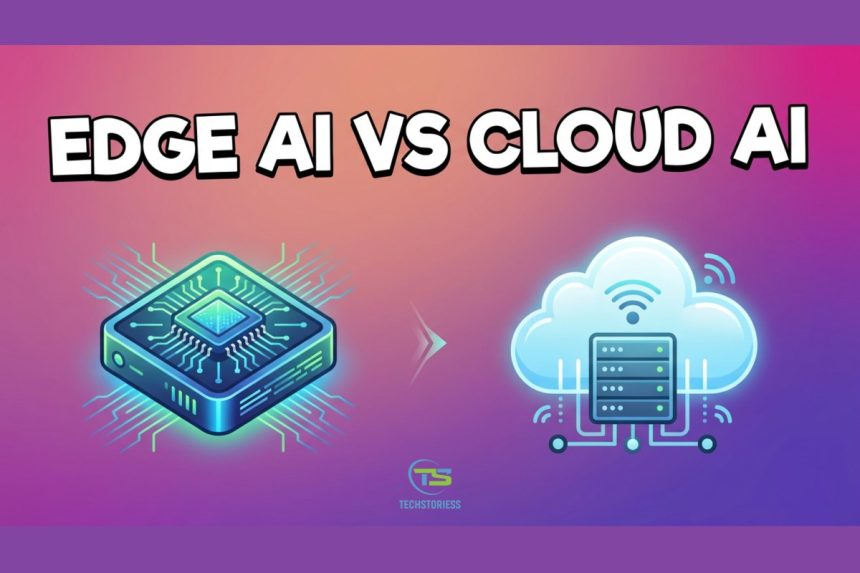
Edge artificial intelligence (edge AI) and cloud artificial intelligence (cloud AI) are two major AI deployment types with many similar features. That’s why many users easily confuse the two. However, along with many similarities there are several key differences that set them apart in terms of deployment, performance, and use cases.
Edge AI focuses on deploying and executing AI algorithms and models on IoT devices such as thermostats, wearable health monitors, and smartphones. Edge AI is a kind of distributed computing where AI-powered applications run closer to the data source to enable faster processing and real-time responses.
On the other hand, Cloud AI is designed around centralized computing, depending heavily on virtual compute resources that are accessed over the internet—technically known as cloud computing.
Both work equally efficiently for supporting advanced data processing and analytics but differ significantly in where AI models are executed, how data is stored and processed, thus they differ greatly when it comes to use cases and benefits.
What is edge AI?
Edge AI devices don’t depend on the internet to function, which makes them a perfect solution for environments with no or limited connectivity like remote locations, industrial sites, and moving assets. As AI can efficiently handle workloads offline, organizations don’t have to rely on uninterrupted network access.
Right from traditional businesses like retail and manufacturing to more complex industries like autonomous transportation, healthcare, and aerospace, growth-oriented businesses are proactively experimenting with edge computing to multiply productivity, gain faster insights, control crucial data, and improve operational resilience.
What is cloud AI?
Cloud AI is an AI type with data processing and analytical capabilities that runs on cloud infrastructure. After collecting the data at its source, it is transferred to the cloud via an internet connection. In the cloud, it can access virtual compute resources connected for large-scale data processing, advanced analytics, and long-term data storage.
Cloud AI is ideal for deploying intensive AI applications that are too computationally demanding and data-intensive to be run directly on edge devices. For instance, deep learning model training, large DL models, and specific NLP applications for predictive and trend analytical capabilities.
Key differences between Edge AI vs Cloud AI

Both edge AI and cloud AI enable intelligent data processing and automation. However, they are fundamentally different underlying architectures. It directly impacts the performance of each model in real-world scenarios, especially in areas like response time, computing capacity, data security, and network dependency. To select the ideal model that satisfies specific operational and business requirements it is important to understand these distinctions.
Computing power
As opposed to Edge AI, which can only utilize the compute resources available on individual edge devices, Cloud AI can access virtually unlimited compute resources through the internet, such as GPUs, CPUs, TPUs, data centers, and distributed systems. This offers far greater capabilities when it comes to computational scale and flexibility.
Low latency
Through data processing at a local device level, Edge AI significantly speeds up workloads and saves time and resources required for data transfer. Cloud AI, on the other hand, depends on remote servers and data centers for processing, which introduces latency and increases dependency on network performance.
Bandwidth
Bandwidth usage is another major differentiator between Cloud AI and Edge AI. Cloud AI requires high bandwidth to transmit data to remote servers, whereas Edge AI operates efficiently with low bandwidth by processing data locally.
Security
When it comes to security, Edge AI clearly surpasses Cloud AI as it stores sensitive data locally on the device where it is collected and processed. This reduces data exposure risks.
Cloud AI stores sensitive data in centralized environments, which passes through network gateways and increases exposure to unauthorized access.
Edge AI Use Cases
Edge AI focuses on local processing of data instead of depending on centralized cloud infrastructure. This approach plays a crucial role in high demanding scenarios that need ultra-low latency, offline reliability, real-time decision-making, and strong data privacy. Edge AI is recommendable for time-sensitive environments or environments with unreliable connectivity.
Autonomous vehicles
Autonomous vehicles operate in highly dynamic, real-time environments where conditions change unpredictably and safety stakes are extremely high. These systems require both precision and speed to navigate changing road conditions, unexpected obstacles, sudden pedestrian movement, and complex human driving behavior—any of which can shift within milliseconds. Even minor delays can significantly impact outcomes, making reliance on remote cloud processing risky due to latency and fluctuating network conditions.
Edge AI enables data to be stored and processed locally within the vehicle. Continuous inputs from cameras, radar, LiDAR, and ultrasonic sensors allow split-second decisions without loss of accuracy. By operating independently of cloud connectivity, Edge AI ensures instant responsiveness and improved safety at all times.
• Enables real-time, safety-critical decision-making
• Eliminates dependency on external network connectivity
• Stores sensitive sensor and location data locally
Predictive maintenance in manufacturing
Modern manufacturing environments generate massive volumes of sensor data from motors, machines, and production lines. Preventing equipment failures requires this data to be analyzed continuously and acted upon immediately. Edge AI processes sensor signals directly on factory equipment or nearby gateways, allowing instant detection of anomalies such as vibration changes, abnormal temperatures, or performance degradation.
Localized intelligence reduces the need to transmit raw data to the cloud and enables rapid intervention—even in facilities with limited or no network connectivity.
• Instantly detects faults and prevents unplanned downtime
• Minimizes data transfer and reduces network dependency
• Supports operations in low-connectivity or disconnected environments
Smart video surveillance
Video surveillance systems generate enormous volumes of visual data, making continuous cloud streaming inefficient and costly. Edge AI allows cameras and local systems to analyze video feeds in real time, detecting unusual behavior, unauthorized access, or safety violations as they occur.
By processing video data locally, organizations can respond instantly to threats while maintaining privacy—an essential requirement in public spaces, transportation hubs, and critical infrastructure.
• Enables instant detection and real-time alerts
• Reduces data transmission and strengthens privacy
• Lowers cloud storage and bandwidth costs
Wearable healthcare devices
Wearable healthcare devices continuously collect sensitive biometric data such as oxygen saturation, heart rate, blood pressure, and movement patterns. Edge AI enables local analysis without relying on constant internet connectivity, delivering immediate insights and alerts without cloud-induced delays.
This is especially important for patients requiring continuous monitoring or living in regions with unreliable connectivity. Local processing also helps meet strict healthcare data privacy requirements.
• Delivers real-time health insights and alerts
• Protects sensitive medical and personal health data
• Operates reliably without constant connectivity
Cloud AI Use Cases
Cloud AI is capable of processing enormous datasets, training complicated models, and delivering intelligence across distributed systems- thanks to the centralized, scalable computing infrastructure. It is ideal for instances that demand high computational power, global accessibility, elastic scalability, and constant learning across large data volumes.
Large-scale AI model training
Training advanced AI models requires vast datasets, high-performance computing resources, and extended processing cycles. Infrastructure such as GPUs, TPUs, and distributed systems is expensive to build and maintain on-premises. Cloud AI provides scalable, on-demand resources optimized for large-scale model training.
This enables organizations to train and refine models efficiently without heavy upfront infrastructure investments.
• Accelerates training of complex AI models
• Supports experimentation with massive datasets
• Reduces infrastructure and maintenance costs
Enterprise business intelligence
Modern organizations generate data across multiple applications, departments, and regions, creating the need for a unified analytics approach. Cloud AI centrally aggregates and analyzes this data, delivering real-time insights such as predictive forecasts, dynamic dashboards, and actionable intelligence.
A centralized cloud foundation provides decision-makers with a comprehensive view of business performance, enabling faster responses to internal trends and market changes.
• Provides a single source of truth for enterprise analytics
• Scales easily with growing data volumes
• Enables faster, data-driven decision-making
Large-scale natural language processing
NLP applications such as sentiment analysis, document classification, and language translation require massive computing power and extensive datasets. Cloud AI enables organizations to process large volumes of multilingual text data across regions.
Centralized infrastructure allows NLP models to continuously improve accuracy, contextual understanding, and adaptability over time.
• Efficiently processes massive text datasets
• Improves accuracy through centralized learning
• Supports multilingual and global workloads
Customer support chatbots
AI-powered chatbots must manage thousands of customer interactions simultaneously while maintaining consistent response quality. Cloud AI provides the scalability and centralized intelligence needed to support high-volume conversational workloads.
By learning from interactions across channels, chatbots continuously improve and deliver more personalized, accurate, and context-aware responses.
• Ensures consistent customer experiences globally
• Continuously learns from large interaction volumes
• Integrates seamlessly with enterprise systems
Conclusion
Edge AI and Cloud AI represent two distinct approaches designed to address different operational needs. Edge AI is best suited for scenarios that demand real-time responsiveness, offline reliability, and stronger data privacy—particularly in time-critical and connectivity-constrained environments.
Cloud AI, on the other hand, is ideal for resource-intensive workloads, offering vast computing power, scalability, and centralized intelligence for advanced model training, large-scale analytics, and enterprise-wide AI deployments. Understanding the strengths and limitations of each enables organizations to strategically combine edge and cloud AI, creating efficient, resilient, and future-ready AI architectures that enhance flexibility, performance, and business value.