


Industrial automation is fast transitioning from the experimental phase to large-scale commercial deployment. For a long time the factories relied on traditional automation systems like fixed robotic arms, conveyor systems, and software-driven workflows operating within carefully controlled environments. In 2026, a new shift is emerging that is making automation more adaptive, mobile and intelligent: humanoid robots that can efficiently navigate through real-world industrial spaces, understand human instructions, and perform physical tasks with increasing accuracy and precision.
- Tesla Optimus – The Most Closely Watched Industrial Humanoid
- Figure AI Figure 03 – Figure AI’s Fast-Rising Industrial Platform
- Boston Dynamics Atlas – The Benchmark for Robot Dexterity
- Agility Robotics Digit – The Warehouse Automation Specialist
- Unitree Robotics G1 – Affordable Humanoid Robotics at Scale
- Sanctuary AI Phoenix – Human-Like Task Execution
- Apptronik Apollo – Designed for Collaborative Industrial Work
- Fourier Intelligence GR-1 – China’s Expanding Robotics Ambition
- UBTECH Robotics Walker S – Smart Manufacturing Integration
- Engineered Arts Ameca – The Human Interaction Specialist
- Why Physical AI Is Becoming the Core of Industrial Automation
- CES 2026 Confirmed the Humanoid Robotics Race Has Accelerated
- The Biggest Challenge Still Facing Humanoid Robots: Dexterity
More than just the arrival of advanced robotics, it represents the convergence of machine learning, large-scale manufacturing, and something we term as physical AI. While conventional automation systems repeat narrowly programmed actions and operate within fixed environments , physical AI empowers robots to observe surroundings, understand context autonomously, respond dynamically, and improve task execution through real-time data processing.
We can already witness this shift across many warehouses, automotive plants, logistics centers and assembly operations. For instance, big tech companies like Amazon have started deploying Digit robots in warehouse environments, while Tesla continues accelerating development of the Tesla Optimus robot, Moreover this transition is also driving investments into startups such as Figure AI – a humanoid robotics company that has attracted unprecedented investment. By 2028 analysts expect the Physical AI market to be a $38 billion industry, a clear indicator that humanoid robotics is continuously moving from research laboratories into commercial infrastructure.
At CES 2026 – a global technology showcase that highlights next-generation innovation , over 12 new humanoid prototypes were showcased, which reflects the fast expanding speed of the competitive landscape. Across the showcased robots some are designed for repetitive warehouse operations, while others demonstrate advanced robot dexterity, delicate handling, enterprise level automation, or collaborative manufacturing tasks.
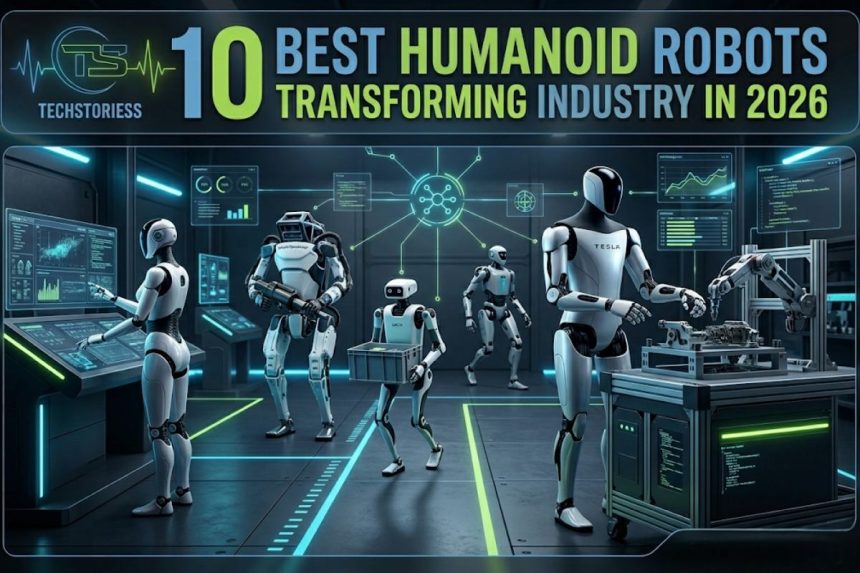
Below we list 10 best humanoid robots that will play a decisive role in industrial automation 2026.
Tesla Optimus – The Most Closely Watched Industrial Humanoid
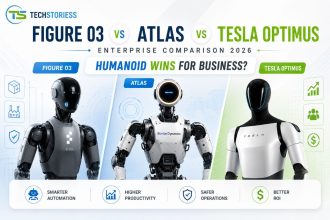
Among others the Tesla Optimus robot certainly stands out . It has already attracted unprecedented industrial curiosity. Initially thought to be another ambitious side project, Optimus has steadily evolved into a serious automation platform capable of performing repetitive factory and logistics work much faster and more efficiently than conventional industrial robots.
Tesla has strategically combined multiple technological disciplines including AI training, computer vision, battery technology, and manufacturing scale under one ecosystem. Typically robotics firms must outsource at least some of their production capabilities which result in higher operational costs but Tesla with its existing automotive infrastructure can theoretically mass-produce humanoid units.
Projected affordability remains the one of the most discussed conversational topics . The company has repeatedly indicated a long-term target price in the range of $20,000 and $30,000 per unit. This projected price point can reshape industrial labor economics if achieved at scale.
This robot is optimized for industrial tasks such as:
- Material handling
- Warehouse transport
- Factory line assistance
- Inventory movement
- Hazardous environment operations
The most distinguishing characteristic of Optimus when compared to earlier industrial robots is its emphasis on adaptability. To make it more commercially feasible for industries the model is being trained to work within human-designed environments rather than functioning inside fenced automation cells.
The continuous progress and increasing capabilities of Optimus has also intensified industry focus on robot dexterity, especially within manufacturing and logistics such as hand coordination and object manipulation – the most challenging areas of robotics.
Figure AI Figure 03 – Figure AI’s Fast-Rising Industrial Platform
Figure AI has definitely gained the highest visibility in the global humanoid robotics startup ecosystem. The company gained global attention when Figure AI raised $675 million from investors including some of the most prominent names in technology and AI.
Figure AI robot or Figure 03 platform serves as its flagship humanoid robot, and is specifically engineered for industrial deployment rather than consumer entertainment, a decisive distinction. Contrary to many robotics companies showcasing visually impressive demos, Figure AI has constantly focused on industrial utility including warehouse movement, object handling, and real operational integration.
The company has been actively collaborating with manufacturing firms and logistics operators indicating a broader strategy towards achieving scalable industrial automation.
Its Key strengths include:
- Advanced AI-assisted movement
- Real-time object recognition
- Multi-step task execution
- Human-like mobility in constrained spaces
- Industrial workflow compatibility
Figure AI also indicates the fast industry-wide shift toward embodied intelligence – systems where AI goes beyond software interfaces to physically interact with the environment and perform tasks autonomously.
With warehouse automation robots gaining higher popularity Figure AI is emerging as one of the strongest competitors to Tesla in the humanoid automation race.
Boston Dynamics Atlas – The Benchmark for Robot Dexterity
For years, Boston Dynamics has been the company known for its innovative, futuristic robotics. Earlier Atlas demonstrated acrobatics and viral mobility videos that captured worldwide attention, but its latest generation reflects a steady move towards a more commercially focused direction.
The latest Atlas platform is increasingly aligned with industrial automation objectives, particularly in work environments that demand balance, movement precision, and robot dexterity as critical operational requirements.
Looking at the mobility capabilities and engineering sophistication it would be reasonable to term Atlas as the most advanced humanoid systems ever built in terms of dynamic motion. It demonstrates exceptional dexterity and stability in navigating uneven surfaces, rapid balance recovery, and movement execution that is far beyond the capabilities of conventional warehouse robots.
Due to its advanced mobility systems Atlas offers industrial applications including :
- Heavy-part handling
- Dynamic warehouse navigation
- Complex inspection routines
- Maintenance assistance
- High-risk industrial tasks
Many years of research into real-world mobility has benefited Boston Dynamics significantly. Unlike conventional fixed robotic systems, Atlas is specially architected for unpredictable and continuously changing environments.
With an increasing number of factories seeking more flexible automation systems, Boston Dynamics can become a central player in high-performance industrial robotics.
Agility Robotics Digit – The Warehouse Automation Specialist
While many humanoid robots remain experimental, we need the model that appears the most practical in the present market landscape . In this area Digit commands a strong position as one of the most practical warehouse automation robots currently gaining commercial attention.
Rather than broad humanoid experimentation Digit was purpose-engineered for logistics environments. This narrowly focused approach helped accelerate commercialization. It is especially structured to prioritize efficient walking, navigating warehouse spaces , package movement, and handling repetitive warehouse workflows with greater precision.
Moreover deployment and testing of Digit robots by the ecommerce giant Amazon further validates the growing global commercial demand for humanoid logistics automation.
The strongest benefits of Digit’s include:
- Reliable bipedal movement
- Package transportation capability
- Compatibility with existing warehouse layouts
- Reduced need for infrastructure redesign
- Human-safe collaborative operation
Recognizing the challenges of fully customized automation systems that demand massive facility modifications, Digit is engineered to easily operate inside human-centric spaces. With more companies attempting to modernize fulfillment centers without rebuilding entire facilities that flexibility is becoming increasingly valuable.
Unitree Robotics G1 – Affordable Humanoid Robotics at Scale
Unitree, a Chinese robotics company, is steadily making its mark in the market by focusing on affordability and speed of iteration- something that makes it a strong contender for the mass market.
Unitree G1 is demonstrating the way robotics manufacturing in Asia has been reshaping global competition. By significantly lowering down the price barriers Unitree is making industrial humanoids more commercially accessible to a wider range of businesses .
The company strongly reflects a broader industry trend: humanoid robots are expanding beyond elite research labs to commercial manufacturing sectors .
The growing visibility and industry discussions around Unitree’s also highlights how industrial automation in 2026 will likely turn into a global competition involving American, Chinese, and European robotics ecosystems simultaneously.
Sanctuary AI Phoenix – Human-Like Task Execution
Heavily focusing on generalized labor automation Sanctuary AI has developed the Phoenix humanoid robot. Engineered to support adaptable task execution rather than single-purpose workflows, this approach differentiates the platform from traditional industrial robots.
This is a notable approach as many industries struggle with tasks that vary slightly from one action to another – instances that traditional automation often can’t handle.
Phoenix strongly focuses on:
- Fine motor control
- Adaptive movement
- AI-driven task learning
- Human-machine collaboration
- Real-world manipulation accuracy
With rapidly evolving physical AI, systems like Phoenix position them as valuable automation assets in sectors demanding flexible labor assistance instead of rigid industrial programming- like retail logistics and light manufacturing.
Apptronik Apollo – Designed for Collaborative Industrial Work
Apptronik continues working to create a commercially deployable humanoid that is optimized to function safely within industrial environments.
Instead of primarily a technology spectacle, Apollo emphasizes practical capabilities like ergonomic movement, collaborative safety, and repetitive industrial task management- capabilities that industries increasingly require .
Some of the Potential deployment sectors where the model can create significant value include:
- Automotive manufacturing
- Supply chain logistics
- Retail backroom automation
- Warehouse operations
- Material transfer systems
The engineering philosophy of the company focuses on making humanoid robots practical coworkers that can be integrated alongside human teams rather than isolated robotic machines confined to restricted automation zones .
Fourier Intelligence GR-1 – China’s Expanding Robotics Ambition
Developed by Fourier Intelligence GR-1 humanoid robot reflects the rapid expansion of Chinese robotics development.
Initially Fourier was associated with healthcare and rehabilitation technologies, but of late the platform is increasingly demonstrating industrial potential.
Fourier GR-1’s growing capabilities in areas like mobility, balance control, and manipulation demonstrate the rapid improvements in robot dexterity standards.
UBTECH Robotics Walker S – Smart Manufacturing Integration
Through its Walker series UBTECH has steadily expanded its industrial robotics ambitions to smart manufacturing environments.
Walker S particularly emphasizes on smart manufacturing ecosystems where humanoid robots can efficiently interact with AI-driven factory management systems.
The Key industrial goals of Walker S include:
- Factory inspection
- Automated transport
- Equipment monitoring
- Human collaboration
- Intelligent manufacturing support
With more smart factories becoming software-connected, robots like Walker S are likely to serve as physical extensions of industrial AI systems to improve operational efficiency.
Engineered Arts Ameca – The Human Interaction Specialist
Famous for its conversational realism and expressive facial design, Ameca’s underlying technologies also remain strongly relevant to industrial robotics evolution.
With humanoid robots sharing work environments with human workers, machine interaction will become increasingly important.
By developing realistic communication and response systems the company could eventually influence industrial collaboration models that would need robots to naturally and safely interpret human instructions.
Why Physical AI Is Becoming the Core of Industrial Automation
The rise of humanoid robots is closely tied to physical AI.
Conventional artificial intelligence largely existed inside digital environments like chatbots, recommendation engines, and software automation systems. Physical AI takes this intelligence into real-world movement, perception, and action.
This includes advanced capabilities such as:
- Spatial awareness
- Object manipulation
- Motion planning
- Environmental adaptation
- Autonomous decision-making
It promises enormous industrial value as factories and warehouses represent dynamic continuously changing environments. The working efficiency depends on constantly improvising around obstacles, changing inventory positions, damaged packaging, or other unexpected workflow interruptions.
Equipped with physical AI humanoid robots are being trained globally to handle those variables more naturally and efficiently.
Industry forecasts indicate that the Physical AI market could reach $38 billion by 2028. It reflects a fast growing confidence that intelligent robotics will emerge as a major economic sector rather than a niche technology category.
CES 2026 Confirmed the Humanoid Robotics Race Has Accelerated
CES 2026 highlighted the quickly evolving humanoid robotics market.
Over 12 new humanoid prototypes were introduced during the event, with applications ranging from warehouse assistance to highly advanced mobility systems like humanoid robots capable of dynamic object handling.
More than the number of displayed robots, the significance of CES 2026 was the shift in commercial seriousness. As opposed to earlier robotics showcases that often focused on curiosity, entertainment or futuristic concepts the latest generation is heavily focusing on commercial utility including industrial deployment, operational efficiency, and scalable manufacturing integration.
This change indicates the era where industry is evolving- rapidly moving beyond experimentation to an early commercialization phase.
The Biggest Challenge Still Facing Humanoid Robots: Dexterity
While the industry is making rapid progress, robot dexterity still remains one of the key challenges for the industry.
Tasks and capabilities like walking navigation systems and vision-based AI models continue advancing rapidly.
But it is extraordinarily difficult to replicate human hands.
Industrial environments demand:
- Precision gripping
- Multi-object manipulation
- Adaptive force control
- Tool handling
- Fine motor coordination
The next decade of industrial automation will be dominated by the companies that solve dexterity at scale.
Conclusion
The race to build the best humanoid robots for industrial automation 2026 demonstrates a major shift from traditional automation systems to adaptive intelligent robotics . Prominent technology companies, logistics giants, and AI startups are now investing seriously into systems engineered to directly operate inside human environments.