


The remote access security narrative has moved well beyond incremental upgrades. What once appeared to be a routine infrastructure decision-whether to scale VPN capacity or optimize remote connectivity-has now evolved into a broader question of risk posture, architectural relevance, and long-term control. In 2026, the debate around zero trust network access vs VPN is no longer theoretical. It is operational, budget-backed, and in many cases, overdue.
- From Network Trust to Identity Context: The Core Shift
- Where VPN Still Fits-and Where It Doesn’t
- Real-World Use Cases Driving the Shift
- ZTNA Migration Guide: From Theory to Execution
- Decision Tree: Choosing the Right Path in 2026
- Market Reality: Beyond the Hype
- Network Access Control in 2026: A Structural Shift
- Conclusion
The urgency is not being driven by vendors alone. Independent research continues to highlight structural weaknesses in legacy VPN models. According to the Zscaler ThreatLabz 2025 VPN Risk Report, 65% of enterprises plan to replace VPNs within the next 12 months, while over half have already experienced VPN-related security incidents. These are not edge cases-they reflect systemic exposure tied to how VPNs were originally designed: to extend trust, not continuously validate it.
At the same time, enterprise environments have shifted dramatically. Applications are no longer confined to data centers. Users are no longer inside predictable perimeters. And attackers are no longer limited to perimeter probing-they now operate with automation, credential harvesting, and lateral movement as default tactics. In this context, choosing between VPN and ZTNA is not about performance optimization. It is about aligning access control with how modern systems actually behave.
From Network Trust to Identity Context: The Core Shift
To understand the ZTNA vs VPN security comparison, it is important to move beyond surface-level definitions and examine the underlying trust models.
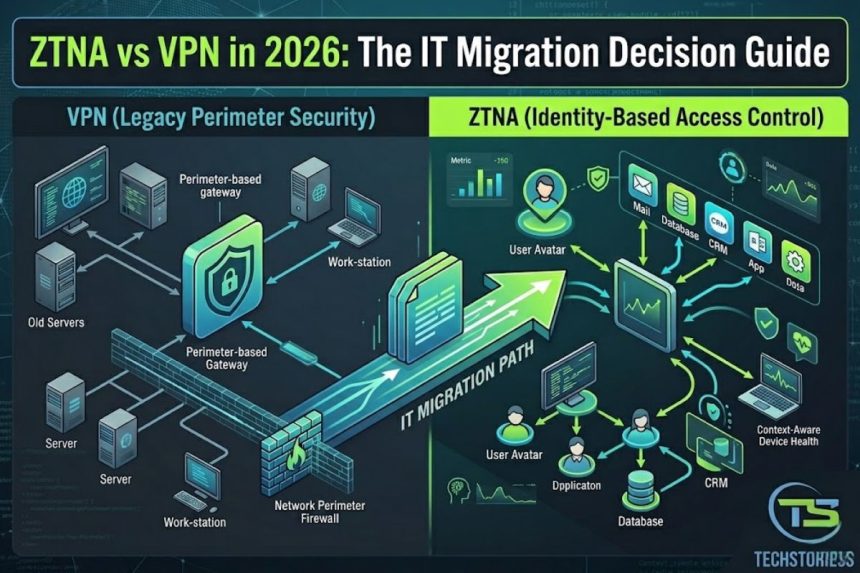
VPNs were designed in an era where network location implied trust. Once authenticated, a user was effectively placed inside the network boundary, gaining broad access based on network segmentation rules. This model assumes that users, devices, and sessions remain trustworthy after initial verification. That assumption no longer holds.
ZTNA, by contrast, operates on a fundamentally different premise: trust is never granted implicitly and must be continuously evaluated. Access is not given to the network, but to specific applications, based on identity, device posture, location, and behavioral context.
This shift has direct implications for attack surfaces and breach containment.
ZTNA vs VPN Security Comparison
| Factor | VPN | ZTNA |
| Trust Model | One-time authentication | Continuous verification |
| Access Scope | Network-level | Application-level |
| Attack Surface | Broad (entire network exposure) | Minimal (app-specific access) |
| Lateral Movement | Possible after access | Restricted by design |
| Visibility | Limited session insight | Granular user and session visibility |
| Risk Containment | Reactive | Proactive |
The difference becomes especially visible during an incident. In a VPN-based environment, compromised credentials can allow attackers to move laterally across systems. In a ZTNA model, access is segmented to individual applications, significantly reducing the blast radius.
Cost vs Risk: The Real Decision Framework
One of the more persistent misconceptions in enterprise discussions is that VPNs are “cheaper” because they already exist. This perspective often overlooks the operational and risk-related costs that accumulate over time.
A more accurate comparison requires evaluating both direct costs and exposure-driven costs.
Cost Vs. Risk Trade-off
| Dimension | VPN (Status Quo) | ZTNA (Migration Path) |
| Security Risk | High due to implicit trust and lateral access | Lower due to least-privilege access |
| Capital Expenditure | Low (existing infrastructure) | Moderate (initial transition) |
| Operational Cost | High (maintenance, scaling, patching) | Predictable (often SaaS-based) |
| User Experience | Degrades with scale and latency | Optimized with direct app access |
| Scalability | Hardware and bandwidth dependent | Cloud-native scalability |
| Compliance Readiness | Increasingly inadequate for modern frameworks | Aligned with zero trust mandates |
This is where the conversation shifts from cost-saving to risk management. A VPN may appear cost-effective until it becomes the entry point for a breach. Industry data suggests that over 58% of ransomware incidents are linked to compromised remote access pathways, often involving VPN or firewall vulnerabilities. In that context, the cost of maintaining legacy access models becomes harder to justify.
Where VPN Still Fits-and Where It Doesn’t
Despite the momentum toward ZTNA, it would be inaccurate to suggest that VPNs are immediately obsolete. Many enterprises continue to rely on them for specific use cases, particularly where legacy dependencies remain.
VPN Still Makes Sense When:
- Internal applications are tightly coupled with network-based access controls
- Infrastructure is largely on-premise with limited identity integration
- Industrial or OT environments require static connectivity models
- Migration budgets or timelines are constrained
However, these are increasingly transitional conditions rather than long-term strategies.
ZTNA Becomes Necessary When:
- Workforce is distributed across geographies and devices
- Applications are cloud-hosted or SaaS-based
- Third-party/vendor access needs strict control
- Regulatory environments demand granular access logging
- Security teams require real-time visibility and enforcement
The shift is less about replacing VPN overnight and more about reducing dependency on network-based trust over time.
Real-World Use Cases Driving the Shift
The transition toward ZTNA is being accelerated by practical challenges rather than abstract security goals.
1. Remote Workforce at Scale
Organizations managing thousands of remote users often encounter performance bottlenecks with VPN concentrators. Latency, bandwidth constraints, and session drops become operational issues. ZTNA addresses this by enabling direct-to-application connectivity, reducing dependency on centralized gateways.
2. Third-Party Access Control
Third-party access adds significant risk when using VPNs, as they often grant broad network-level access after initial authentication. This unnecessarily exposes internal systems, especially if vendors or contractors use unmanaged devices. ZTNA enforces application-level, least-privilege access, thus ensuring that external users can only reach specific resources they are authorized for. It also enables context-aware, time-bound access with continuous verification throughout the session. This approach enhances security, limits lateral movement, and provides detailed audit logs for better visibility and compliance.
3. Cloud-First Architectures
As enterprises move workloads to cloud environments, routing traffic through on-premise VPN infrastructure introduces inefficiencies. ZTNA integrates more naturally with identity providers and cloud-native architectures, reducing unnecessary network hops.
4. Compliance and Audit Requirements
Regulatory frameworks increasingly demand fine-grained access logs and real-time enforcement. VPN logs often lack the level of detail required for modern audits, whereas ZTNA platforms provide application-level visibility.
ZTNA Migration Guide: From Theory to Execution
A successful ZTNA migration guide must go beyond high-level recommendations and reflect how enterprises actually transition in phases.
The first step is not technology deployment-it is understanding access patterns and dependencies. Many organizations discover that they lack clear visibility into who accesses what, under which conditions, and through which pathways. Without this baseline, any migration risks replicating existing inefficiencies.
Once access mapping is established, the focus shifts to identity maturity. ZTNA depends heavily on identity providers, multi-factor authentication, and device posture validation. Weak identity foundations will limit the effectiveness of any zero trust implementation.
From there, organizations typically adopt a phased rollout strategy. Instead of replacing VPN entirely, they begin with a small set of applications and user groups. This allows teams to validate policies, monitor behavior, and refine access controls without disrupting operations.
Running VPN and ZTNA in parallel is a common and practical approach. Over time, as confidence in ZTNA increases, the VPN footprint is gradually reduced. This staged transition minimizes risk while enabling measurable progress.
Zero Trust Implementation Steps
- Map application access and user dependencies
- Strengthen identity and authentication layers
- Introduce device posture validation
- Start with low-risk applications
- Run hybrid access (VPN + ZTNA)
- Gradually decommission unnecessary VPN access
The emphasis here is not speed, but control and predictability.
Decision Tree: Choosing the Right Path in 2026
For many IT teams, the challenge is not understanding ZTNA-it is deciding when and how to move.
Stay with VPN (Short-Term) If:
- Core applications require network-level access
- Identity infrastructure is underdeveloped
- Immediate migration risk outweighs benefits
Adopt ZTNA (Strategic Move) If:
- Remote and hybrid work is permanent
- Security incidents have exposed VPN limitations
- Cloud adoption is accelerating
- Compliance requirements are tightening
Hybrid Approach (Most Common Reality):
- Gradual migration aligned with application modernization
- VPN retained for legacy systems
- ZTNA used for new and critical workloads
This hybrid model reflects current enterprise behavior more accurately than binary choices.
Market Reality: Beyond the Hype
While ZTNA is gaining traction, it is important to separate practical adoption from industry messaging. Not all deployments are seamless, and not all organizations are ready for full transition.
Common challenges include:
- Integration complexity with legacy systems
- User experience inconsistencies during transition
- Policy misconfigurations leading to access issues
- Learning curve for security teams
Additionally, ZTNA is often implemented as part of broader frameworks such as Secure Access Service Edge (SASE). This means the decision is not isolated-it intersects with networking, identity, and cloud strategies.
The narrative that ZTNA will completely replace VPN in the immediate term is overstated. What is more accurate is that VPN is increasingly becoming a fallback access layer, rather than the primary model.
Network Access Control in 2026: A Structural Shift
The evolution of network access control in 2026 reflects a deeper architectural transition. Control is moving away from network boundaries toward identity, context, and continuous validation mechanisms.
This shift is driven by several factors:
- Distributed infrastructure and edge computing
- Increased reliance on SaaS and APIs
- Sophisticated attack techniques targeting credentials
- Regulatory pressure for granular access control
In this environment, traditional perimeters lose relevance. What replaces them is not a single technology, but a framework of controls centered around identity and behavior.
ZTNA is one component of this framework, alongside identity governance, endpoint security, and real-time analytics.
Conclusion
The debate around zero trust network access vs VPN 2026 is often framed as a replacement decision. In practice, it is a question of alignment-between access models and modern operating realities.
VPNs were built for a different era. They continue to serve specific needs, but their limitations are increasingly visible under current conditions. ZTNA addresses many of these gaps, but it also introduces new considerations around identity, policy management, and integration.
For IT teams, the path forward is not about adopting the latest model, but about evaluating risk, understanding dependencies, and moving deliberately. The organizations that approach this transition with clarity – rather than urgency alone-are more likely to achieve both security and operational stability.
In that sense, the migration to ZTNA is not just a technology shift. It is a redefinition of how access is granted, monitored, and controlled in a distributed, identity-driven environment.