



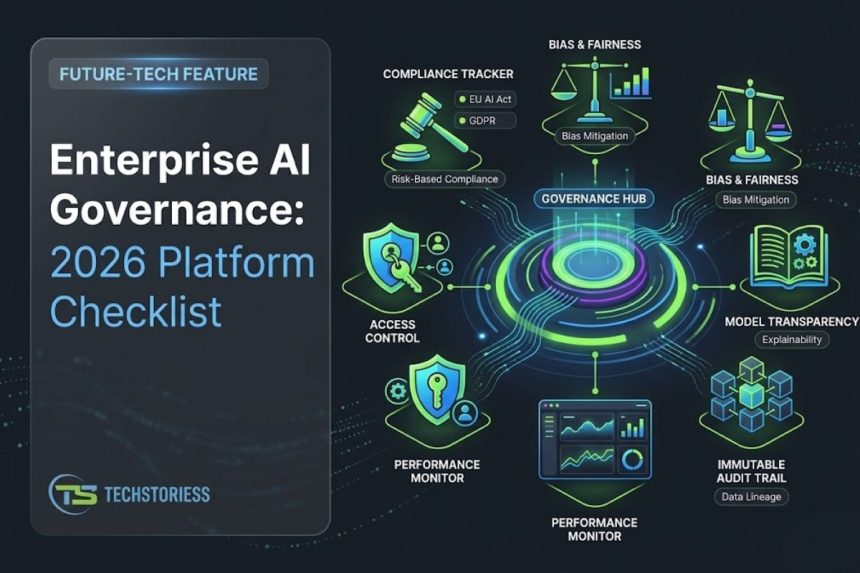
The artificial intelligence landscape in 2026 has fundamentally evolved compared to five years ago. Today the key debate among organizations is not about whether or not to implement the AI, it is about how to govern it responsibly. With an increasing number of organizations adopting AI at scale, the need for robust AI TRiSM (Trust, Risk, and Security Management) frameworks has become non-negotiable.
- Understanding AI TRiSM: The Foundation of Modern Governance
- Critical Components: Your 2026 Platform Checklist
- Enterprise AI Governance Lead’s Role: Data Points and Expectations
- Selection Criteria: What to Look For in 2026
- Implementation Roadmap for 2026
- The Business Case: ROI of AI Governance Platforms
- Key Takeaways
- Conclusion
According to recent surveys, 78% of organizations now report governance as a critical priority, up from just 34% in 2022. However, many organizations find it challenging to implement comprehensive governance strategies without the right platform infrastructure. This checklist guides organizations through selecting and implementing AI governance platforms that address real-world challenges in 2026.
Understanding AI TRiSM: The Foundation of Modern Governance
AI TRiSM inducates the evolution of AI governance beyond compliance checkboxes. It embraces three interconnected pillars: trust in AI systems, risk mitigation, and security hardening across the entire AI lifecycle.
To gain sustainable success modern AI governance platforms need to simultaneously address all three dimensions. Organizations investing in AI TRiSM today are experiencing tangible benefits: 65% report faster model deployment with confidence, 72% cite improved stakeholder trust, and 58% demonstrate measurable risk reduction in production environments.
The governance lead- typically a Chief AI Officer, AI Ethics Lead, or Governance Officer -:has become a crucial role in enterprise decision-making. This role demands tools that provide real-time visibility into AI system performance, fairness metrics, and compliance status across hundreds of models.
The Three Pillars of AI TRiSM
- Trust: can you understand and justify the decisions made by your AI system?
- Risk: Can you detect and mitigate potential failures before they impact customers?
- Security: Are your AI systems protected against adversarial attacks and data breaches?
Critical Components: Your 2026 Platform Checklist
Here are some of the key components that must be present in your platform checklist to ensure efficiency and practical reliability:
1. Explainable AI (XAI) Capabilities
Explainable AI has transitioned from helpful additions to essential requirements. In 2026, regulators across EMEA, APAC, and North America are proactively mandating model interpretability. Your governance platform must provide:
Feature Importance and Attribution Methods
- SHAP (SHapley Additive exPlanations) value analysis
- LIME (Local Interpretable Model-agnostic Explanations) implementations
- Integrated Gradients for deep learning models
- Anchor explanations for human-friendly narratives
Governance leads the explainability features reduce model audit cycles by 40% and accelerate stakeholder sign-off by 50%. Organizations using advanced Explainable AI tools report 3.2x faster model validation compared to those relying on manual documentation.
Practical Application: When a loan applicant is denied by lending algorithm, the governance team needs instant visibility into factors (income, credit history, employment gaps) that led to that decision. Modern XAI platforms surface this automatically, enabling fair decision-making and regulatory compliance.
2. LLM Bias Detection and Mitigation
Large Language Models have significantly accelerated AI capabilities, but they also introduce unique bias risks. In fact in present scenario the fastest growing governance category is LLM bias detection systems, with 84% of enterprises deploying dedicated monitoring by 2026.
Essential LLM Bias Detection Features:
Demographic Parity Analysis
- Monitor and report performance disparities across protected classes (gender, race, age, geographic location)
- Track fairness metrics at inference time, not just training time
- Identify emerging biases as model behavior shifts with data drift
Stereotyping and Harmful Content Detection
- Determine outputs that perpetuate harmful stereotypes
- Flag potentially discriminatory language patterns
- Monitor for jailbreak attempts and adversarial prompts
Contextual Bias Assessment
- Understand how biases manifest in specific use cases (hiring, credit, healthcare)
- Compare model outputs to human baseline performance
- Establish fairness thresholds aligned with business risk tolerance
Real-World Impact: In a Fortune 500 financial service company a Governance Lead implemented LLM bias detection for their customer service chatbot. Within a month, they identified that the system was using 1.8x more financial jargon when responding to queries from non-English native speakers, creating a subtle accessibility barrier. Early identification prevented reputational risk and customer churn.
3. Model Monitoring and Performance Tracking
To produce ongoing outcomes governance platforms should not stop at initial deployment; they must provide continuous monitoring:
- Real-time performance dashboards showing accuracy, precision, recall, and F1 scores
- Data drift detection detecting when input data characteristics change
- Model degradation alerts warning when performance crosses governance thresholds
- Prediction deviation analysis surfacing when model outputs diverge from expected distributions
To enable real-time monitoring and a true 360-degree view of issues, governance leaders require a centralized monitoring framework spanning hundreds of production models. In the absence of unified monitoring, teams are forced to stitch together disparate tools—an approach that can increase failure response times by up to 300% and significantly weaken operational control.
4. Regulatory Compliance Automation
In 2026, compliance requirements encompass multiple frameworks:
- EU AI Act compliance (mandatory for enterprises operating in EMEA)
- CCPA/CPRA compliance (California and other U.S. states)
- GDPR Article 22 rights (explaining automated decision-making)
- Industry-specific regulations (FCRA for financial services, HIPAA for healthcare)
- Sector guidelines (Singapore’s AI governance framework, UK’s AI framework)
To systemize and verify the compliance leading platforms now include pre-built compliance templates and automated evidence collection. This cuts down governance team workload by 60% and eliminates compliance documentation gaps.
5. Governance Workflow and Approval Automation
Modern governance platforms employ workflows that require governance lead sign-off before models reach production:
- Model cards and documentation generation
- Fairness assessments with automated pass/fail determinations
- Security scanning for known vulnerabilities and attack vectors
- Stakeholder approval workflows with audit trails
- Version control and rollback capabilities for rapid incident response
Unlike conventional bureaucratic overhead†these frameworks act as active risk mitigation systems. Organizations with well-structured governance workflows report 73% faster incident response and 85% fewer model-related compliance violations.
6. Data Provenance and Quality Management
To effectively govern AI systems you first need to deeply understand their training data:
- Data lineage tracking showing where data originated and how it transformed
- Data quality metrics (completeness, accuracy, consistency, timeliness)
- Training data documentation including collection methods, limitations, and known biases
- Data retention and deletion tracking for GDPR compliance
- Synthetic data validation for systems using generated training data
Governance leads increasingly require data provenance capabilities. In 2026, 71% of enterprises recognize data lineage tracking a key player in their governance strategy.
Enterprise AI Governance Lead’s Role: Data Points and Expectations
The role of governance lead has evolved from compliance manager to strategic business leader. Key metrics and responsibilities in 2026:
Typical Governance Lead Responsibilities
– Model Inventory Management: Tracking 150-500+ models in production
– Risk Assessment: Evaluating fairness, robustness, and security risks for each model
- Stakeholder Communication: Translating technical AI risks into business language
- Vendor Management: Overseeing AI governance platform contracts and implementation
- Incident Response: Leading root cause analysis when models fail or produce biased outcomes
- Policy Development: Creating organizational AI governance policies and standards
- Team Leadership: Managing AI ethics teams, fairness engineers, and compliance specialists
Key Performance Indicators for Governance Functions
Organizations employ effective metrics to track governance maturity, such as:
- Time-to-production for models (reduced by average 35% with proper governance)
- Fairness violations detected pre-deployment (targeting 100%)
- Compliance audit pass rates (aiming for 95%+)
- Mean time to resolution for governance issues (benchmark: <24 hours)
- Stakeholder satisfaction with governance transparency (targeting 85%+ approval)
- Model performance stability (measuring drift detection accuracy)
Selection Criteria: What to Look For in 2026
Here are some of the crucial features to look for in an ideal selection criteria:
Must-Have Features
- Multi-model support across traditional ML, deep learning, and LLMs
- Real-time monitoring with sub-minute latency for alerts
- Explainability at scale handling thousands of features and complex architectures
- LLM bias detection specifically optimized for transformer-based models
- API-first architecture enabling easy integration into existing MLOps pipelines
- Audit-ready reporting with compliance templates and evidence collection
- Role-based access control protecting sensitive fairness and performance data
Capabilities to further multiply the efficiency
- Automated bias remediation recommendations
- Synthetic data generation for fairness testing
- Custom fairness metric development frameworks
- Integration with popular ML platforms (Hugging Face, MLflow, Databricks)
- Automated governance metric calculation
- Executive dashboards with AI-specific KPIs
Vendor Evaluation Checklist
- How well does your Vendor understand your industry’s specific regulatory environment?
- Can they demonstrate Explainable AI and LLM bias detection capabilities in your use case?
- Do they have a well strategized update cycle for detection models as threats evolve?
- Do they provide governance lead training and change management support?
- What’s their data residency and security certification status?
- Can they scale to your current model count plus 3-5 year growth projections?
Implementation Roadmap for 2026
To ensure well grounded implementation, organizations need to build a solid, phased strategy, allocating reasonable time to each phase.
Phase 1: Foundation (Months 1-3)
- Select and deploy governance platform
- Establish governance lead’s team and responsibilities
- Conduct baseline AI risk assessment across existing models
- Implement basic Explainable AI for high-risk systems
Phase 2: Scale (Months 4-6)
- Deploy LLM bias detection across all large language models
- Establish monitoring for 80%+ of production models
- Create governance workflows and approval processes
- Develop internal governance standards documentation
Phase 3: Optimization (Months 7-12)
- Achieve 100% model coverage with governance platform
- Establish automated compliance reporting
- Implement advanced fairness testing and bias remediation
- Conduct governance maturity assessment and refine processes
The Business Case: ROI of AI Governance Platforms
By implementing comprehensive governance platforms in 2024-2025 organizations have experienced significant, and measurable benefits like:
- 68% reduction in model-related compliance violations
- 47% faster time-to-production for high-risk AI systems
- $2.3M average savings annually through avoided regulatory fines and operational incidents
- 52% improvement in stakeholder confidence in AI decision-making
- 73% reduction in model bias-related incidents and customer complaints
By properly investing in the proper tooling governance lead can reap rich dividends across the organization.
Key Takeaways
Before wrapping up the article let us have a quick relook on the key takeaways:
- AI TRiSM (Trust, Risk, Security Management) is the ground framework for modern governance
- Explainable AI are no longer optional features; they are now non negotiable regulatory requirements, not
- LLM bias detection is crucial as enterprises deploy more large language models
- The governance lead role demands platform tools that provide unified visibility across hundreds of models
- Comprehensive governance significantly cuts down time-to-production while improving compliance and safety
- Implementation should follow a properly phased approach starting with foundation-building in months 1-3
Conclusion
In 2026, AI governance has evolved beyond compliance exercise to a competitive advantage. Organizations with mature governance capabilities, powered by robust AI TRiSM platforms featuring advanced Explainable AI and LLM bias detection, stay at the cutting edge by deploying AI faster, with greater confidence, and fewer failures. This accelerates their AI journey while avoiding costly pitfalls.
By equipping their infrastructure with modern, cutting edge tools governance lead can make confident, data-driven decisions about which AI systems to deploy, how to operate them safely, and how to demonstrate that safety to regulators and stakeholders.
In 2026 your governance platform checklist should prioritize trust, risk mitigation, and security as interconnected capabilities. For that you need to assess and shortlist vendors not on marketing claims but on their ability to address real-world governance challenges in your industry.
To lead the market with AI in 2026 organizations must embrace governance early, invest in the right tools, and empower their governance leads with both capability and authority. Following this checklist will help you build your competitive advantage in responsible AI.








Your writing is so eloquent and heartfelt It’s impossible not to be moved by your words Thank you for sharing your gift with the world