


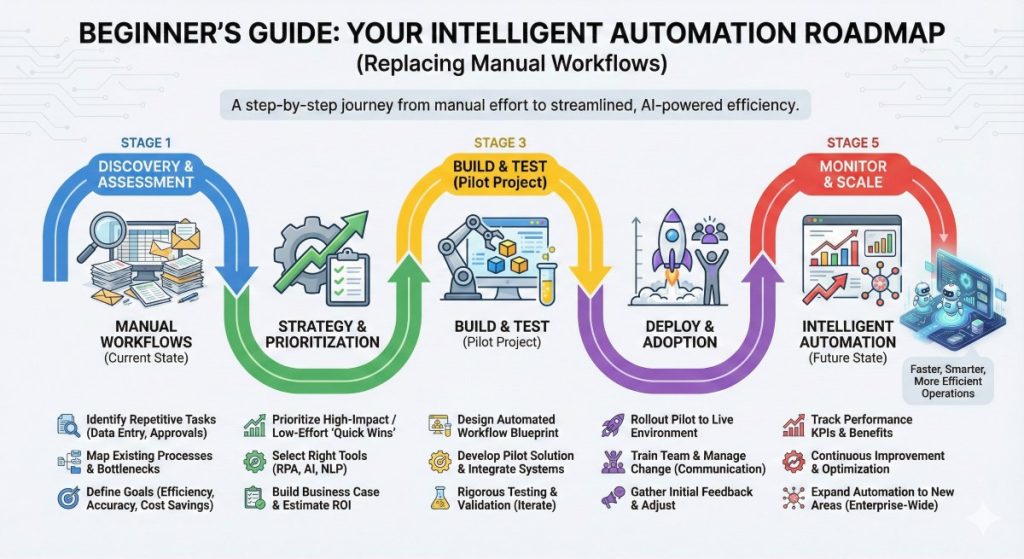
With fast increasing competition in global business enterprises need to speed up their operations, increase accuracy and deliver fast outputs. For that they need a transition from a tedious, manual work model to intelligent automation to accelerate speed and efficiency.
Many enterprises find it challenging to implement automation solutions in their enterprises. In this guide we simplify how to create your AI initiative by confidently planning, using a pilot project, and scale automation.
What is intelligent automation?
Intelligent Automation (IA) integrates traditional automation (like RPA) with AI technologies like Machine Learning, Natural Language Processing and Computer Vision to manage tasks that involve variability, interpretation, and cognitive reasoning. It helps systems to learn from patterns, adjust their responses, and make context-aware decisions rather than relying solely on static rules. It represents a more advanced form of automation that can process unstructured inputs, boost operational performance, minimize manual errors, and enable employees to focus on higher-value work while workflows become increasingly intelligent and self-optimizing.
Get Clear on What Your Business Really Needs
Before choosing platforms or workflows, define the purpose. Intelligent automation drives real impact when it’s powered by strategy, not by trendy technology. Identify the areas where autonomy can create measurable improvement—speed, accuracy, risk reduction, or customer satisfaction.
Begin With Outcomes, Not Just Tasks
Unlike traditional rule-based systems, intelligent automation can learn and adapt. So choose areas where faster execution, better accuracy, or lower risk support your business goals. Whether you aim to enhance customer service, reduce costs, or ensure data consistency, let objectives—not tools—lead the journey.
Find Out What’s Slowing You Down
Once goals are defined, identify the major friction points that drag operational efficiency. Repeated delays, approval loops, heavy manual entries, or unclear steps are strong signs of processes ready for automation.
Your process likely needs automation if it involves:
- High-volume, repeatable tasks
- Heavy reliance on spreadsheets or email
- Frequent handoffs or rework
- Error-prone manual steps
Talk directly to the teams doing the work. Hidden workarounds usually reveal the real problems—not the documented ones.
Focus on the Tasks That Matter Most
Even if several areas qualify for automation, doing everything at once leads to confusion and slow adoption. Start with tasks that are easier to automate yet produce noticeable improvements. These “quick wins” build confidence and support across teams.
Decide How You’ll Measure Success From Day One
Metrics look different across industries.
- Healthcare and finance prioritize compliance and risk reduction.
- Agencies prioritize speed, accuracy, and turnaround time.
Define what success means for you—fewer errors, faster output, reduced manual hours, or higher customer satisfaction. Clear targets make evaluation easier later.
Don’t chase tasks. Focus on outcomes..
Understand How Work Really Happens Today
Once you know what you want to achieve, dig into how work currently flows. Processes that look simple on paper often involve many hidden steps in reality. Automation built without this understanding will create more chaos than clarity.
Capture the Process Exactly as It Runs Now
Document your process step by step—not through SOPs but through conversations with people who execute the work daily. This reveals unofficial steps, extra checks, manual fixes, and delays that don’t show up in official documents.
Spot Where Things Typically Get Stuck
Identify the points where breakdowns happen. Where does output drop? Where do approvals drag? Where does data get stuck? These micro-frictions highlight where automation can deliver instant gains.
Clarify Where Human Judgment Is Involved
Not all decisions can be automated right away. If some steps need human judgment, define what parts can be automated with rules and where human oversight must remain. Build gradual logic and feedback loops so the automation becomes smarter over time.
Know How Your Data Moves Across the System
Data is the engine of intelligent automation.
Assess:
- Type of data
- Format and consistency
- Data location
- Access permissions
Unorganized or siloed data reduces accuracy. Fixing data issues early prevents automation errors later.When you understand your workflow clearly, you design automation that enhances it—not one that copies chaos.
Pick Tools That Actually Fit Your Needs
With your workflows mapped and goals defined, choose tools based on what you need—not what’s popular. Not all automation platforms are intelligent, and not all AI is autonomous.
When Simple Rule-Based Automation Is Enough
Robotic Process Automation (RPA) works best for stable, structured, repetitive digital tasks. It mimics human actions but fails if the environment changes—like a form layout update or a field shift.
Automation That Can Understand and Interpret Data
AI-augmented automation combines RPA with capabilities like:
- Natural language processing
- Image recognition
- Document understanding
It can handle semi-structured inputs such as emails, PDFs, or messages—and make narrow decisions within defined limits.
Fully Intelligent Systems That Can Work on Their Own
Autonomous agent platforms are the most advanced. They use LLMs, dynamic data, and adaptive logic to execute complex processes, self-correct, and coordinate with multiple tools. They focus on outcomes, not instructions.
If building from scratch isn’t feasible, no/low-code platforms provide:
- Fast deployment
- Easy learning curves
- Cross-team usability
- Built-in integrations
Don’t pick the “most advanced” tool. Pick the one that reliably reduces effort and scales with you.
Begin Small With a Practical, High-Value Pilot
Avoid the urge to automate everything. Start with a focused pilot that requires minimal setup but delivers meaningful impact. Choose repetitive or rule-based workflows with limited complexity.
Example: automating customer onboarding reduces manual data entry and improves customer satisfaction immediately. Pick low-effort, high-impact tasks. Great pilots show quick ROI and build company-wide confidence.
Expand Automation One Function at a Time
Once the pilot succeeds, expand in a disciplined, structured manner. Jumping into too many areas at once dilutes focus and reduces impact.
Grow in the Areas That Deliver the Most Value
Don’t scale by volume—scale by function. Automate the next department that drives clear business value. For example, after support automation, the next logical move might be sales outreach or lead qualification.
Reuse Proven Workflows Instead of Rebuilding
Many AI platforms let you clone templates or workflow fragments. This prevents duplicate effort and ensures consistency across teams.
Scaling is not about doing more at once—it’s about doing the right things in the right order.
Keep Tracking and Improving Your Automations
Even intelligent systems need oversight. As your business evolves, so must your automation. Regular monitoring ensures performance, accuracy, and relevance stay high.
Things to track:
- Tasks completed and hours saved
- Workflow usage
- User adoption
- Cross-team impact
Strong agentic systems measure both operational efficiency and organizational engagement.
Review Regularly and Keep Refining
- Conduct periodic audits
- Gather team feedback
- Adjust goals as you scale
- Retire low-ROI workflows
- Strengthen those delivering the highest value
Intelligent automation is not a “set and forget” system. Regular feedback and tuning keep it effective and aligned with your goals.
Conclusion
Intelligent automation thrives on clarity, structure, and steady scaling. When you start with clear objectives, understand real workflows, select the right tools, run thoughtful pilots, and refine continuously, automation becomes far more than a productivity booster—it becomes a strategic asset. With a grounded, step-by-step approach, your organization can shift from manual dependence to a smooth, scalable, autonomous operation where teams focus on meaningful work and technology handles the rest.