


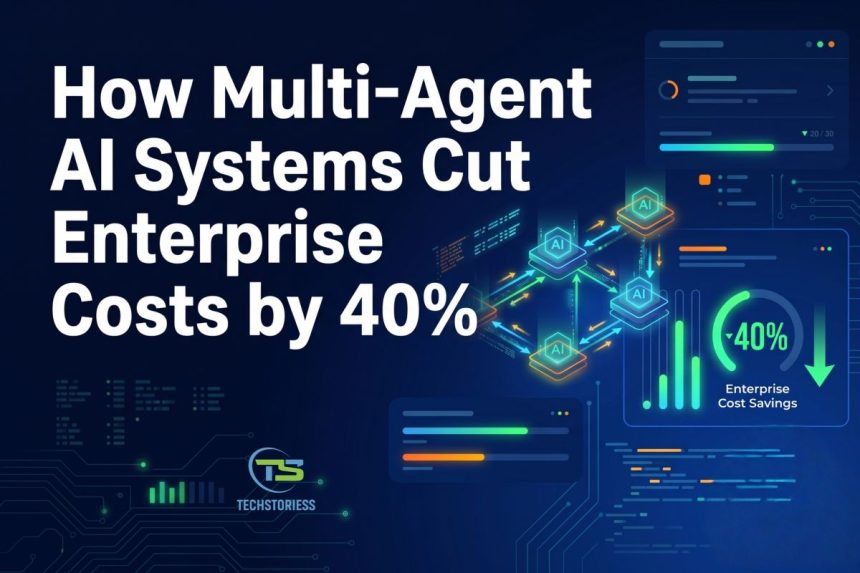
Gartner projects that 40% of enterprise applications will embed task-specific AI agents by the end of 2026, up from less than 5% in 2025 — one of the fastest enterprise technology adoption curves on record. Multi-agent systems — networks of specialized agents that divide up a workflow rather than one model trying to do everything — are the architecture behind most of that shift. Enterprises running these systems in procurement, finance, and IT operations report cost reductions that cluster around 40%, though the real number depends heavily on which functions you automate and how mature the deployment is.
This guide breaks down where that 40% actually comes from, what’s realistic to expect by function, and how to build a measurable framework around it rather than treating the number as a marketing headline. For a primer on the underlying technology — how what are autonomous AI agents actually reason, plan, and act — that companion piece covers the mechanics this article assumes.
Where the Cost Reduction Actually Comes From
Multi-agent systems don’t cut costs through one mechanism — they compress several at once. A multi-agent AI system divides a workflow across specialized agents: one gathers data, another validates it against policy, a third executes the transaction, and a supervisory agent watches for exceptions. That parallel structure is what lets the savings compound instead of plateauing the way single-purpose automation tools typically do.
The clearest evidence sits in finance operations. Ardent Partners’ State of ePayables 2025 research puts the average fully loaded cost to process a vendor invoice at $10.89; best-in-class organizations using AI-driven capture and matching bring that down to $2.78 — a 74% reduction — while also cutting the invoice cycle from 10.9 days to roughly 3.1 days. NetSuite reports similar numbers from its own customer base: leading adopters process invoices 81% faster at 79% lower cost. These aren’t projections — they’re benchmarks from organizations already running the systems.
In manufacturing, McKinsey’s research on predictive maintenance shows AI-driven monitoring cutting unplanned downtime by up to 50% and maintenance costs by 10–40%, largely by replacing fixed maintenance schedules with agents that continuously read sensor data and flag failures before they happen. In customer operations, IBM’s research puts the reduction in contact-center operating costs at up to 30% when AI-driven virtual agents handle routine tier-one volume.
The common thread: none of these gains come from replacing a single tool. They come from removing the handoffs, waiting time, and rework that pile up between steps in a process — which is exactly what a coordinated set of agents is built to eliminate.
Building a Measurable Framework
Treating multi-agent deployment as a cost optimization program — not just a technology rollout — starts with an honest cost baseline. Most enterprises under-count their true process cost because they only track direct line items like salaries and software licenses, leaving out delay costs, error-correction cycles, and compliance exposure. Deloitte’s 2026 Tech Trends research found that only 11% of organizations surveyed have moved agentic AI systems into production, even though 38% are actively piloting them — a gap Deloitte attributes less to the technology and more to organizations automating already-broken processes instead of redesigning them first.
That’s the practical argument for measuring before you deploy. A useful framework tracks five things per workflow: cost per transaction, cycle time, error rate, human-intervention ratio, and infrastructure utilization. Enterprises that baseline these before rollout are the ones who can later show — rather than assert — where the savings came from.
Decomposing the Savings by Lever
The oft-cited “40%” isn’t one number from one source — it’s a blend of savings across functions that don’t add up linearly, because most enterprises only capture three or four of these levers at once, and they overlap (faster cycle times, for instance, also reduce error-correction cost). Here’s what’s actually documented for each lever, function by function:
| Lever | Typical Range | What Drives It | Source |
|---|---|---|---|
| Labor automation (routine task handling) | 20–30% cost reduction | Shifting tier-one customer inquiries, data entry, and ticket triage to agents | IBM |
| Process acceleration (cycle time) | 70–81% faster cycle times | Parallel agent execution replacing sequential manual handoffs | Ardent Partners / NetSuite |
| Error and rework reduction | 60–80% lower per-invoice cost | Automated matching and exception routing catching errors before payment | Ardent Partners |
| Infrastructure efficiency | Falling sharply industry-wide | Model and inference costs have dropped roughly 280-fold in two years, though usage growth is outpacing that decline for many enterprises | Deloitte Tech Trends 2026 |
| Decision speed (IT operations) | 25–40% lower mean-time-to-resolution | Agents correlating alerts and surfacing root cause before a human starts investigating | Vendor-reported AIOps deployment data (2025–2026) |
The honest takeaway: a 40% figure is realistic for a single, well-scoped, high-volume process like accounts payable. Blended across an entire enterprise, most organizations should model somewhere in the 15–30% range in year one, with the higher end reachable only in specific functions with the data quality to support it.
Where Enterprises See the Highest ROI
Procurement and vendor management. McKinsey research on AI-driven procurement decision-making shows roughly a 10% reduction in operational costs alongside a 30% acceleration in supplier selection cycles. The Hackett Group’s broader analysis puts the ceiling higher — up to 40% of SG&A costs — for organizations that fully automate the intake-to-pay lifecycle rather than layering AI onto an existing manual process.
Finance operations. As covered above, accounts payable automation is the most well-documented use case in this category, with independent benchmark data (not vendor marketing) showing 74–79% cost reductions per invoice at scale.
IT operations and incident response. Engineering teams running AI-driven incident response report mean-time-to-resolution reductions in the 25–40% range, mainly by compressing the investigation phase — the part of an incident where engineers manually correlate logs, dashboards, and deployment history across five different tools before they can even start fixing anything.
Framework Choices: Why AG2 Keeps Coming Up
Worth clarifying up front: Microsoft’s original AutoGen framework — the project that popularized multi-agent conversation patterns — entered maintenance mode in 2026, with Microsoft shifting its own investment to the newer Microsoft Agent Framework. The actively developed continuation of the original codebase is AG2, an Apache-licensed, community-governed fork maintained by AutoGen’s original creators after they left Microsoft. It’s not a commercial product from a single vendor — it’s open source, which is part of why it keeps showing up in enterprise architecture discussions alongside alternatives like CrewAI, LangGraph, and Microsoft’s own newer framework.
What AG2 offers that’s relevant to the cost conversation is native support for agent-to-agent negotiation and shared context — agents can hand off partial results and adjust to workflow changes without a human re-specifying the task. That matters for cost because it’s the coordination overhead — not the underlying model calls — that tends to eat into ROI on multi-agent deployments. Whichever framework an enterprise chooses, the governance and permission model matters more to total cost than the framework’s branding.
Integration Strategy: A Phased Rollout
Given how wide the pilot-to-production gap is — Deloitte’s 11% figure again — a phased approach isn’t optional caution, it’s the difference between joining that 11% or not.
Phase 1 (Months 1–2): Baseline and process mapping. Identify high-volume, well-bounded processes — accounts payable, IT ticket triage, supplier onboarding — and measure the five metrics above before any agent touches the workflow.
Phase 2 (Months 2–4): Pilot deployment. Deploy agents against a narrow slice of the workflow first. Ardent Partners’ own data shows even best-in-class AP teams still have manual review on roughly two-thirds of invoices — full touchless processing is a maturity curve, not a day-one setting.
Phase 3 (Months 4–6): Scale and optimize. Expand agent scope only after the pilot’s error rate and human-intervention ratio have stabilized against your baseline, not against a vendor’s demo numbers.
Governance and Cost Discipline
Cost discipline and governance are the same problem viewed from two angles. Deloitte’s 2026 State of AI in the Enterprise survey found that only 21% of organizations have a mature governance model for agentic AI — and ungoverned agent sprawl is exactly what turns a cost-saving deployment into a cost-adding one, since idle or redundant agents still consume compute and API budget.
A workable governance model defines role boundaries for each agent, standardized communication protocols between agents, and real-time cost monitoring on compute and API usage — not just workflow outcomes. This isn’t just a compliance requirement; it’s the mechanism that prevents the infrastructure-efficiency lever in the table above from silently reversing into infrastructure cost creep, which several enterprises have already reported as usage scales faster than per-unit costs fall.
The Strategic Case Beyond Cost
Cost reduction is the easiest part of the multi-agent AI case to prove, which is why it dominates the pitch — but the sturdier argument for enterprises is what faster, coordinated execution does to decision speed and competitive response time. Organizations that get the governance and measurement right first are the ones positioned to compound those gains rather than plateau after an initial pilot, and to become part of the production-grade minority rather than the pilot-purgatory majority Deloitte keeps documenting year over year.
The technology underneath all of this — how an individual agent reasons, plans, and acts before any of it gets coordinated into a multi-agent system — is covered in more depth in our companion piece on what are autonomous AI agents.