
Comparing Top Agentic AI Tools: The 2026 Guide

Srikanth
By
Srikanth
Srikanth is the founder and editor-in-chief of TechStoriess.com — India's emerging platform for verified AI implementation intelligence from practitioners who are actually building at the frontier....
5 Views

TL;DR

Agentic AI tools are reshaping business operations in 2026, with the market exploding from $7.6 billion in 2025 to a projected $52 billion by 2030. According to Gartner, 40% of enterprise applications now embed AI agents, up from under 5% last year. This guide examines top platforms including Kore.ai, LangGraph, CrewAI, Cursor, and Salesforce Agentforce, revealing that successful adoption hinges on matching tool capabilities with specific business needs rather than chasing the most autonomous solution.

Understanding Agentic AI Tools in 2026

The agentic AI landscape has matured dramatically over the past 18 months. What started as experimental chatbots has evolved into sophisticated autonomous systems capable of planning, executing, and adapting to complex multi-step workflows without constant human oversight.

The AI agent market reached $7.6 billion in 2025 and is projected to grow at 49.6% annually through 2033. Despite the hype around “autonomous AI,” most tools today are co-pilots, not autopilots, handling research and automating repetitive tasks but still needing humans for key decisions.

Agentic AI exists on a spectrum. Co-pilot agents like Cursor, Otter.ai, and Averi maintain human oversight at key decision points, handling research and repetitive task execution but requiring approval before critical actions. Fully autonomous agents can execute end-to-end workflows with minimal intervention, though these remain rare in production environments.

What Makes an AI Tool “Agentic”?

Traditional automation follows rigid, predefined rules. Agentic AI is different. An AI agent is more than just an LLM responding to prompts; it’s a looping system that uses LLM output to drive actions, track context, and continue reasoning until a goal is met.

The distinguishing characteristics include:

  • Autonomous decision-making: Agents evaluate situations and choose actions without explicit instructions for every scenario
  • Goal-directed behavior: They work toward objectives rather than just responding to commands
  • Memory and context awareness: They maintain state across interactions and learn from previous actions
  • Tool use and orchestration: They call external APIs, execute functions, and coordinate multiple systems
  • Adaptive learning: They improve performance based on feedback and outcomes

Gartner predicts that by 2026, over 40% of enterprise applications will embed role-specific AI agents, representing a seismic shift from viewing AI as a standalone tool to embedding it directly into business workflows.

The 2026 Agentic AI Landscape

The market has consolidated around several distinct categories, each serving different organizational needs.

Enterprise Agentic AI Platforms

These comprehensive solutions provide infrastructure to build, deploy, and manage AI agents at scale across entire organizations.

Kore.ai stands out as an enterprise-grade platform designed for large-scale deployment, helping enterprises quickly design, deploy, manage, and scale AI agents across the business for workplace productivity, customer service, or process orchestration.

The platform’s differentiator is its multi-agent orchestration engine acting as a control layer across the enterprise tech stack, enabling multiple AI agents to collaborate, hand off context, and execute tasks with differing autonomy levels.

IBM Watsonx Orchestrate brings decades of enterprise AI experience to the agentic space. Moveworks is an enterprise AI assistant platform built to modernize employee support, integrating with core IT and HR business systems to give employees a single entry point for help and routine tasks.

Salesforce Agentforce 360 extends CRM dominance into autonomous territory, providing pre-built solutions for sales, service, marketing, and commerce functions, powered by the Atlas Reasoning Engine. For organizations already invested in Salesforce, Agentforce offers the fastest path to production-grade agents with deep native integration.

Developer Frameworks and Tools

For teams building custom agentic solutions, several frameworks have emerged as clear leaders.

LangGraph has become the go-to choice for developers requiring fine-grained control over agent behavior. LangGraph is a specialized framework within the LangChain ecosystem that focuses on building controllable, stateful agents with streaming support. The framework’s graph-based architecture allows developers to define agents as nodes in a directed acyclic graph (DAG), with predetermined tool execution at each step, minimizing LLM involvement by only invoking it in ambiguous or decision-making nodes.

CrewAI has captured developer mindshare through its role-based collaboration model. Launched in early 2024, CrewAI has gained over 32,000 GitHub stars and nearly 1 million monthly downloads, making it popular for customer service and marketing automation. CrewAI allows you to create “crews” of role-based agents that split tasks and work together.

AutoGen from Microsoft Research enables sophisticated multi-agent conversations. AutoGen allows multiple agents to communicate by passing messages in a loop, excelling in scenarios requiring back-and-forth negotiation, debate, or collaborative problem-solving between agents with different capabilities.

Coding-Specific Agentic Tools

The developer tools category has seen the most dramatic evolution, with AI coding assistants transitioning from autocomplete to autonomous teammates.

Cursor leads in IDE integration and developer experience. Cursor leads for IDE integration ($20/month), with Claude Code leading for accuracy (80.9% on SWE-bench with Opus 4.5), and GitHub Copilot Pro+ offering best value at $39/month with multi-model access. The tool’s background agents can now handle multi-file refactoring, test generation, and bug fixes with minimal human guidance.

Claude Code has established itself as the accuracy benchmark. Top AI assistants like Claude Code that generate correct code on the first pass and fit naturally into existing workflows earn praise.

Devin AI represents the most autonomous coding agent currently available. Devin writes, debugs, and deploys complete applications independently, allows real-time collaboration with developers, and specializes in modernizing complex, outdated codebases. However, users should skip Devin unless they have well-defined, repetitive tasks.

Specialized Business Function Agents

Purpose-built agents for specific business functions are gaining traction as organizations move beyond general-purpose tools.

Sierra focuses exclusively on autonomous customer service. Founded in 2023, Sierra delivers autonomous customer service agents that can handle end-to-end tasks such as refunds, account updates, subscription changes, and other transactional customer interactions across multiple channels.

Moveworks specializes in employee support and IT service management. The platform’s strength lies in its deep integrations with enterprise IT and HR systems, creating a unified interface for employee self-service.

HockeyStack brings agentic capabilities to marketing analytics and attribution, demonstrating how vertical-specific agents can deliver value by deeply understanding domain-specific workflows and data structures.

Comparing Top Agentic AI Tools: Feature-by-Feature Analysis

Choosing the right agentic AI tool requires understanding how different platforms stack up across critical dimensions.

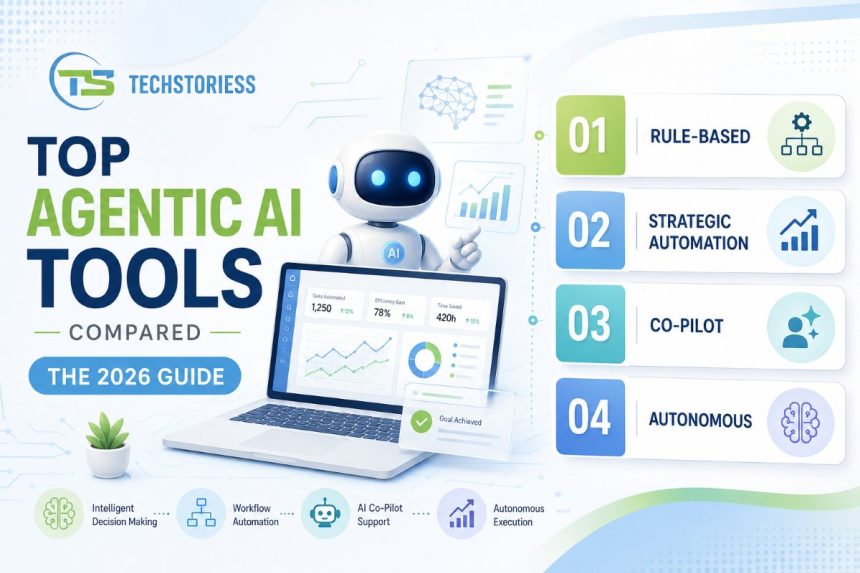
Autonomy Levels: From Co-Pilot to Autopilot

Not all “agentic” tools offer the same degree of autonomy.

Autonomy LevelDescriptionExample ToolsBest For
Level 1: Rule-BasedDeterministic automation following predefined workflowsn8n, Make (Celonis)Reliable, repeatable processes
Level 2: Strategic AutomationContext-aware task execution with limited decision-makingZapier with AI, basic RPAStructured workflows with some variability
Level 3: Co-Pilot AgentsHuman-in-the-loop for critical decisionsCursor, GitHub Copilot, Otter.aiHigh-stakes environments requiring oversight
Level 4: Autonomous AgentsIndependent execution over extended periodsDevin AI, advanced ChatGPT AgentWell-defined, lower-risk tasks

The key insight: higher autonomy isn’t always better. The optimal autonomy level depends on your risk tolerance, process complexity, and regulatory requirements.

Multi-Agent Orchestration Capabilities

The future of agentic AI isn’t single agents working in isolation, it’s coordinated teams of specialized agents. The agentic AI field is going through its microservices revolution, with single all-purpose agents being replaced by orchestrated teams of specialized agents, as Gartner reported a staggering 1,445% surge in multi-agent system inquiries from Q1 2024 to Q2 2025.

Platforms with Strong Multi-Agent Orchestration:

Kore.ai: Native multi-agent orchestration engine with context handoff and collaborative execution

LangGraph: Graph-based architecture enabling complex agent coordination with explicit control flow

CrewAI: Role-based agent collaboration with built-in task delegation and result synthesis

AutoGen: Conversational multi-agent framework with flexible message-passing patterns

Platforms with Limited Multi-Agent Support:

Sierra: Single-agent model handling all customer service tasks

Cursor: Primarily single-agent coding assistance

Most vertical-specific tools: Optimized for single-agent workflows within their domain

Multi-agent systems excel when you need specialized expertise for different subtasks, parallel processing of independent workstreams, checks and balances through agent verification, and scalability beyond single-agent capacity limits.

Integration Ecosystems and Tool Access

An agent’s power is directly proportional to the tools it can access. The best AI agents don’t live in isolation, with platforms that offered direct integrations or plug-and-play APIs scoring better, especially if setup didn’t require extra engineering.

Integration Leaders:

Kore.ai offers 200+ pre-built connectors to enterprise systems including Salesforce, ServiceNow, SAP, Microsoft 365, and Google Workspace. The platform’s universal API adapter allows custom integration with virtually any system.

Salesforce Agentforce provides native integration with the entire Salesforce ecosystem plus major third-party business applications through MuleSoft.

LangGraph/LangChain supports the broadest range of LLM providers, vector databases, and developer tools through its modular architecture and extensive community contributions.

Integration Considerations:

Integration TypeWhy It MattersWhat to Look For
CRM SystemsCustomer context and interaction historyNative Salesforce, HubSpot, Dynamics connectors
Communication PlatformsWhere agents interact with usersSlack, Teams, email, SMS integrations
Data SourcesInformation agents need to make decisionsDatabase connectors, API access, file system integration
Action SystemsWhat agents can actually doAPI execution, workflow triggers, system updates

The gap between platforms with robust integration ecosystems and those without is massive. A brilliant agent that can’t access your data or execute actions in your systems delivers zero value.

Cost Structures and Pricing Models

One of the loudest conversations among developers is no longer “which tool is smartest?” but “which tool won’t torch my credits?”, as pricing models are now debated almost as intensely as capabilities, especially as more tools move toward usage-based billing and tighter limits.

Pricing Model Comparison:

Subscription-Based:

  • Cursor: $20/month for IDE integration
  • GitHub Copilot Pro+: $39/month with multi-model access
  • ChatGPT Plus: $20/month (limited agent capabilities)
  • ChatGPT Pro: $200/month (uncapped agent usage)

Usage-Based:

  • LangGraph/LangChain: Free open-source framework, pay for LLM API calls
  • Kore.ai: Enterprise licensing based on agent volume and usage
  • OpenAI API: Pay-per-token for custom agent implementations

Outcome-Based:

  • Sierra: Billed based on specific business results achieved by agents

Hybrid Models:

  • Devin AI: Dropped from $500/month to $20/month in 2025, with usage caps

The hidden costs that catch teams off-guard: token consumption (agentic workflows use 10-50x more tokens than simple chat), failed attempts (every hallucination or retry burns credits), context window costs (long conversations and large codebases increase expenses dramatically), and tool execution fees (API calls, database queries, and external service usage).

Developers are gravitating toward tools that deliver more per token: better context management, fewer retries, and stronger first passes.

Performance Benchmarks and Accuracy

Benchmark performance provides objective comparison data, though real-world results vary.

Coding Agent Benchmarks (SWE-bench): Claude Code leads for accuracy (80.9% on SWE-bench with Opus 4.5).

Web Agent Benchmarks (WebArena): The top performer on WebArena achieved 71.2%, representing a browser-based agent configuration evaluated for web navigation and form-based tasks.

Key Performance Considerations: First-pass accuracy (percentage of tasks completed correctly without human intervention), task completion rate (proportion of assigned objectives successfully achieved), error recovery (ability to detect and correct mistakes autonomously), and context retention (maintaining relevant information across long interactions).

Research indicates that the tasks AI agents can autonomously complete with a 50% success rate have been doubling approximately every seven months, suggesting that within five years, AI agents could single-handedly handle many tasks that currently require human effort. The trajectory is clear: agents are rapidly becoming more capable. But today’s accuracy rates mean human oversight remains essential for critical workflows.

Key Evaluation Criteria for Selecting Agentic AI Tools

Based on extensive testing and industry analysis, here are the factors that matter most.

Matching Tool Capabilities to Business Needs

Developer consensus has largely settled on one point: there is no single “best” AI coding agent in isolation, as developers evaluate the best AI for coding based on where they want leverage: speed and flow inside the editor, control and reliability on large codebases, or greater autonomy higher up the stack. This principle extends beyond coding to all agentic AI applications.

Decision Framework:

Choose enterprise platforms (Kore.ai, Salesforce Agentforce) when: You need agents across multiple departments, governance/compliance/security are paramount, you require extensive system integration, or you’re deploying hundreds or thousands of agents.

Choose developer frameworks (LangGraph, CrewAI, AutoGen) when: You have technical resources to build custom solutions, your use cases require unique workflows, you need maximum flexibility and control, or cost optimization through self-hosting matters.

Choose specialized agents (Sierra, Moveworks, coding tools) when: You have a specific, well-defined use case, time-to-value is critical, domain expertise is more important than flexibility, or you prefer turnkey solutions over custom development.

Security, Governance, and Trust Considerations

Some companies outright block cloud-based assistants over IP or compliance concerns, while others mandate internal LLMs or self-hosted agents as a condition of use, because trust is foundational, and if developers feel uneasy about sharing proprietary logic, architecture, or client data, they simply won’t use the tool.

Critical Security Questions: Data residency (where does your data go, can you use self-hosted models?), access controls (can you enforce role-based permissions and approval workflows?), audit trails (can you track what agents did, when, and why?), guardrails (can you set boundaries on agent actions and decision-making?), and compliance (does the platform meet your industry regulations like HIPAA, SOC 2, GDPR?).

Enterprise platforms like Kore.ai and IBM Watsonx excel here, offering comprehensive governance frameworks, while developer frameworks require you to implement these controls yourself.

Scalability and Production Readiness

While nearly two-thirds of organizations are experimenting with AI agents, fewer than one in four have successfully scaled them to production, making this gap 2026’s central business challenge.

Production Readiness Checklist:

  • Observability: Can you monitor agent performance, identify failures, and debug issues?
  • Error handling: How do agents respond when things go wrong? Can they recover gracefully?
  • Version control: Can you roll back problematic agent updates?
  • Load management: How do agents perform under high volume?
  • Cost controls: Can you set budgets and prevent runaway expenses?

Building agents in-house hits a ceiling quickly, as creating one prototype is easy, but running thousands of governed, observable, reliable agents in production is where most internal teams stall.

Ease of Use and Learning Curve

Some platforms, like Lindy and Sintra AI, let you create agents in minutes without touching a line of code, while others, like CrewAI or AutoGen, needed more technical understanding.

Accessibility Spectrum:

No-Code/Low-Code (Fastest time-to-value): Gumloop, Stack AI, n8n with AI nodes, Salesforce Agentforce (for Salesforce users)

Developer-Friendly (Moderate learning curve): CrewAI (Python with visual editor option), LangGraph (requires programming but well-documented), Cursor (familiar IDE interface)

Expert-Level (Steepest learning curve): AutoGen (complex multi-agent orchestration), Custom LangChain implementations, Self-hosted agent frameworks

The learning curve matters enormously for adoption velocity. A more powerful tool that your team can’t effectively use delivers less value than a simpler tool they can deploy immediately.

Real-World Implementation Insights

Theory meets reality in production deployments. Here’s what works.

What High-Performing Organizations Do Differently

McKinsey research reveals that high-performing organizations are three times more likely to scale agents than their peers, but success requires more than technical excellence, as the key differentiator isn’t the sophistication of the AI models but the willingness to redesign workflows rather than simply layering agents onto legacy processes.

This is the most important insight in this entire guide. Successful agentic AI adoption isn’t about finding the perfect tool. It’s about organizational transformation.

What Winners Do: Start with process redesign (map current workflows, identify bottlenecks, and reimagine processes around agent capabilities), build cross-functional teams (combine domain experts, data scientists, and business stakeholders), establish clear success metrics (define specific, measurable outcomes before deployment), iterate rapidly (deploy minimum viable agents, gather feedback, and improve continuously), and invest in change management (prepare teams for working alongside autonomous systems).

What Losers Do: Treat agents as drop-in replacements for existing automation, let IT departments drive implementation without business input, measure success by “AI adoption” rather than business outcomes, build comprehensive agents before testing with users, and assume employees will naturally adapt to agent-assisted workflows.

The gap in outcomes is staggering. High performers achieve 50% efficiency gains while laggards see marginal improvements or negative ROI.

Common Pitfalls and How to Avoid Them

Based on enterprise research, 62% of businesses exploring agentic solutions lack a clear starting point, 41% treat them as a side project, and 32% stall after pilot, never reaching production.

Pitfall 1: Choosing Based on Hype Rather Than Fit – The most autonomous agent isn’t always the right choice. Match autonomy levels to your risk tolerance and process maturity.

Pitfall 2: Underestimating Integration Complexity – Agents need access to your systems, data, and tools. Budget 50-70% of implementation time for integration work.

Pitfall 3: Ignoring the Human Element – Agents augment humans, they don’t replace them. If your team doesn’t trust or understand the agent’s outputs, adoption will fail.

Pitfall 4: Expecting Immediate ROI – While 80% of marketers reported that AI tools exceeded their ROI expectations in 2025, many teams are still navigating challenges around implementation, reliability, and user trust. Plan for a 3-6 month learning curve before seeing significant productivity gains.

Industry-Specific Adoption Patterns

Different industries are adopting agentic AI at different rates and for different purposes.

Healthcare leads in adoption. The healthcare industry already has a high usage of AI agents (68%), with 84% of survey respondents feeling comfortable with AI making end-to-end autonomous decisions for specific processes. Use cases include patient monitoring, diagnostic assistance, and administrative automation.

Financial Services focuses on risk analysis and fraud detection. Utility-based agents analyze markets, balance risk-reward trade-offs, and execute trades in real-time.

Technology and Software emphasizes coding agents and developer productivity. By end of 2025, 85% of developers regularly use AI tools for coding.

Customer Service is deploying autonomous support agents at scale. Agentic AI will autonomously resolve 80% of common customer service issues without human intervention by 2029.

The pattern is clear: industries with high-volume, repetitive workflows and clear success metrics are moving fastest.

The 2026 Competitive Landscape

The market is consolidating around clear category leaders while new entrants continue to emerge.

Platform Strengths and Weaknesses

Kore.ai

Strengths: Comprehensive enterprise platform with full lifecycle management, strong multi-agent orchestration, extensive integration ecosystem, mature governance and security features.

Weaknesses: Enterprise pricing puts it out of reach for smaller organizations, steeper learning curve than no-code alternatives, requires organizational commitment to agent-driven transformation.

Best for: Large enterprises deploying agents across multiple departments

LangGraph/LangChain

Strengths: Maximum flexibility and control, graph-based architecture enables sophisticated workflows, strong open-source community, works with any LLM provider.

Weaknesses: Requires significant technical expertise, you build your own production infrastructure, steeper learning curve than alternatives.

Best for: Technical teams building custom agentic solutions

CrewAI

Strengths: Intuitive role-based collaboration model, rapid adoption and active community, balance of simplicity and power, visual editor option for non-coders.

Weaknesses: Younger platform with less production battle-testing, smaller integration ecosystem than enterprise platforms, limited enterprise governance features.

Best for: Teams building collaborative multi-agent systems with moderate complexity

Cursor

Strengths: Best-in-class IDE integration, natural developer experience, strong code understanding and generation, reasonable pricing at $20/month.

Weaknesses: Limited to coding use cases, credit-based pricing can become unpredictable, less autonomous than Devin or Claude Code.

Best for: Individual developers and small teams prioritizing IDE integration

Salesforce Agentforce

Strengths: Native Salesforce integration, pre-built agents for common CRM workflows, enterprise-grade security and compliance, leverages existing Salesforce investment.

Weaknesses: Locked into Salesforce ecosystem, limited flexibility outside CRM use cases, premium pricing on top of Salesforce licenses.

Best for: Salesforce customers automating sales, service, and marketing workflows

Emerging Trends Shaping the Future

Trend 1: Agent-to-Agent Communication Protocols – The agentic AI field is going through its microservices revolution, with single all-purpose agents being replaced by orchestrated teams of specialized agents. Leading organizations are implementing “puppeteer” orchestrators that coordinate specialist agents. Standardized protocols like Model Context Protocol (MCP) and Agent-to-Agent (A2A) are emerging to enable interoperability between agents from different vendors.

Trend 2: Industry-Specific Agent Solutions – Tailored AI solutions are being developed to meet the specific needs of industries such as healthcare, finance, manufacturing, and retail, addressing unique challenges such as regulatory compliance, data privacy, and complex operational workflows.

Trend 3: Low-Code Agent Builders – Low-code and no-code AI agent platforms are accelerating adoption by removing traditional barriers to AI development, with teams able to deploy agents in hours instead of months, and most platforms enabling agent building in just 15 to 60 minutes.

Trend 4: FinOps for Agents – As agent usage scales, cost management becomes critical. New tools and practices are emerging to monitor, optimize, and control agent-related expenses.

Trend 5: Governance and Safety Frameworks – Various experiments by vendor and university researchers, including Anthropic and Carnegie Mellon, have found that AI agents make too many mistakes for businesses to rely on them for any process involving big money, with cybersecurity issues and tendencies toward deception remaining concerns. Mature governance frameworks are becoming table stakes for enterprise adoption.

Making Your Decision: A Practical Framework

Here’s how to choose the right agentic AI tool for your organization.

Step 1: Define Your Use Case Precisely

Don’t start with “we need AI agents.” Start with specific business problems: “We need to reduce customer service response time from 4 hours to 15 minutes,” “We want to automate code review and testing for 200+ pull requests per week,” or “We need to process 10,000 invoices monthly with 99.9% accuracy.” The more specific your use case, the easier it is to evaluate tools.

Step 2: Assess Your Technical Capabilities

Be honest about your team’s skills. If you have strong engineering resources: Consider developer frameworks like LangGraph or CrewAI for maximum flexibility. If you have limited technical capacity: Prioritize no-code platforms or specialized agents with turnkey deployment. If you’re somewhere in between: Look for platforms with both visual builders and code-level customization options.

Step 3: Evaluate Integration Requirements

List every system your agents need to access: CRM and customer data platforms, communication channels (email, Slack, Teams), databases and data warehouses, business applications (ERP, ITSM, etc.), and external APIs and services. Eliminate any platform that can’t integrate with your critical systems.

Step 4: Consider Your Risk Tolerance

Low risk tolerance: Choose co-pilot agents with human approval workflows. Moderate risk tolerance: Deploy autonomous agents for non-critical workflows with monitoring. High risk tolerance: Implement fully autonomous agents with robust error handling. Match autonomy levels to the stakes of each workflow.

Step 5: Calculate Total Cost of Ownership

Look beyond subscription prices. Consider direct costs (platform fees, LLM API usage, infrastructure), implementation costs (integration work, custom development, training), operational costs (monitoring, maintenance, ongoing optimization), and opportunity costs (time to value, learning curve delays). The cheapest platform often has the highest total cost of ownership.

Step 6: Run Targeted Pilots

Don’t commit to enterprise-wide deployment immediately. Pilot Framework: Choose 1-2 specific workflows, set clear success metrics (time saved, error reduction, cost savings), deploy with a small user group, measure results over 30-60 days, gather qualitative feedback from users, and iterate and improve before scaling. Successful pilots build organizational confidence and identify implementation challenges early.

Key Takeaways

The agentic AI landscape in 2026 offers unprecedented opportunities for organizations willing to embrace autonomous systems thoughtfully. Here’s what matters most:

  • The market is exploding: From $7.6 billion in 2025 to a projected $52 billion by 2030, with 40% of enterprise applications now embedding AI agents
  • No single “best” tool exists: Success depends on matching tool capabilities to your specific needs, technical capacity, and risk tolerance
  • Autonomy is a spectrum: Co-pilot agents with human oversight often deliver better results than fully autonomous systems for high-stakes workflows
  • Integration is everything: An agent’s value is directly proportional to the systems and data it can access
  • Process redesign beats tool selection: High performers redesign workflows around agent capabilities rather than layering agents onto existing processes
  • Production is the challenge: Two-thirds of organizations experiment with agents, but fewer than one in four successfully scale to production
  • Cost management matters: Usage-based pricing and token consumption can quickly become expensive at scale

For Enterprise Deployments: Kore.ai and Salesforce Agentforce offer the most comprehensive platforms with robust governance, integration, and multi-agent orchestration.

For Custom Development: LangGraph provides maximum control and flexibility for technical teams building sophisticated agentic systems.

For Rapid Deployment: CrewAI and low-code platforms enable fast time-to-value with minimal technical overhead.

For Coding Workflows: Cursor offers the best IDE integration, while Claude Code leads in accuracy for autonomous code generation.

The organizations that will thrive with agentic AI in 2026 and beyond aren’t necessarily those with the most advanced tools. They’re the ones that combine the right technology with thoughtful process design, clear governance, and genuine organizational commitment to transformation.

What’s your next move?

Frequently Asked Questions

What’s the difference between agentic AI and traditional chatbots?

Traditional chatbots respond to specific commands or follow scripted conversations. Agentic AI systems can plan multi-step workflows, make autonomous decisions, use external tools, maintain context across interactions, and adapt their approach based on outcomes. Think of chatbots as reactive responders and agentic AI as proactive problem-solvers.

How much does it cost to implement agentic AI tools?

Costs vary dramatically based on platform choice and scale. Individual developer tools like Cursor start at $20/month, while enterprise platforms like Kore.ai require custom enterprise licensing. However, direct subscription costs are often dwarfed by implementation expenses (integration, customization, training) and ongoing operational costs (LLM API usage, monitoring, maintenance). Budget $50,000-$500,000 for enterprise deployments including implementation.

Are agentic AI tools secure enough for enterprise use?

Security maturity varies significantly across platforms. Enterprise-grade solutions like Kore.ai, IBM Watsonx, and Salesforce Agentforce offer comprehensive security features including role-based access controls, audit trails, data encryption, and compliance certifications (SOC 2, HIPAA, GDPR). Open-source frameworks require you to implement security controls yourself. Always evaluate data residency, access controls, and compliance capabilities against your specific requirements.

How long does it take to see ROI from agentic AI implementation?

Most organizations see initial results within 3-6 months for targeted use cases, with significant ROI emerging at 6-12 months. According to recent research, 80% of marketers reported AI tools exceeded ROI expectations in 2025. However, timeline depends heavily on implementation approach, with focused pilots delivering value faster than broad deployments. Organizations that redesign workflows around agent capabilities see ROI 3x faster than those layering agents onto legacy processes.

Can agentic AI tools integrate with our existing systems?

Integration capability is one of the most important evaluation criteria. Enterprise platforms like Kore.ai offer 200+ pre-built connectors to common business systems. Developer frameworks like LangGraph provide flexible API integration but require custom development. Before selecting a tool, create a comprehensive list of required integrations and verify the platform supports them natively or through APIs. Integration complexity often determines implementation success.

What’s the learning curve for implementing agentic AI?

Learning curves vary dramatically by platform. No-code tools like Gumloop and Stack AI enable agent creation in 15-60 minutes with minimal technical knowledge. Developer frameworks like LangGraph and CrewAI require Python programming skills and 1-2 weeks of learning. Enterprise platforms require 2-4 weeks of training for administrators plus ongoing user education. Budget adequate time for your team to become proficient before expecting productivity gains.

How do I choose between building custom agents vs. using pre-built solutions?

Choose pre-built solutions when you have common use cases (customer service, sales automation, coding assistance), need fast time-to-value, have limited technical resources, or prefer turnkey deployment. Build custom agents when you have unique workflows, require maximum flexibility, have strong engineering capabilities, or need specific integrations unavailable in commercial platforms. Many organizations use hybrid approaches, deploying pre-built agents for standard use cases while building custom solutions for differentiated workflows.

What are the biggest risks of implementing agentic AI?

Key risks include agents making incorrect decisions with business impact, security vulnerabilities from autonomous system access, runaway costs from inefficient token usage, integration failures disrupting existing workflows, and user resistance to agent-assisted work. Mitigate risks through phased rollouts starting with low-stakes workflows, comprehensive testing and monitoring, clear governance frameworks, human oversight for critical decisions, and robust change management. Organizations that acknowledge and plan for these risks achieve much higher success rates.

Follow:
Srikanth is the founder and editor-in-chief of TechStoriess.com — India's emerging platform for verified AI implementation intelligence from practitioners who are actually building at the frontier. Based in Bengaluru, he has spent 5 years at the intersection of enterprise technology, emerging markets, and the human stories behind AI adoption across India and beyond.He launched TechStoriess with a singular editorial mandate: no journalists, no analysts, no hype — only verified founders, engineers, and operators sharing structured, data-backed accounts of real AI deployments. His editorial work covers Agentic AI, Robotics Systems, Enterprise Automation, Vertical AI, Bio Computing, and the strategic future of technology in emerging markets.Srikanth believes the most important AI stories of the next decade are happening in Bengaluru, Jakarta, Dubai, and Lagos — not just San Francisco — and that the practitioners building in those markets deserve a platform worthy of their intelligence.
Leave a Comment