


In 2026, the conversation about AI Agents and jobs has moved past the abstract “AI will change everything” stage. Semi-autonomous systems are now sitting inside real workflows, making bounded decisions, and quietly reshaping who does what inside organizations.
An AI agent is a software system that combines a large language model with memory, planning logic, and tool access. It can interpret a goal, break it into steps, and carry out multi-step tasks with minimal human prompting — a meaningful jump from a chatbot that only responds when asked. For a deeper technical breakdown of what are autonomous AI agents and how they reason, plan, and act inside enterprise systems, our companion guide covers the architecture in detail.
This piece looks at the other side of that shift: not how agents work, but what they mean for jobs. It covers the roles they’re creating, the ones they’re compressing, and how team structure, culture, and career paths are being redrawn as a result.
The Data So Far
| Finding | Source |
|---|---|
| 170 million jobs created and 92 million displaced globally by 2030 — a net gain of 78 million | World Economic Forum, Future of Jobs Report 2025 |
| 82% of executives plan to adopt AI agents within the next one to three years | World Economic Forum, AI agents enter the workplace (Jan 2026) |
| Jobs requiring AI skills are growing 69% faster than the overall job market, carrying a 62% average wage premium | PwC, 2026 Global AI Jobs Barometer |
| AI-exposed entry-level roles are now 7x more likely to require senior-level skills like judgment and leadership | PwC, 2026 Global AI Jobs Barometer |
| 39% of core job skills are expected to change by 2030 | World Economic Forum, Future of Jobs Report 2025 |
These numbers matter because they cut against the simplest “AI takes jobs” framing. The clearer pattern, especially in PwC’s research, is bifurcation. Some roles are being simplified and commoditized, while others are being “professionalised” — made more valuable because AI now handles the routine parts and leaves the judgment-heavy parts to humans. Understanding which side of that split a role falls on is more useful than asking whether AI agents will “take jobs” in the aggregate.
Key Benefits of AI Agent–Driven Work Models
Work models driven by AI agents have moved past simple task automation into end-to-end operational participation — AI agents now touch planning, coordination, execution, and monitoring in the same workflow.
| Benefit | What Changes | Where It Shows Up |
|---|---|---|
| Non-linear productivity gains | Output scales without a matching rise in headcount | Customer support, IT service management, finance ops |
| Continuous decision readiness | Leaders get real-time signals instead of periodic reports | Executive dashboards, ops reviews |
| Lower coordination load | Agents absorb status tracking, follow-ups, and handoffs | Cross-team project delivery |
| Stronger cross-functional execution | Agents synchronize work that used to require meetings | Business–IT handoffs |
| Built-in operational resilience | Systems self-monitor and adapt to anomalies | IT operations, supply chain |
| Improved quality and compliance at scale | Rules are applied consistently with full audit trails | Finance, healthcare, regulated industries |
The “non-linear” framing isn’t just marketing language. PwC found that the top 20% of AI-exposed companies achieved average labor productivity growth of 163% relative to 2018 — nearly five times the gain seen at less AI-exposed firms. That gap is the practical difference between automating a task and embedding an agent into the workflow around it: the second approach compounds.
The coordination benefit is worth a specific mention too. A large share of modern work — status tracking, follow-ups, rework — is invisible labor that never shows up on a task list but consumes real hours. AI agents that continuously monitor progress and resolve routine exceptions free people to spend that time on judgment calls, creative problem-solving, and relationship management instead.
New Job Roles in AI Agent–Driven Organizations
AI is no longer just automating clerical tasks — agents now operate with minimal supervision across real workflows. That shift is creating a new layer of roles focused on designing, supervising, and governing the collaboration between people and agents, rather than executing tasks directly.
| New Role | Core Responsibility | Closest Role Today |
|---|---|---|
| AI Workflow Architect | Designs end-to-end human-agent workflows, decision boundaries, and escalation logic | Business process / solutions architect |
| Agent Supervisor & Performance Steward | Monitors agent behavior and outcomes, tunes exceptions | Team lead / QA manager |
| Outcome Owner | Owns the business result a human-agent system delivers, not headcount or activity | Product or program manager |
| AI Governance & Risk Lead | Sets guardrails, audit mechanisms, and accountability frameworks | Risk / compliance officer |
| Human–Agent Experience Designer | Designs trust calibration, interfaces, and feedback loops for adoption | UX designer / change manager |
| Capability & Enablement Lead | Builds employee skills for working alongside agents | L&D / enablement lead |
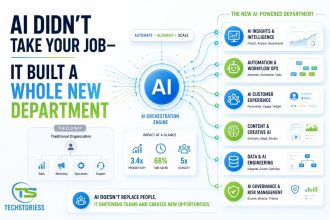
These aren’t hypothetical job titles. Hiring data already shows adjacent roles appearing at large enterprises that didn’t exist in their pipelines two years ago — Agentic AI Engineer, AI Agent Architect, AI Trainer. These map closely onto what PwC calls “professionalised” roles: jobs where AI absorbs the routine work and pushes human responsibility toward judgment, oversight, and strategic decisions. In practice, AI didn’t take these jobs so much as build an entirely new layer around itself, one focused squarely on directing and governing what agents do.
Structural, Cultural, and Strategic Shifts
Beyond individual roles, agent-driven models are changing how teams are organized and how decisions get made.
Structure: from hierarchies to agent-orchestrated teams. Traditional structures relied on layers of managers to catch coordination failures — status updates, handoffs, escalations. When AI agents handle that layer directly, teams compress toward being output-focused rather than role-constrained, and managers shift toward designing workflows and guardrails instead of supervising task completion.
Roles: humans as architects, AI agents as executors. Agents absorb passive responsibilities — status tracking, routine analysis, follow-ups — and free people to concentrate on context-setting, ethical oversight, and exception handling. This is consistent with what multi-agent systems are built to do at scale: coordinate specialized agents across functions while keeping a human accountable for the outcome.
Culture: redefined trust and accountability. Introducing agents into daily work changes how accountability is shared. Transparent, traceable workflows — where anyone can see what an agent did and why — matter more for trust than the agent’s raw capability. Teams that skip this step tend to see either over-reliance (rubber-stamping agent decisions) or under-trust (manually redoing everything anyway), both of which cancel out the productivity gain.
Strategy: competitive advantage through team design. PwC’s research frames this as a genuine divide, not a rounding error. Companies most able to use AI grew headcount 52% since 2018 versus 36% at less AI-exposed firms, and grew wages faster too. The organizations pulling ahead aren’t simply deploying agents onto legacy processes. They’re rethinking ownership models, decision rights, and team boundaries around what agents are actually good at. Comparing agentic AI against traditional copilots is a useful starting point for leaders trying to decide where that redesign should begin.
What This Means for Workers
For individual workers, the WEF and PwC data point toward the same practical advice, even though they’re measuring different things.
- Human-intensive skills are rising in value, not falling. WEF projects that 39% of core job skills will change by 2030. Meanwhile, 85% of employers plan to prioritize upskilling existing staff over pure hiring. The skills gaining the most ground — creative thinking, judgment, leadership — are exactly the ones agents can’t easily absorb.
- Entry-level work is being “seniorised,” not eliminated. PwC’s analysis found that AI-exposed junior positions are seven times more likely to require traditionally senior skills like strategic decision-making. Routine tasks that used to teach junior employees the ropes over several years are increasingly handled by agents, which compresses the runway for building judgment on the job.
- The wage premium for AI fluency is real and growing. Jobs requiring specific AI skills are growing 69% faster than the job market overall. The average wage premium attached is 62% — a strong signal for where to invest learning time.
None of this replaces the underlying point made in why human judgment is the most underrated skill of the AI era: the roles growing fastest are the ones where agents raise the floor of routine execution and leave judgment as the differentiator. For a role-specific look at how this plays out, what’s actually left for developers once AI is writing the code is a useful case study.
Quick Answers
What’s the difference between an AI agent and a chatbot?
A chatbot responds to a prompt and stops. An AI agent interprets a goal, plans the steps needed to reach it, and calls tools or APIs to execute those steps on its own. It keeps working with minimal further input — closer to a junior digital employee than a search box.
Will AI agents replace jobs?
Net employment is projected to grow, not shrink. The WEF’s Future of Jobs Report 2025 forecasts 170 million new jobs against 92 million displaced by 2030, a net increase of 78 million. The distribution is uneven, though: routine, “democratised” roles are being simplified, while judgment-heavy, “professionalised” roles are growing faster and paying more.
What new job roles are emerging around AI agents?
Roles focused on designing, supervising, and governing human-agent collaboration — workflow architects, agent supervisors, AI governance leads, and enablement specialists — rather than roles that execute tasks directly. Adjacent titles like Agentic AI Engineer and AI Trainer are already appearing in enterprise job postings today.
Conclusion
AI agent–driven models are turning traditional, human-led team structures into hybrid operating models. People and agents work in tandem: humans supply judgment, context, and accountability, while agents supply speed, consistency, and continuous execution. This is already underway rather than theoretical — WEF projects a net gain of 78 million jobs by 2030, and PwC finds AI-skilled roles growing 69% faster than the market with wages to match.
The organizations capturing that upside are the ones redesigning roles, responsibilities, and governance around what agents are actually good at, instead of layering agents onto workflows built for an all-human team. For enterprise leaders mapping out where to start, seven enterprise use cases that actually deliver ROI and moving past pilot purgatory into production-scale deployment are the logical next steps.