


TL;DR
In the race of Agentic ai vs Traditional copilots … Traditional copilots still win on speed of deployment and predictable per-user cost. They deliver 10–35% task-level efficiency gains within 1–3 months. Autonomous AI agents cost 2–4× more to stand up and take 12–24 months to break even. But agents remove entire workflows — not just tasks — from the human queue. That’s where the structural cost savings and Year-5 ROI of 120–170%+ actually come from. The right choice depends on whether you’re trying to speed up existing work or redesign how the work gets done.
- TL;DR
- Difference Between Traditional Copilots and Agentic ai?
- Why Traditional Copilots Scaled First — and Where Their ROI Plateaus
- Traditional Copilots vs. Agentic AI ROI: The 2026 Numbers
- Why Agentic AI’s ROI Curve Looks Different
- A 5-Step Framework for Deciding Between the Two
- Governance and Risk Ownership Move Upstream
- Illustrative Scenario: Agentic AI in a Logistics Workflow
- Organizational Impact, Cost Models, and Vendor Risk
- Copilots Aren’t Obsolete — They’re Becoming the Interface Layer
- FAQ
- Conclusion: Assistance vs. Agency in 2026
Difference Between Traditional Copilots and Agentic ai?
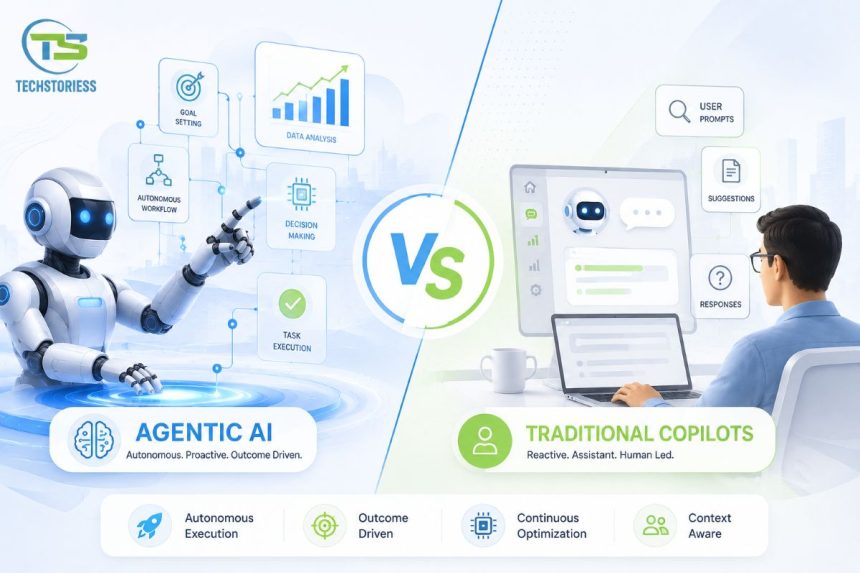
A traditional copilot reacts. You prompt it, it drafts, summarizes, or recommends, and a person decides whether to act on the output. Copilots have made real inroads into CRMs, ERPs, and service desks over the past few years. They slot into work humans are already doing — they don’t replace the decision, they just speed it up.
Autonomous AI agents work differently. Rather than waiting for a prompt, they take a goal and break it into steps. They choose the tools needed to complete each step, execute, and adjust as conditions change — without a person approving every action. If you want the full mechanics of how that works, our guide on what are autonomous AI agents breaks down the reasoning-plan-act loop in detail.
Definition: Agentic AI — also called autonomous AI agents — refers to AI systems capable of interpreting a high-level objective and planning the steps to reach it. These systems then execute those steps across tools and systems, adapting based on the results, largely without step-by-step human input.
That one distinction — reacting to a prompt versus owning a goal — is what separates a productivity add-on from a structural change to how work gets done. It’s the thread running through every ROI, governance, and staffing decision in this article.
Why Traditional Copilots Scaled First — and Where Their ROI Plateaus
Traditional copilots spread quickly because they didn’t ask anyone to change how they worked. They sat inside tools people already used — HR platforms, sales CRMs, marketing suites, support desks — and made the existing steps faster.
That’s also their ceiling. A copilot can speed up drafting, summarizing, or coding, but a person still has to enter the prompt, check the output, and hand it to the next step. Gartner estimates that in complex enterprises, more than 60% of copilot-driven productivity gains get absorbed by coordination and review overhead. The task gets faster, but the decision doesn’t — and the process around it stays the same size.
The pattern shows up consistently in adoption data: strong early wins, then a plateau once the easy gains inside individual tasks run out.
Traditional Copilots vs. Agentic AI ROI: The 2026 Numbers
| Metric | Traditional Copilots | Autonomous AI Agents |
|---|---|---|
| Initial investment | Baseline | 2–4× higher than copilot programs |
| Payback period | 1–3 months | 12–24 months to break even |
| Task/process efficiency gain | 10–35% task-level efficiency | 30–70% reduction in process cycle time |
| Error/rework impact | 5–15% quality improvement (support); 15–30% less debugging (dev) | 20–50% decrease in operational error rates |
| Manual handoffs | Largely unchanged | 25–60% reduction |
| Operating cost impact | Predominantly soft savings (time, not headcount) | 15–35% reduction in ongoing operational costs |
| Year 2 ROI | Often flattening (efficiency gains saturate workflows within 6–9 months) | ~25–40% net positive |
| Year 5 ROI | Not typically modeled this far out | 120–170%+ in mature deployments |
| Savings type | Soft (time savings) | Hard (headcount, error-handling, throughput) |
Sources: Microsoft Work Trend Index, McKinsey, GitHub Copilot research, PwC, Gartner, Google Cloud, Capgemini Research Institute, ABI Research, Boston Consulting Group.
By function, copilot gains cluster around three areas:
| Function | Reported Copilot Impact |
|---|---|
| Software development | 20–45% faster code completion; 15–30% less debugging/rework |
| Marketing, content, documentation | 25–40% faster draft creation; 10–20% more output volume |
| Customer support, sales enablement | 10–25% shorter handling time; 5–15% better response quality |
Fewer than 30–35% of enterprises, per PwC and McKinsey adoption research, manage to turn those early copilot gains into measurable cost reduction rather than just faster individual tasks — which is the gap agentic AI is built to close.
Why Agentic AI’s ROI Curve Looks Different
Agentic AI’s economics run in the opposite direction from a copilot’s. The design phase — orchestration, exception handling, governance rules, policy modeling — is expensive and shows little visible ROI up front. Once an agentic workflow is stabilized, though, the savings compound instead of plateauing, because the system is removing an entire process from the human queue rather than shortening one step in it.
Capgemini’s research backs this up with a specific pattern. Organizations that tie autonomous AI agent projects to business KPIs — revenue, cycle time, error cost — see 2.5–3× higher ROI than teams running pilot-only programs, rather than tying projects to productivity metrics alone. And per BCG, over 70% of AI transformation failures come from gaps in operating model and governance, not the technology itself. Agentic AI’s demand for clearer process ownership isn’t a side effect. It’s often the thing that was missing already.
A 5-Step Framework for Deciding Between the Two
Rather than treating this as an all-or-nothing bet, most enterprises are better served by mapping the decision workflow by workflow:
- Map the workflow’s decision points. Count how many times a human currently has to approve, review, or hand off work in this process. High-frequency, low-judgment handoffs are agentic candidates; low-frequency, high-judgment ones usually aren’t yet.
- Check the failure cost. If a wrong action is cheap to reverse (a drafted email, a flagged ticket), a copilot is often sufficient. If a wrong action is expensive or hard to undo (a shipped order, a compliance filing), start with bounded agent autonomy and hard guardrails, not full autonomy.
- Estimate the coordination tax. If the workflow crosses three or more systems or teams, that’s usually where copilot ROI plateaus fastest — and where agentic orchestration has the most room to add value.
- Size the investment horizon. Copilots suit teams needing payback inside a single budget cycle. Agentic AI suits processes an enterprise plans to run largely unchanged for 2+ years, since the 12–24 month break-even only pays off if the workflow sticks around long enough to compound.
- Assign risk ownership before go-live. Decide who — a process owner, a governance council, compliance — is accountable for agent decisions before the agent is live, not after something goes wrong.
Most enterprises don’t end up picking one technology enterprise-wide; they end up running copilots and agents side by side, matched to the workflow in front of them.
Governance and Risk Ownership Move Upstream
Copilots don’t remove governance risk so much as spread it across individual behavior — inconsistent usage, undocumented decisions, and compliance drift that’s hard to catch until an audit. Agentic AI doesn’t eliminate that risk, but it does relocate it somewhere more inspectable: the system itself.
In practice, that means three things happen before an agent gets production access, not after:
- Policy gets encoded, not assumed. Rules that lived in a manager’s head — escalation thresholds, spending limits, approval chains — get written into the agent’s constraints explicitly.
- Every action gets logged. Agentic systems generate an audit trail as a byproduct of running, which is more traceable than a person’s undocumented judgment call.
- Accountability gets assigned at the process level, not the individual level. Deloitte’s research found that organizations defining AI risk ownership by process — rather than leaving it with whichever employee happened to be using the tool — scale AI more successfully. They’re 2.3× more likely to move beyond pilot stage than organizations that don’t.
The shift feels uncomfortable for the same reason moving from manual reconciliation to automated financial controls felt uncomfortable a decade ago. It forces the accountability question to get answered explicitly instead of staying implicit. But it’s not a new model. It’s the same one already governing ERP platforms and automated trading systems, now applied to a new category of cognitive work.
Illustrative Scenario: Agentic AI in a Logistics Workflow
The following is a composite, illustrative example built from common patterns in agentic logistics deployments — not a documented case study of a specific named company.
Picture a mid-size freight operator running regional delivery routes. A weather system closes a highway corridor. In a copilot-assisted setup, a dispatcher gets an alert, opens three systems to check affected shipments, drafts reroute options, and calls carriers to confirm capacity. The copilot speeds up the drafting and lookup, but a human still runs the sequence end to end — likely over 45–90 minutes depending on shipment volume.
In an agentic setup, the autonomous AI agent detects the disruption directly from a carrier-status feed. It cross-references affected shipments against delivery SLAs and checks carrier capacity across alternate routes. It then rebooks the shipments that fall within its pre-set risk and cost thresholds, and escalates only the handful that exceed them — say, high-value freight or contractually penalized late deliveries — to a human dispatcher for a final call. The dispatcher’s job shifts from running the whole sequence to reviewing the exceptions the agent flagged.
Organizational Impact, Cost Models, and Vendor Risk
New Roles, New Skills
Traditional copilots tend to make existing roles more productive without changing what the role is. Autonomous AI agents change the role itself. In IT service management, for example, teams increasingly supervise fleets of agents handling incidents and routine changes rather than working every ticket by hand. That shift pulls demand toward governance, orchestration, and exception-handling skills. Managing AI becomes part of the job description, not just a tool used within it.
Cost Models
The two approaches also scale differently on cost. Copilots are priced per seat, so cost grows in a straight line with headcount — predictable, but it doesn’t get cheaper as usage deepens. Agentic AI is usually priced on compute and orchestration complexity, so cost is tied to output rather than user count. Expanding an agent’s scope is a configuration change, not a hiring decision — which is why marginal cost tends to decline as adoption matures.
Data Advantage and Vendor Risk
There’s a secondary effect worth planning for. Autonomous AI agents generate structured execution data — what was decided, when, and why — as a natural byproduct of running. That data is far easier to feed into continuous process optimization than scattered copilot interaction logs, and the advantage compounds the longer an agentic workflow runs.
On the vendor side, traditional copilot tooling has become fairly commoditized, so switching cost stays relatively low. Agentic platforms vary widely in how extensible and open their orchestration layer is. That makes the initial platform choice a more strategic — and stickier — decision than it looks at first.
Copilots Aren’t Obsolete — They’re Becoming the Interface Layer
None of this makes traditional copilots disappear. In practice, the two are converging into a layered setup. Copilots remain the human-facing interface for guidance, clarification, and oversight, while agentic systems handle the backend execution the copilot used to just describe. A dispatcher in the logistics example above still needs an interface to review the exceptions an agent escalates — that interface is very likely a copilot.
FAQ
What’s the main difference between a traditional copilot and an autonomous AI agent?
A traditional copilot responds to a prompt and leaves the action to a human. An autonomous AI agent takes a goal, plans the steps, and executes them across systems with minimal human input at each step.
Which delivers better ROI in 2026 — traditional copilots or agentic AI?
It depends on the time horizon. Traditional copilots pay back faster (1–3 months) with soft, time-based savings. Agentic AI takes longer to break even (12–24 months) but produces hard, structural savings that compound — Year-5 ROI in mature deployments runs 120–170%+ versus a plateauing curve for copilots.
Do autonomous AI agents replace traditional copilots?
No. Most enterprises run both, with copilots serving as the interface for human oversight and agents handling end-to-end execution behind that interface.
What’s the biggest risk enterprises underestimate with agentic AI?
Governance ambiguity — deploying agents without first assigning who owns the risk when an agent’s decision goes wrong. Organizations that assign that ownership at the process level scale AI successfully at roughly 2.3× the rate of those that don’t, according to Deloitte.
How do I decide which workflows are ready for agentic AI?
Start with the 5-step framework above. Map decision points, check the cost of a wrong action, estimate how many systems or teams the workflow crosses, size the investment horizon, and assign risk ownership before launch.
Conclusion: Assistance vs. Agency in 2026
Traditional copilots and autonomous AI agents aren’t competing for the same job. Copilots make today’s work faster without changing who does it. Agentic AI changes who — or what — does the work in the first place, trading a slower payback for a structural, compounding return. The enterprises pulling ahead in 2026 aren’t the ones picking a side; they’re the ones matching the technology to the workflow, workflow by workflow, and being deliberate about who owns the risk either way.