


As artificial intelligence shifts from a supporting capability to a core design principle, organizations are rethinking how software systems are conceptualized and built. This transition marks a fundamental change in application architecture, where intelligence is no longer optional but foundational.
- What Is an AI-Native Development Platform?
- How AI native platforms differ from traditional development platforms?
- Key Characteristics of AI-Native Platforms
- Key Characteristics of AI-Native Systems
- Best Practices for Building AI-Native Systems
- Design with Modularity for Iterative AI Integration
- Benefits of AI-Native Application Development
- Conclusion
With rapidly advancing artificial intelligence capabilities, AI has evolved into a foundational design principle rather than remaining a supporting feature. It has redefined how software systems are built, deployed, and scaled. Conventional applications are increasingly giving way to AI-native platforms—systems with artificial intelligence embedded directly into their architecture, workflows, and decision-making processes. Instead of treating AI as an external service or isolated feature, these systems infuse every layer with embedded intelligence, enabling continuous learning, autonomous operations, and real-time adaptability. This shift is especially relevant for growth-oriented organizations seeking to engineer scalable, resilient, and future-ready solutions.
What Is an AI-Native Development Platform?
An AI-native development platform refers to a platform that integrates artificial intelligence directly into its core architecture rather than introducing it as an external component. This embedded intelligence guides the building, deployment, and evolution of applications end to end. Instead of AI operating as a separate layer or post-deployment enhancement, intelligence actively shapes how applications are designed, optimized, scaled, and improved throughout their lifecycle.
How AI native platforms differ from traditional development platforms?
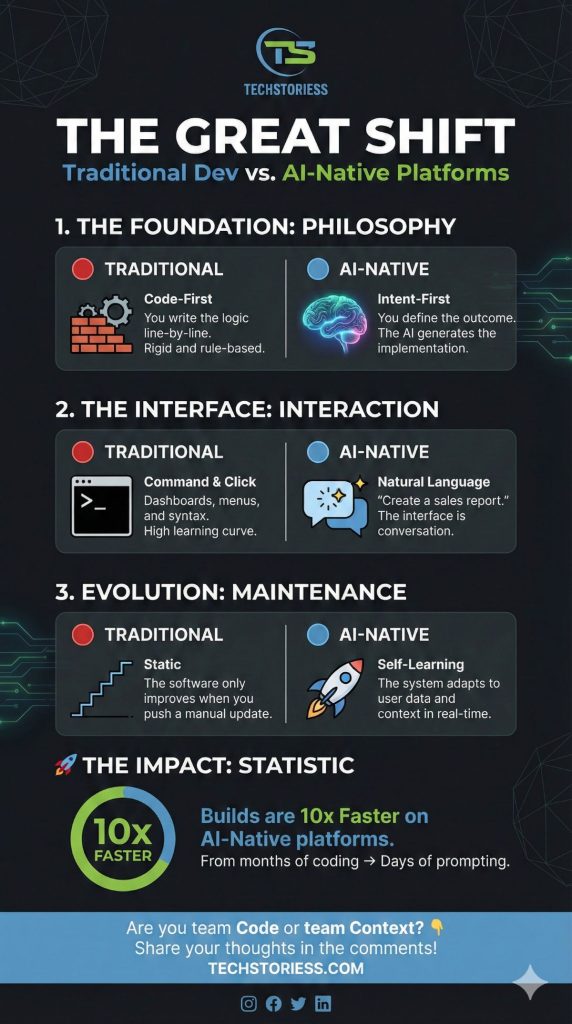
Beyond implementation, AI-native development platforms differ fundamentally in philosophy when compared to conventional approaches to software development.
Unlike traditional platforms that treat AI as an add-on capability, AI-native platforms embed intelligence directly into the development lifecycle. This allows applications to continuously adjust behavior, performance, and resource utilization in real time, resulting in systems that are more responsive, efficient, and context-aware by design rather than through periodic optimization.
Key Characteristics of AI-Native Platforms
AI-native platforms share a defined set of core characteristics that enable intelligence to operate cohesively across the entire system rather than powering isolated components.
Pervasive Intelligence Throughout the System
In AI-native infrastructure, intelligence is embedded across all layers of the system, including data processing, user interfaces, and backend operations. For example, in a streaming platform, AI-driven adaptive encoding, personalization logic, predictive analytics, and infrastructure optimization operate within the same platform to deliver a seamless, intelligent experience that continuously adapts to user behavior and system conditions.
At the same time, the system optimizes streaming quality, personalizes movie poster thumbnails, and manages server loads concurrently, ensuring performance, engagement, and operational efficiency without manual intervention.
Continuous Learning and Adaptation
AI-native systems evolve autonomously over time, improving efficiency and acquiring contextual intelligence without constant human input. This continuous learning loop enables systems to refine outputs and performance dynamically:
- Data collection: The system observes user behavior, interactions, and outcomes
- Pattern recognition: AI identifies what is effective and what is not
- Automatic adjustment: The system modifies its approach in real time
- Validation: Results are measured and fed back into the learning cycle
Zero-Touch Autonomous Operations
AI-native platforms can independently handle routine operational and maintenance tasks without human intervention. They automatically scale resources, detect and resolve errors, and optimize performance. This significantly reduces operational overhead and allows human teams to focus on strategic initiatives and higher-value problem-solving, improving both business outcomes and workforce productivity.
Distributed Processing Architecture
With built-in intelligence, AI-native systems can prioritize workloads dynamically based on urgency and business impact. For example, latency-critical tasks such as real-time fraud detection are prioritized over non-urgent batch processes like report generation or backups, ensuring optimal responsiveness and system reliability.
Key Characteristics of AI-Native Systems
Beyond platform-level capabilities, AI-native systems also exhibit core architectural and operational traits that distinguish them from traditional AI-enabled systems.
Built-In AI Functionality
With AI embedded directly into system architecture, organizations can automate workflows, enhance decision-making, and transform manual processes into intelligent, automated pipelines that reduce time and cost. Embedded AI continuously adjusts system performance and scalability in response to changing workloads, data volumes, and usage patterns.
Data-Centric Architecture
AI-native systems treat data as a strategic asset rather than a passive backend resource. This approach prioritizes data availability, quality, and relevance, enabling real-time analytics and streamlined data flows. As a result, organizations can respond faster to market changes, personalize customer experiences, and manage data access securely and efficiently.
AI-native systems can dynamically introduce new capabilities to support heavy workloads and complex requirements without requiring infrastructure overhauls. Their modular design allows incremental upgrades while maintaining consistent system performance.
To ensure long-term scalability and adaptability, it is important to build AI-native systems with modularity, transparency, and resilience in mind. This approach not only simplifies evolution but also enables organizations to innovate continuously while managing complexity effectively.
Best Practices for Building AI-Native Systems
As an increasing number of global organizations are utilizing AI-native systems, success depends not just on adopting sophisticated models is not enough to gain success. It is equally important to design architectures that can automatically evolve, scale, and earn trust over time. AI-native doesn’t treat AI as an add-on, but * that requires deliberate choices around structure, transparency, responsiveness, and user interaction. Here are some of the best practices outlining how teams can build AI-native systems that can immediately adapt to rapid technological changes, offer consistent performance and deliver significant value across diverse use cases.
Design with Modularity for Iterative AI Integration
Building modular AI-native systems enables seamless updates and integration of new algorithms or technologies with minimal disruption.
Focus on AI Explainability for Trust-Building
Transparent AI decision-making is essential for building user trust and ensuring compliance with governance and regulatory standards.
Prioritize Edge AI for Latency-Critical Applications
Embedding edge intelligence enables real-time responses in scenarios such as autonomous vehicles, remote healthcare monitoring, and industrial automation.
Incorporate Adaptive UX for Dynamic AI Behaviors
Dynamic user interfaces that adjust in real time help personalize user experiences based on evolving AI insights.
Utilize Synthetic Data for Model Robustness
Synthetic datasets can strengthen AI models, especially in edge cases where real-world data is limited or biased.
Benefits of AI-Native Application Development
AI-native platforms deliver architectural advantages that translate directly into measurable business and operational outcomes.
Improved Application Efficiency and Speed
On-device and localized data processing reduces latency and ensures uninterrupted performance, even in environments with limited connectivity. Combined with adaptive learning, AI-native applications evolve with changing user behavior and demand patterns while maintaining consistent performance at scale.
Elevated User Experience Through Personalization
AI-driven predictive analytics enable context-aware, hyper-personalized interactions. By delivering relevant content and recommendations in real time, organizations can increase engagement, boost conversions, and foster long-term customer loyalty.
Reduced Costs and Increased Flexibility
Automation of development and operational tasks accelerates time-to-market while lowering operational overhead. Embedded intelligence also reduces cloud dependency by dynamically optimizing resource usage, resulting in a more cost-efficient, resilient, and scalable IT architecture.
Conclusion
As AI becomes intrinsic to modern software systems, AI-native platforms represent a clear departure from static, rule-based architectures toward adaptive, self-optimizing ecosystems.
By embedding intelligence directly into system architecture, data pipelines, and user experiences, AI-native platforms enable continuous learning, autonomous operations, and context-aware decision-making at scale. The result is faster performance, improved personalization, reduced operational overhead, and greater agility in responding to evolving market demands.
In an environment defined by complexity and rapidly expanding data volumes, AI-native systems provide a sustainable foundation for long-term innovation. Organizations that adopt modular, explainable, and data-centric AI architectures position themselves to adapt intelligently to uncertainty—an essential capability for successful digital transformation.