


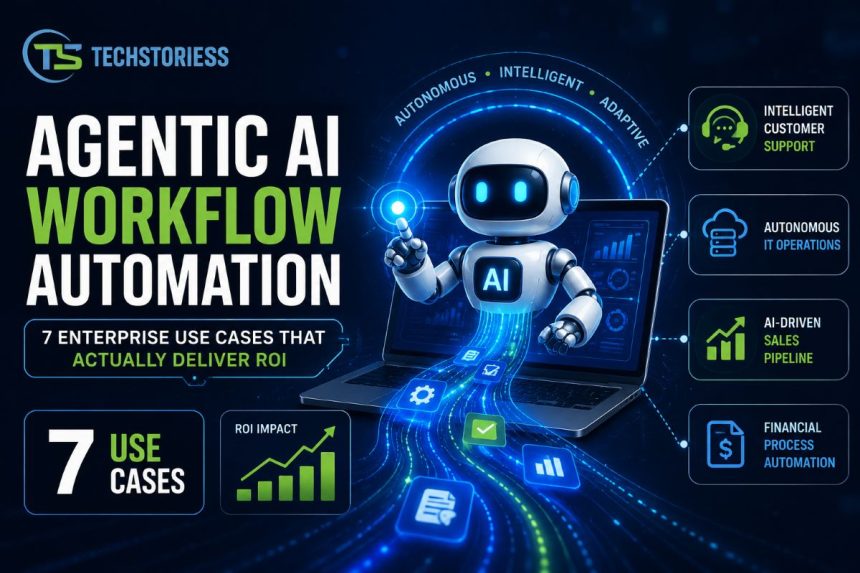
Seven enterprise functions are producing verified, dollar-and-hour agentic AI returns in 2026: customer support, IT operations, sales pipeline management, financial compliance, marketing orchestration, supply chain logistics, and software engineering. Each is covered below with the specific companies, agents, and numbers behind the ROI claim — not composite estimates.
The interest is real and measurable. Gartner recorded a 1,445% surge in enterprise inquiries about multi-agent systems between Q1 2024 and Q2 2025. Yet interest and execution remain two different things: Deloitte’s research puts the pilot-to-production success rate for agentic AI at just 11%. That gap is exactly why use-case selection — not model selection — decides whether a deployment becomes a line item or a case study.
If you want the foundational explainer first — what are autonomous AI agents and how they differ architecturally from copilots or RPA — start there. This piece assumes that baseline and goes straight to where the ROI has actually shown up in production.
A note on the numbers below: none of them come from our own client work, and we’ve flagged that explicitly rather than implying otherwise. Each is a publicly reported figure from the company involved or from a named research firm, cited to its source, and hedged with “estimated” or “reportedly” where the underlying methodology wasn’t disclosed. That’s a deliberately higher bar than the vague “organizations typically see 30–60% improvement” framing common in this space — a claim is only as useful as the name and number behind it.
Agentic AI vs. Traditional Automation, in One Line
Traditional automation executes a fixed sequence of steps. Agentic AI plans the sequence itself, adapts it mid-task, and only stops to ask a human when it hits a defined confidence or risk threshold. That distinction — decision ownership, not just task execution — is where every ROI figure in this article originates. For the fuller architectural breakdown, see our comparison of agentic AI against traditional copilots.
Why Most Agentic AI Initiatives Never Reach Production
Three structural issues explain Deloitte’s 11% figure more than any model limitation does:
- Orchestration complexity gets underestimated. Multi-agent coordination introduces dependency chains that a single-workflow automation never has to deal with.
- ROI isn’t defined before the pilot starts. Teams that skip baseline metrics can’t prove impact later, even when the deployment quietly works.
- Governance arrives too late. In regulated industries especially, retrofitting audit trails and approval gates after go-live stalls rollouts indefinitely.
Our Agentic AI Deployment Playbook for Indian Enterprises walks through the 90-day framework that addresses all three. For this article, the fix is narrower: pick use cases where the ROI math has already been proven elsewhere.
7 Enterprise Use Cases With Documented ROI
1. Customer Support Resolution
The setup: a triage agent classifies the incoming query, a retrieval agent pulls account and policy context, and an action agent executes the resolution — refund, account update, or escalation — without a human touching the ticket.
Klarna’s AI assistant is the clearest public data point here: by Q3 2025 it was handling the workload of roughly 853 full-time agents and had saved the company an estimated $60 million. Klarna later reintroduced human agents for emotionally sensitive or ambiguous disputes — a useful reminder that “autonomous” doesn’t mean “unsupervised everywhere.” At the benchmark level, NiCE reports enterprise agentic deployments in production achieving 20–40% call containment and 25–35% lower cost per contact.
2. IT Operations and Incident Management
Agents monitor telemetry, correlate alerts into a single “situation” instead of hundreds of individual pages, propose a root cause, and execute pre-approved remediation — restarting a service, rolling back a deployment, scaling a resource.
Microsoft’s internal Triangle system reportedly reached 97% triage accuracy and cut time-to-engage by 91%, while Uber’s Genie copilot has saved an estimated 13,000 engineering hours since September 2023, according to an analysis of production AI-agent incident-response deployments. In security operations specifically, a joint deployment between DXC Technology and 7AI reported 224,000 analyst hours saved — equivalent to 112 full-time-equivalent years — while cutting both detection and response time in half.
3. Sales Pipeline Acceleration
Agents score inbound leads against ideal-customer-profile and intent signals, draft and send multi-channel outreach, keep CRM records current, and flag stalled deals for human follow-up.
A 2026 analysis of enterprise sales deployments — including companies like PepsiCo, Williams-Sonoma, and Lennar — cites Bain estimates of 30%+ win-rate improvements where the underlying sales process was redesigned rather than just automated, with some organizations seeing 5.8x ROI within 14 months of going into production. The same research is candid that only about a quarter of sales AI initiatives hit their projected numbers — which is exactly why process redesign has to come before the agent does, not after.
4. Financial Process Automation and Compliance Monitoring
Agents reconcile transactions, flag anomalies against policy thresholds, generate compliance reports, and prepare audit documentation — with humans retaining sign-off on anything above a defined risk level.
JPMorgan Chase has been reported to run more than 450 AI use cases in active production across trading, compliance, risk, and operations, including a document-intelligence agent that processes M&A memos and regulatory filings. Separately, Salesforce has publicly reported cutting $5 million in legal costs through agentic contract review and automation.
5. Marketing Campaign Orchestration
Strategy agents define the campaign brief, content agents generate assets, distribution agents manage channel-by-channel delivery, and analytics agents reallocate budget toward what’s converting — mid-flight, not at the next planning cycle.
Grubhub’s agentic onboarding campaign, built on Braze, is one of the more fully quantified examples: it reportedly drove an 836% increase in campaign ROI, a 20% increase in orders, and a 188% rise in student sign-ups by adapting the onboarding journey to individual user behavior in real time. BCG’s 2026 CMO survey is a useful reality check alongside that result: only 8% of marketing organizations currently run fully autonomous, multi-agent campaigns — most are still at the “agent assists one workflow” stage, which is where the bulk of the market still has room to move.
6. Supply Chain Decision Intelligence
Agents monitor demand signals, predict disruptions before they cascade, re-route shipments, and rebalance inventory — flagging exceptions to a human rather than pausing for approval on every routine decision.
General Mills’ AI-driven logistics system assesses more than 5,000 daily shipments and has reportedly produced over $20 million in savings since fiscal 2024 by optimizing routing, timing, and vendor performance autonomously. Manhattan Associates’ Active Agents platform, highlighted in Google Cloud’s 2026 enterprise use-case roundup, extends the same pattern across warehouse, transportation, and order management.
7. Engineering Workflow Automation
Agents break requirements into tasks, generate and modify code across a codebase, run test suites, and iterate on failures — with a human reviewing before merge, not before every keystroke.
Morgan Stanley’s DevGen.AI code-review agent has reportedly reviewed more than 9 million lines of legacy code and saved developers an estimated 280,000 hours, freeing roughly 15,000 engineers to move off manual code translation and onto product work. More broadly, McKinsey research covering large enterprise engineering teams found a 40% average uplift in developer output, measured by task completion, pull-request throughput, and time to merge.
The 7 Use Cases at a Glance
| Use Case | Named Example(s) | Primary ROI Driver | Documented Impact |
|---|---|---|---|
| Customer Support | Klarna | Headcount-equivalent resolution | ~$60M saved; ~853 FTE equivalent |
| IT Operations | Microsoft, Uber, DXC/7AI | Faster detection & response | 91% faster time-to-engage; 224K analyst hours saved |
| Sales Pipeline | PepsiCo, Williams-Sonoma, Lennar | Win-rate & pipeline velocity | 30%+ win-rate lift; 5.8x ROI in 14 months |
| Financial Compliance | JPMorgan, Salesforce | Risk reduction & cost cuts | 450+ live use cases; $5M legal cost savings |
| Marketing Orchestration | Grubhub | Conversion & sign-ups | 836% campaign ROI increase |
| Supply Chain | General Mills, Manhattan Associates | Cost & routing efficiency | $20M+ saved since FY2024 |
| Engineering Workflow | Morgan Stanley | Developer hours reclaimed | 280,000 hours saved; 40% output uplift |
Where ROI Actually Comes From
Across all seven, the return traces back to three drivers: direct cost reduction from labor and process efficiency, revenue acceleration from faster execution cycles, and risk reduction from continuous monitoring and compliance checks. What separates the deployments above from the majority that stall isn’t the underlying model — it’s that each agent owns a complete decision end-to-end instead of assisting a human through one step of it.
The Architecture Question
None of the results above came from handing an agent unlimited scope on day one. Each combines a Plan-and-Execute pattern — decompose the objective, act, evaluate, refine — with a human-in-the-loop checkpoint calibrated to risk: full autonomy for a routine refund, mandatory sign-off for a six-figure trade reversal. Multi-agent coordination adds real value here, and real complexity too — we cover that trade-off in more depth in why multi-agent systems will define enterprise AI through 2026.
Getting From Pilot to Production
The organizations above didn’t scale by rolling out enterprise-wide on day one. They picked one bounded, measurable workflow, set a baseline before go-live, and expanded only after the numbers held up in production — the same governance-first sequencing we outline in our broader look at enterprise AI adoption and the pilot-to-production gap.
Frequently Asked Questions
Which agentic AI use case delivers ROI fastest? Customer support and financial-services fraud/compliance monitoring typically show the fastest payback — often within one to two quarters — because the underlying decisions are high-volume, repeatable, and easy to measure against a ticket or transaction baseline. Supply chain and marketing orchestration tend to take longer, since they depend on data-pipeline maturity and multi-touch attribution before the numbers stabilize.
Do these ROI figures apply to every company, or just large enterprises? The named examples above are large enterprises with mature data infrastructure, which is part of why their deployments succeeded. Mid-sized organizations can see comparable percentage gains on a narrower, well-scoped workflow, but the absolute dollar and hour figures won’t scale down linearly — start with your own baseline, not theirs.
What’s the single biggest reason agentic AI pilots fail to reach production? Per Deloitte’s research, the leading cause isn’t model quality — it’s the combination of undefined ROI baselines, underestimated orchestration complexity, and governance that gets designed after launch instead of before it.
Conclusion
The seven use cases above share one trait: a named organization, a specific agent function, and a number that held up after go-live. That’s a higher bar than “agents could theoretically help here” — and it’s the bar enterprise leaders should apply to their own shortlist before committing budget. Start with the use case where your own baseline metrics are already clean, prove the ROI on one workflow, and only then reach for the next one.