


As organisations race to build AI applications, train machine learning models, and comply with increasingly strict privacy regulations, synthetic data generation platforms have become a critical part of modern data strategies.
- Synthetic Data Generation Platforms: Why They Matter in 2026
- Key Features to Look for in Synthetic Data Tools
- Evaluation Criteria
- Synthetic Data Generation Platforms Scored Matrix
- MOSTLY AI Review
- Gretel Review
- K2view Review
- Tonic Review
- Gretel vs MOSTLY AI
- Gretel vs K2view
- Tonic vs MOSTLY AI
- Use Cases: Synthetic Data for AI Training and Beyond
- Pricing Overview (2026 Estimates)
- How to Choose the Right Synthetic Data Generation Platform
- Conclusion
- Frequently Asked Questions
- Ready to Find the Right Synthetic Data Platform?
Real-world data often contains sensitive information, regulatory constraints, and access limitations. This creates a challenge for AI teams, developers, analysts, and data scientists who need large volumes of realistic data without exposing customer information. That’s where modern synthetic data generation platforms come in.
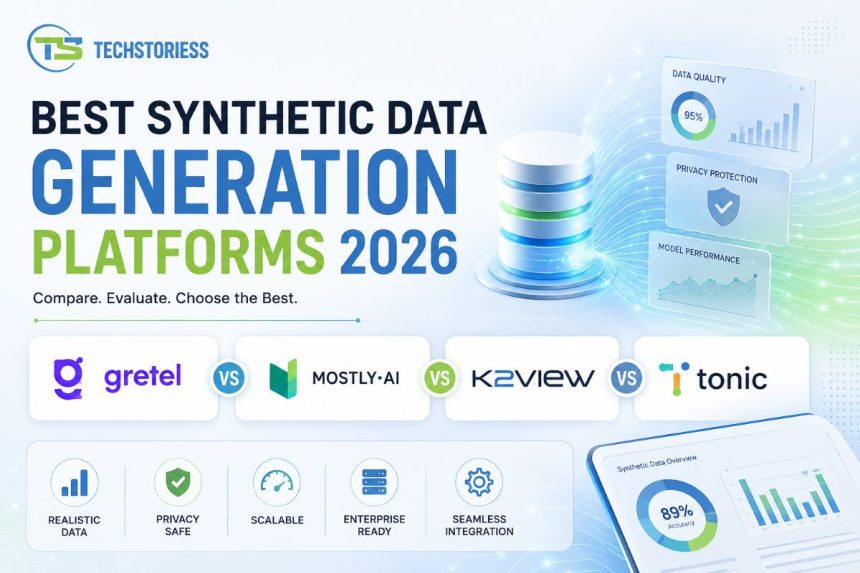
The best platforms generate realistic datasets that preserve statistical accuracy while protecting privacy. They enable faster development, safer testing, improved analytics, and scalable synthetic data for AI training. In this guide, we compare four leading vendors—Gretel, MOSTLY AI, K2view, and Tonic—to identify which solution delivers the most value in 2026.
Synthetic Data Generation Platforms: Why They Matter in 2026
Synthetic data generation platforms create artificial datasets that mimic the characteristics of real data without exposing actual records. Synthetic data is artificially generated information that statistically resembles real datasets. It enables safe experimentation, unlimited scaling for rare events or edge cases, and regulatory compliance with GDPR, HIPAA, and CCPA.
These platforms have evolved far beyond simple data masking. Modern solutions use advanced machine learning, generative AI, and statistical modelling techniques to produce highly realistic datasets suitable for:
- AI model training
- Software testing
- Analytics development
- Data sharing
- Regulatory compliance
- Sandbox environments
- Data product development
The growing adoption of generative AI has dramatically increased demand for high-quality synthetic data tools. Organisations now need larger training datasets while maintaining strict privacy standards.
Key Features to Look for in Synthetic Data Tools
Before diving into the comparison, consider these must-haves:
- Data Types Supported: Tabular, time-series, text, unstructured, relational databases.
- Generation Methods: AI-powered (e.g., GANs, transformers), rules-based, from-scratch, or modelled on real data.
- Privacy & Compliance: Differential privacy, PII detection, auditability.
- Fidelity & Utility: Statistical similarity, referential integrity, downstream model performance.
- Ease of Use & Integration: No-code options, APIs, CI/CD pipelines, cloud/on-prem deployment.
- Scalability & Performance: Speed, handling large/complex datasets, cost efficiency.
- Additional Capabilities: Subsetting, masking, quality metrics, versioning.
Evaluation Criteria
To create a meaningful synthetic data platform comparison, each platform was scored across eight key categories.
| Category | Weight |
| Data Realism | 20% |
| Privacy Protection | 20% |
| Ease of Use | 15% |
| AI Training Readiness | 15% |
| Enterprise Scalability | 10% |
| Data Variety Support | 10% |
| Governance & Compliance | 5% |
| Pricing Flexibility | 5% |
Scores are based on product capabilities, public documentation, enterprise adoption patterns, and market positioning as of 2026.
Synthetic Data Generation Platforms Scored Matrix
| Platform | Overall Score | Best For |
| MOSTLY AI | 9.3/10 | Enterprise synthetic data and privacy |
| Gretel | 9.1/10 | AI development and developer workflows |
| K2view | 8.7/10 | Real-time enterprise data operations |
| Tonic | 8.5/10 | Development and testing environments |
MOSTLY AI Review
What Is MOSTLY AI?
MOSTLY AI is one of the most recognised synthetic data generation platforms focused on generating highly realistic and privacy-safe structured data. The company has built its reputation around preserving complex relationships within datasets while maintaining strong privacy guarantees.
Strengths
MOSTLY AI excels in:
- Privacy-preserving synthetic data generation
- Financial services datasets
- Healthcare data generation
- Customer analytics environments
- Regulatory compliance use cases
One reason enterprises choose MOSTLY AI is its ability to preserve correlations across multiple tables. This is essential for realistic business simulations and advanced AI model training.
AI Training Performance
For synthetic data for AI training, MOSTLY AI consistently performs well because generated records maintain realistic distributions and behavioural patterns.
This makes it useful for:
- Fraud detection models
- Customer segmentation
- Risk prediction systems
- Predictive analytics
Weaknesses
Potential limitations include:
- Higher enterprise-oriented pricing
- More complex deployment requirements
- Learning curve for smaller teams
MOSTLY AI Score
| Category | Score |
| Data Realism | 9.8 |
| Privacy | 9.9 |
| Ease of Use | 8.5 |
| AI Training | 9.6 |
| Scalability | 9.4 |
| Overall | 9.3 |
Gretel Review
What Is Gretel?
Gretel is a developer-focused synthetic data software platform that combines synthetic data generation, privacy engineering, and AI-ready datasets. Its API-first approach has made it especially popular among engineering teams and AI developers.
Strengths
Gretel stands out because of:
- Developer-friendly APIs
- Flexible deployment options
- Strong AI integration
- Text and structured data support
- Fast dataset generation
Unlike many traditional synthetic data tools, Gretel is designed to heavily target modern AI workflows.
Synthetic Data for AI Training
Organisations building large language models and machine learning systems often use Gretel to rapidly generate training datasets at scale.
Its strengths include:
- Data augmentation
- LLM fine-tuning support
- Test data generation
- Model validation datasets
Weaknesses
Areas where Gretel may lag include:
- Governance features compared with enterprise-focused competitors
- Some advanced compliance workflows
Gretel Score
| Category | Score |
| Data Realism | 9.2 |
| Privacy | 9.1 |
| Ease of Use | 9.5 |
| AI Training | 9.8 |
| Scalability | 9.8 |
| Overall | 9.1 |
K2view Review
What Is K2view?
K2view approaches synthetic data from a broader enterprise data management perspective. The platform combines data virtualisation, test data management, and synthetic data generation into a single architecture.
Strengths
K2view performs particularly well in:
- Large-scale enterprise environments
- Complex relational datasets
- Real-time data operations
- Multi-system integrations
Organisations with fragmented legacy systems often benefit from K2view’s architecture.
Enterprise Data Management Advantages
Many enterprises select K2view because synthetic data generation is integrated into a larger data ecosystem rather than a standalone process.
This creates advantages for:
- Banking environments
- Telecom operators
- Large retailers
- Global enterprises
Weaknesses
Common challenges include:
- More implementation effort
- Higher complexity
- Less intuitive user experience
K2view Score
| Category | Score |
| Data Realism | 9.0 |
| Privacy | 9.1 |
| Ease of Use | 7.9 |
| AI Training | 8.8 |
| Scalability | 9.8 |
| Overall | 8.7 |
Tonic Review
What Is Tonic?
Tonic is a widely adopted synthetic data platform focused on software development, testing, and QA environments. Its goal is simple: provide realistic data without exposing sensitive information.
Strengths
Tonic excels in:
- Development workflows
- Test environment creation
- Rapid onboarding
- User-friendly interfaces
- Data masking and synthesis
Engineering teams often choose Tonic because it reduces the time required to provision test datasets.
Development Team Benefits
Compared with many enterprise-focused synthetic data generation platforms, Tonic is easier to deploy and manage.
Typical use cases include:
- QA testing
- Application development
- CI/CD pipelines
- Sandbox environments
Weaknesses
Potential limitations include:
- Less advanced AI training capabilities
- Fewer enterprise governance controls
- Limited advanced modeling options
Tonic Score
| Category | Score |
| Data Realism | 8.7 |
| Privacy | 8.9 |
| Ease of Use | 9.3 |
| AI Training | 8.1 |
| Scalability | 8.4 |
| Overall | 8.5 |
Gretel vs MOSTLY AI
Which Platform Is Better?
The answer depends on your priorities.
Choose MOSTLY AI If:
- Privacy is your top concern
- You operate in regulated industries
- You need highly realistic structured data
- Compliance requirements are strict
Choose Gretel If:
- You are building AI products
- You need API-first workflows
- Developer productivity matters
- AI model training is a priority
In the Gretel vs MOSTLY AI debate, MOSTLY AI generally wins for enterprise privacy and realism, while Gretel leads for AI innovation and developer flexibility.
Gretel vs K2view
Key Differences
- The Gretel vs K2view comparison highlights two very different philosophies.
- Gretel focuses on synthetic data generation and AI workflows.
- K2view focuses on enterprise-wide data management and operational integration.
Gretel Advantages
- Faster deployment
- Better AI support
- Strong developer experience
- Flexible APIs
K2view Advantages
- Enterprise scalability
- Complex data ecosystem support
- Large operational environments
- Strong data orchestration
Organisations focused on AI projects typically prefer Gretel, while enterprises managing massive data infrastructures often favour K2view.
Tonic vs MOSTLY AI
Which One Delivers More Value?
The Tonic vs MOSTLY AI comparison is common among organisations evaluating privacy and testing solutions.
Choose Tonic If:
- Your primary goal is software testing
- Teams need rapid onboarding
- Simplicity is important
Choose MOSTLY AI If:
- Data quality is mission-critical
- AI training datasets are required
- Enterprise compliance is mandatory
MOSTLY AI delivers stronger synthetic data generation capabilities overall, while Tonic provides a smoother experience for development teams.
Use Cases: Synthetic Data for AI Training and Beyond
- AI Model Training: Gretel and Tonic excel at generating diverse datasets for fine-tuning LLMs or handling cold-start problems.
- Software Testing & DevOps: K2view and Tonic preserve relational integrity for realistic test environments.
- Privacy-Preserving Analytics: MOSTLY AI and Gretel enable secure data sharing and collaboration.
- Edge Cases & Scaling: All platforms help simulate rare events, but K2view’s entity approach best handles business processes spanning systems.
Choose based on your data complexity: simple tabular/AI experiments favour Gretel or MOSTLY AI; intricate enterprise systems favour K2view or Tonic.
Pricing Overview (2026 Estimates)
- Gretel: Freemium with Team (~$295/mo) and Enterprise (custom). Usage-based credits.
- MOSTLY AI: Free tier, credit-based Team/Enterprise. Flexible for varying needs.
- K2view: Enterprise-focused, custom pricing—higher for full platform but strong ROI in large deployments.
- Tonic: Free tier with credits, Plus (~$29/mo), Enterprise custom. Pay-as-you-go friendly.
Always request demos for current quotes, as needs vary.
How to Choose the Right Synthetic Data Generation Platform
Selecting the right synthetic data generation platform depends on business goals.
Consider the following questions:
What is your primary use case?
- AI training
- Testing
- Analytics
- Data sharing
How strict are your privacy requirements?
Regulated industries typically need stronger privacy controls and governance capabilities.
What level of scalability is required?
Large enterprises often prioritise integration and operational complexity.
Who will use the platform?
Developer-focused teams may prefer Gretel or Tonic. Enterprise data teams may favour MOSTLY AI or K2view.
Conclusion
The market for synthetic data generation platforms continues to mature rapidly in 2026.
MOSTLY AI earns the highest overall score due to its exceptional privacy capabilities and realistic data generation. Gretel remains the strongest choice for AI-focused organisations. K2view excels in enterprise-scale environments, while Tonic delivers outstanding value for development and testing teams.
The right platform ultimately depends on your goals. Organisations focused on compliance and realism should evaluate MOSTLY AI. Teams building next-generation AI products may find Gretel a better fit. Enterprises with complex data ecosystems should consider K2view, while engineering teams can benefit from Tonic’s simplicity.
By aligning platform strengths with business requirements, companies can maximise the value of synthetic data while reducing privacy risk and accelerating innovation.
Frequently Asked Questions
1. What are synthetic data generation platforms?
Synthetic data generation platforms create artificial datasets that replicate the patterns and characteristics of real-world data without exposing actual records.
2. Which is the best synthetic data platform in 2026?
MOSTLY AI ranks highest overall for privacy and realism, while Gretel leads for AI-focused applications and developer workflows.
3. Is synthetic data safe for AI training?
Yes. High-quality synthetic data can significantly improve model training while reducing privacy risks when generated correctly.
4. What is privacy-preserving synthetic data?
Privacy-preserving synthetic data maintains the statistical properties of original data while preventing identification of real individuals.
5. How does Gretel compare with MOSTLY AI?
In the Gretel vs MOSTLY AI comparison, Gretel offers stronger AI development workflows, while MOSTLY AI delivers superior privacy protection and enterprise-grade realism.
Ready to Find the Right Synthetic Data Platform?
Evaluate your privacy requirements, AI objectives, and scalability needs before making a decision. Compare demos, test generated datasets, and assess governance features to identify the synthetic data generation platform that best supports your organisation’s growth and innovation goals.