


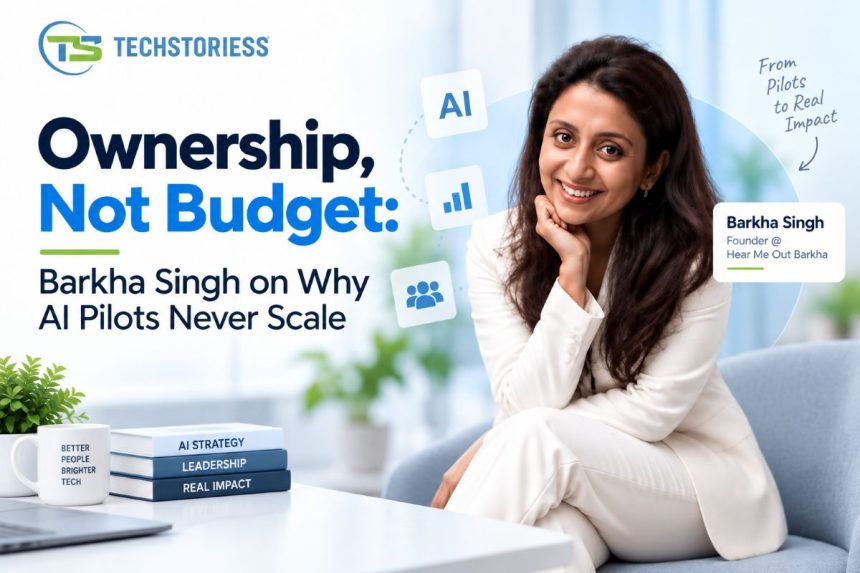
Every enterprise AI pilot looks promising. Very few survive the jump to scale.
We sat down with Barkha Singh – Founder of Hear Me Out Barkha, and formerly VP Sales at Saxon AI and Chief Revenue Officer at ZNet Technologies, where she led a cross-functional team to a 25% revenue increase – to ask why. Her answer wasn’t about model performance or algorithm quality. It was about something far more human: who actually owns the change once the pilot ends.
What’s the #1 reason enterprise AI pilots stall before they scale?
It does due to lack of it’s defined ownership.
I’ve seen organizations successfully prove that AI can predict, automate, or recommend. What they fail to prove is who changes their daily workflow because of it.
The moment you move from pilot to scale, questions emerge:
- Which team owns adoption?
- Which KPI changes?
- What process gets redesigned?
- Who funds the next phase?
Where does enterprise AI ROI show up fastest and where does it lag expectations?
Fastest ROI
In my experience, the quickest ROI appears in:
- A defined strategy aligned with sales, and marketing productivity
- Customer support
- Process automation
Knowledge management
Imagine AI actually reducing campaign and proposal creation time from 4 hours to 30 minutes, or helps support agents resolve tickets 45% faster, the business impact becomes visible almost immediately.
Slowest ROI
The most overhyped area is often strategic decision intelligence.
Organizations expect AI to magically improve forecasting, strategic planning, or executive decision making. The reality is that these use cases depend heavily on data quality, organizational maturity, and behavioural change.
The technology can generate insights, but getting leaders to trust and act on those insights takes much longer than anticipated.
So I often tell CXOs:
Automation delivers efficiency first. Intelligence delivers value later.
Having sat in Sales, Product, and CRO seats, who tends to be the real blocker when an AI initiative doesn’t get enterprise-wide adoption?
Interestingly, it’s rarely budget.
I’ve seen organizations approve multi-million-dollar programs and still fail to get adoption.
The real challenge is usually the change resistance to adopt to the AI initiatives.
In many cases, AI exposes process inefficiencies that have existed for years. What looks like a technology problem is actually a change management problem.
The organizations that succeed, invest as much in change management, as they do in the AI platform itself.
From a revenue and growth leadership lens, what’s one metric a CXO should track in the first 90 days?
If I had to choose only one metric, it would be:
Time-to-Value Reduction
For example:
- Sales cycle reduced from 120 days to 60 days
- Proposal turnaround reduced from 5 days to 3 hours
- Customer issue resolution reduced from 48 hours to 6 hours
- Employee onboarding reduced from 6 weeks to 2 days
Revenue leaders care about speed because speed compounds across the business.
In the first 90 days, I want evidence that AI is accelerating a critical business motion.
After spending years leading revenue, sales, partnerships, and AI-led transformation programs, I’ve learned that successful enterprise AI deployments are far less about model performance and far more about business adoption. The winners are not the companies with the smartest algorithms. They’re the ones that redesign workflows, align accountability, and measure outcomes that executives actually care about: growth, efficiency, and speed.
Wrapping Up
Barkha Singh’s core argument comes from more than a decade spent across sales, business intelligence, and revenue leadership — including growing channel partnerships by over 100% and scaling lead flow by a third through earlier roles in her career. Her conclusion cuts against most of the AI hype cycle: the companies winning aren’t the ones with the smartest models, they’re the ones that redesign workflows, assign real accountability, and measure the outcomes executives actually care about — growth, efficiency, and speed. If there’s one line from this conversation worth sitting with, it’s hers: automation delivers efficiency first, intelligence delivers value later