



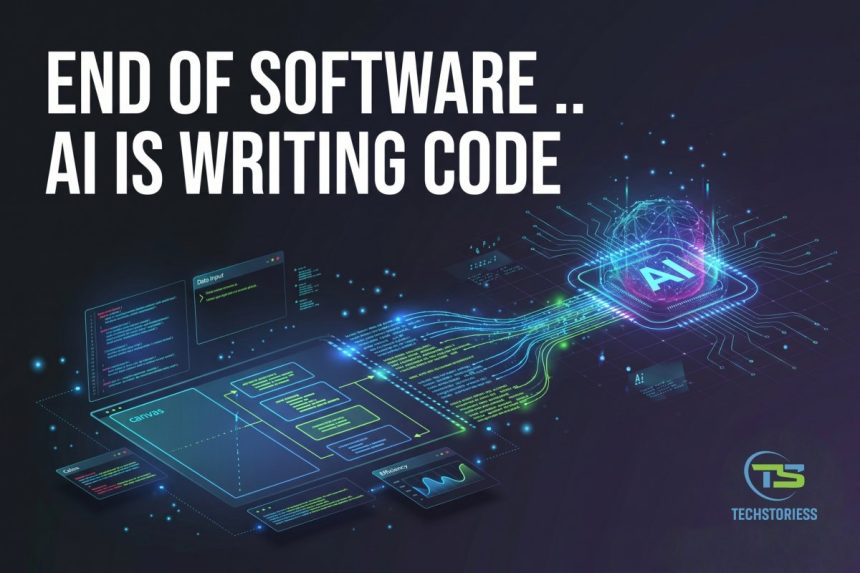
Picture a web developer preparing a dashboard for customer support. He doesn’t open an IDE, search for boilerplate, or manually define database schemas. Instead, he simply communicates with the computer in structured English-detailing workflows, specifying constraints, and outlining integrations. Within a short time, a working application begins to take shape. APIs are connected, the database schema is defined, validation rules applied, and edge cases accounted for. Without writing a single line of code, a deployable version is ready.
- The Shift: From Writing Code to Defining Systems
- The Shift: From Writing Code to Defining Systems
- Developers as Editors, Not Builders
- What AI Still Cannot Do (And Why It Matters)
- What AI Still Cannot Do and why It Matters?
- The New Developer Skill Stack
- The Emerging Profile: Systems Strategist
- The Job Market Shift: Who Wins, Who Gets Replaced
- The Rise of AI-Native Software Development
- Final Insight: The End of Coding or the Beginning of Real Engineering?
More than just speed or automation, this scenario illustrates how AI is redefining the very nature of software development.
Until recently, software development meant writing code, debugging logic, and manually integrating components. Technical fluency defined professional effectiveness: developers had to translate complex logic into syntactically correct programs, structure functions efficiently, and identify hidden errors across thousands of lines. Over time, the identity of a developer was synonymous with their ability to execute this manual craftsmanship flawlessly.
Today, AI can generate production-ready code with working functionality. Though not perfect, these outputs are often practically usable. Leveraging AI, developers can autocomplete entire modules, suggest architectural patterns, and even simulate workflows. Instead of manually constructing each component, developers now focus on defining what should exist-the one who determines the system’s intent rather than coding every detail.
This scenario mirrors the long arc of evolution in software development. Initially, programmers worked with punch cards and assembly, performing tedious, error-prone tasks. High-level languages then simplified logic expression, and tools progressively automated translation and compilation. Each transition faced resistance, yet every shift ultimately enabled developers to build more complex systems faster, reducing repetitive labor while improving reliability.
However, the post-AI era introduces a unique inflection point. Unlike prior developments, it does not merely simplify traditional tasks-it eliminates them, redefining the developer role entirely.
Earlier innovations made coding easier; today, the emphasis is on articulating intent. Developer efficiency is measured not by typing speed or lines of code, but by the precise on of communication with AI – defining intent, specifying constraints, and guiding systems toward desired outcomes.
The tactile, line-by-line construction of logic is no longer the decisive skill. Machines can handle it.
This raises a question: will AI replace developers? Is the era of human programmers over? What would be the future of software developers as AI can write end to end codes?
The answer depends on how you define a developer. If a developer is strictly a coding engineer, yes. But if you embrace the shift, the opportunity lies in evolving into a designer of intelligent systems rather than a typist of code.
The Shift: From Writing Code to Defining Systems
Historically, software development was a production-focused activity: developers translated operational goals into working systems by manually implementing every function, structuring each module, and managing all integrations. Competence was judged by mastery over syntax, framework knowledge, and debugging efficiency.
AI is fundamentally changing this model.
Writing complex code is no longer the central activity-it has become a byproduct of clearly defined intent. Today, developers focus on designing systems rather than manually constructing every logic component.
Instead of typing lines of code, developers now work with AI to define a system’s structure. They specify how components interact, outline constraints, anticipate edge cases, and guide the AI in translating these specifications into functional software. The AI handles the implementation, freeing humans to focus on the design and reasoning behind the system.
Take API development as an example. Traditionally, developers:
- Wrote endpoint definitions
- Handled request parsing
- Structured response formats
- Implemented validation logic
With AI, the scenario shifts. Developers now define:
- The purpose of each API
- Data contracts and expected inputs/outputs
- Handling of failure scenarios
The AI generates endpoints, suggests validation layers, and flags inconsistencies. However, the responsibility for defining what the API represents and how it should behave remains with human developers.
At a larger scale-considering system architecture-developers’ responsibilities extend beyond syntax or code structure to:
- Defining communication between services
- Ensuring state consistency
- Handling failures across components efficiently
- Maintaining scalability under variable loads
In short, machines handle syntax and repetitive coding, while humans exercise judgment, reasoning, and strategic design.
While AI can suggest architectural patterns, it cannot fully capture business context, weigh trade-offs, or anticipate long-term implications. Developers must decide: Should the system prioritize speed over consistency? Flexibility over simplicity? What is the acceptable cost of scaling? The answers shape the system itself, far beyond the underlying code.
The Shift: From Writing Code to Defining Systems
By delegating the core coding work to AI, developers can concentrate on strategic decisions that shape the system, such as:
- Breaking down ambiguous problems into clearly defined modules
- Establishing system boundaries and component responsibilities
- Planning for failure modes and edge cases
- Aligning technical decisions with real-world constraints
This shift elevates developers from mere code producers to system designers.
It also redefines productivity. Previously, metrics like lines of code written or speed of feature delivery measured competence. With AI handling those tasks, such metrics lose relevance. Today, a developer’s effectiveness is measured by whether the system is:
- Coherent and logically consistent
- Scalable under growing demand
- Maintainable over time
- Aligned with business objectives
It’s important to note that AI does not produce deterministic, linear outcomes. Its suggestions scale quickly, but small mistakes in system definition can propagate widely. One poorly defined interface or misinterpreted requirement can create cascading issues.
Thus, the role of the developer now encompasses not only defining the system but also taking ownership of its success or failure. Skills are shifting from mechanical implementation to judgment, foresight, and strategic design.
This is the essence of the AI-driven transformation: developers no longer build every line of code; they define, guide, and oversee the systems that AI constructs.
Developers as Editors, Not Builders
For decades, developers were primarily writers of code, responsible for producing every line from scratch, translating raw logic into functional systems. The AI era has fundamentally changed that.
Developers are no longer just code writers-they have become editors of code.
AI largely removes the initial barrier of the blank page-the so-called “developer’s block.” A well-structured prompt can now generate entire functions, modules, or even multi-layered application scaffolds. But beyond this point, human oversight remains essential. Developers must review, refine, and optimize AI-generated code to ensure it meets real-world requirements.
Editing AI-generated code involves multiple responsibilities:
- Interrogating correctness: Does the logic actually solve the intended problem or just appear plausible?
- Evaluating edge cases: How will the system behave under unexpected inputs, failures, or scale?
- Ensuring consistency: Does this piece align with overall system architecture and design principles?
- Refining structure: Can the solution be simplified without losing efficiency? Is it scalable for future needs?
More than simply producing code, developers now optimize AI outputs to achieve intended outcomes.
AI-generated code may function correctly in isolation, but it is not inherently reliable. It can overlook rare edge cases, introduce inefficiencies, or make assumptions that fail under production conditions. Left unchecked, such issues can escalate, affecting overall system performance and business objectives.
To evaluate AI outputs effectively, developers must have a precise mental model of the system: anticipating inconsistencies, understanding side effects, and challenging the AI’s implicit assumptions. Unlike manually writing code, AI compresses the learning process. Developers must reverse-engineer intent, validate assumptions, and integrate outputs seamlessly into existing systems.
The editing responsibility extends beyond code itself. Developers now refine prompts, adjust constraints, and iterate on instructions to guide AI in producing reliable outputs. Instead of only reviewing the final code, they actively shape the process that generates it, ensuring that the system behaves as intended from the ground up.
This marks a profound mindset shift:
- The builder mindset focused on assembling pieces into a working system.
- The editor mindset focuses on selection, refinement, and judgment-deciding what should remain, what should be modified, and what needs to be rethought entirely.
In this new paradigm, the value of a developer is no longer measured by how much code they produce, but by how effectively they discern quality, consistency, and alignment with business goals. The code may be written by machines, but its reliability, coherence, and adaptability remain human responsibilities.
Developers are now directors of software creation: they guide AI, make critical decisions, and ensure that systems function robustly in real-world conditions. The ability to interpret, refine, and validate has become the true measure of expertise in the post-AI era.
What AI Still Cannot Do (And Why It Matters)
Experienced developers know that software development is not just about mechanics-it’s about intent, judgment, and context. Ownership of a system extends from high-level architecture to edge-case handling, and maintaining this oversight sharpens decision-making skills and preserves domain knowledge.
AI excels at following established patterns, producing outputs that appear flawless on the surface. Yet these outputs can fail under real-world conditions. Humans are essential for ensuring that systems remain reliable, scalable, and secure even when requirements are ambiguous or evolving.
Software systems are influenced by multiple factors-user behavior, business rules, legacy constraints, regulatory requirements, and unpredictable edge cases. Much of this context is implicit, derived from historical decisions or undocumented practices. AI can only process explicit inputs; it cannot infer the full depth of why a system behaves a certain way unless that context is provided.
As a result, AI often focuses on immediate outcomes rather than long-term reliability. For example, a function may work perfectly in isolation but falter when integrated into a complex workflow. Latency constraints, concurrency issues, and subtle security vulnerabilities may only appear under production pressures. These failures are not always obvious in testing-they emerge in real-world usage.
This limitation extends to long-term system thinking. Software is rarely a one-off task; it evolves to meet growing needs. Developers anticipate future use cases, manage technical debt, and make trade-offs that preserve maintainability and scalability. AI cannot assume accountability for these decisions-humans remain responsible for ensuring the system’s continued effectiveness.
Every design choice carries consequences. A poorly structured database schema can limit scalability. A missed edge case can cause cascading failures. Subtle security flaws can expose sensitive data. These are not just technical issues-they impact business, legal, and reputational outcomes. Humans must take responsibility for these outcomes, as AI cannot be held accountable.
What AI Still Cannot Do and why It Matters?
AI struggles in situations of ambiguity. Real-world requirements are often incomplete, contradictory, or continuously evolving. Developers must fill in the gaps, ask the right questions, challenge unrealistic assumptions, and ensure clarity before implementation. AI, by contrast, tends to follow patterns, producing outputs that may appear reasonable but rest on fragile foundations.
Security further underscores AI’s limitations. AI-generated code can inadvertently introduce vulnerabilities, including:
- Improper input validation
- Weak authentication flows
- Misconfigured dependencies
These are common failure modes, not rare exceptions, and require deliberate scrutiny. Security is not just about applying standard patterns-it demands adversarial thinking and anticipation of potential exploits, a level of reasoning that remains deeply human.
The broader point is that AI can generate components, but it cannot understand systems holistically. Software is not merely code-it is an interconnected structure with dependencies, constraints, and evolving behavior. Managing this complexity requires continuous oversight, judgment, and adaptation.
This is why the developer’s role is not disappearing-it is shifting toward areas where responsibility cannot be automated:
- Defining system boundaries
- Evaluating trade-offs
- Ensuring long-term reliability
- Taking ownership of outcomes
AI can assist, accelerate, and even outperform humans in narrow tasks, but it cannot own the system as a whole. In software engineering, ownership is everything.
The New Developer Skill Stack
With AI taking over the act of writing code, the core competency of developers is shifting. The modern developer is no longer measured by how quickly they type lines of code but by how effectively they frame problems, design systems, and guide intelligent tools. The center of gravity has moved from implementation to orchestration.
What emerges is a new skill stack, blending engineering, product thinking, and strategic judgment. It emphasizes designing robust systems, collaborating with AI, and making high-level decisions that AI alone cannot manage.
System Design & Architecture
At the top of this stack is system design-the ability to think in abstractions rather than lines of code.
As AI handles implementation, developers must define:
- System boundaries
- Data flow between components
- Trade-offs between scalability, cost, and performance
- Failure handling mechanisms
A well-written function cannot compensate for a poorly designed system. Conversely, a sound architecture can absorb imperfect implementation by controlling how failures propagate. Developers must now think in terms of distributed systems, event-driven architectures, and modular design principles-not to implement every detail, but to ensure AI-generated outputs fit into a coherent whole.
AI Collaboration Skills
Working with AI is an active, iterative process, not a passive one. The quality of AI-generated outputs depends heavily on:
- How clearly the developer expresses intent
- How well constraints are defined
- How effectively feedback is provided
This is often called “prompt engineering,” but in practice, it is closer to instruction design. Developers must:
- Break complex problems into structured prompts
- Guide AI through multi-step reasoning
- Iterate quickly based on imperfect outputs
- Detect when AI is hallucinating or making flawed assumptions
The process becomes a continuous loop: Define → Generate → Evaluate → Refine. Mastery is not about perfect output on the first attempt, but efficiently converging on the right solution.
AI collaboration transforms developers into directors of software creation, shaping not just what is produced, but how it is produced.
Product Thinking
In the AI era, the differentiator is no longer how fast or well you can write code-AI handles that. The real question is whether you should build it, and how it should behave.
Product thinking requires developers to understand:
- User intent and behavior
- Business goals and constraints
- Trade-offs between usability and technical complexity
AI can generate features, but it cannot determine their value or how they should interact in a real-world context. Developers must take responsibility for shaping the system meaningfully, ensuring that features align with user needs, business priorities, and operational realities.
This responsibility blurs traditional boundaries. Teams are smaller, automation is higher, and developers often act as engineers, product designers, and strategists simultaneously. Their role shifts from executing tasks to making critical decisions about the system as a whole.
Debugging & Validation
AI can produce code at remarkable speed, but verification remains a human responsibility. The challenge is no longer writing logic, but ensuring that it behaves correctly under all conditions.
Developers need:
- Strong mental models of system behavior
- The ability to trace issues across multiple layers
- Skills to identify subtle, non-obvious failures
Validation becomes a first-class skill, encompassing:
- Writing effective tests
- Simulating edge cases
- Stress-testing assumptions
In this environment, developers act as the final checkpoint, bridging AI-generated outputs and real-world reliability. Their judgment ensures that automated code not only works in theory but performs as intended in practice.
Cross-Domain Awareness
Modern software operates in complex ecosystems-it intersects with business processes, legal requirements, user behavior, and operational realities. As AI abstracts technical details, these non-technical factors become critical.
Developers who understand:
- How a feature impacts revenue
- How data flows affect compliance
- How user behavior influences system performance
…can make better decisions than those who focus solely on technical correctness.
Cross-domain awareness ensures that AI-generated solutions are practical, compliant, and effective in the real world. Developers act as translators between technical possibilities and business realities, aligning system design with organizational objectives.
This skill transforms developers into systems strategists, capable of orchestrating AI outputs to meet strategic goals rather than simply producing code.
The Emerging Profile: Systems Strategist
Taken together, these shifts define a new archetype: the AI-era developer as a systems strategist.
This developer:
- Clearly defines problems and desired outcomes
- Designs solutions at a high level rather than coding every detail
- Leverages AI as a force multiplier
- Ensures outputs align with real-world constraints
Technical depth is still essential-but it is applied differently. Instead of focusing on syntax and frameworks, it is applied to:
- Decision-making
- Trade-off analysis
- Maintaining system integrity
AI lowers the floor by automating basic implementation but raises the ceiling, demanding sharper thinking, better judgment, and broader context awareness. Developers who adapt can operate at unprecedented levels of leverage. Those who resist risk finding that coding alone no longer defines value.
In essence, the AI era shifts the role of the developer from implementer to strategist, from executing instructions to shaping systems, guiding outcomes, and taking ownership.
The Job Market Shift: Who Wins, Who Gets Replaced
Every technological shift reshapes the labor market. What makes the AI transition unsettling is not just that roles are changing-it’s that they are compressing.
AI does not eliminate the need for software development; it changes the economics of human effort. Entry-level roles are the most immediately affected. Traditionally, junior developers:
- Implemented well-defined tasks
- Wrote boilerplate code
- Fixed small bugs
- Learned through repetition
These tasks are precisely what AI handles best. Code generation systems can now:
- Scaffold entire applications
- Write standard CRUD operations
- Suggest fixes for common bugs
- Generate documentation alongside code
The traditional pathway into software development is narrowing. Companies need fewer people to do the same work, and the remaining work demands higher-level thinking from the outset.
The result is polarization:
- Low-skill, repetitive roles shrink – “knowing how to code” is no longer a differentiator.
- High-skill roles expand – organizations seek developers who can design systems end-to-end, make architectural decisions, and collaborate with product and business teams.
Smaller teams can now achieve higher output. A product that once required ten developers might be maintained by three or four-if those individuals leverage AI effectively. Productivity gains are real but unevenly distributed. Those who operate at a higher level become highly valuable; those who cannot may struggle to find a foothold.
A new category is emerging: AI-native developers. These individuals:
- Think in terms of systems rather than code
- Delegate implementation to AI effectively
- Iterate rapidly through ideas and prototypes
- Focus on outcomes rather than process
Experience still matters, but adaptability is now the key metric. Years spent writing code do not automatically translate into effectiveness in an AI-driven workflow. Value is tied to judgment, system-level thinking, and the ability to operate with leverage.
The broader implication: AI is not replacing developers but raising the bar. The middle ground-where competence in syntax and frameworks was sufficient-is eroding. The field now rewards those who can make high-level decisions, guide AI, and shape systems.
The Rise of AI-Native Software Development
The shift is not just about who writes code-it’s how software comes into existence.
Historically, software was built sequentially: ideas → specifications → code → working systems. Each step introduced friction: delays, miscommunication, and overhead. Even small products required coordinated effort across multiple roles.
AI collapses this sequence. We are entering an era where software can be described into existence.
Natural language is now a legitimate interface for programming. A developer-or even a non-developer-can outline an idea, define constraints, and watch a functional system emerge. This is sometimes called “vibe coding,” but the shift is deeper: programming is becoming expressive, not just technical.
Implications are immediate:
- Time to build shrinks – Tasks that once took weeks can now be completed in hours or minutes. Prototypes are often production-ready.
- Lower barrier to entry – Non-technical individuals can create functional applications. Expertise is still required, but it shifts from implementation to defining what and how to build.
- Volume of software increases – Easier creation leads to more experiments, more products, and rapid iteration.
But this abundance brings a new challenge: quality and differentiation. Anyone can build, but what matters is:
- Does the system solve a meaningful problem?
- Does it behave reliably in real-world conditions?
- Does it integrate effectively with other systems?
AI-native development also changes workflow. Instead of linear coding and testing, developers:
- Define intent upfront
- Generate implementations via AI
- Continuously refine through feedback loops
This makes software creation fluid and iterative, blurring lines between design, development, and testing.
The developer’s role is repositioned. They are no longer just builders-they are directors of creation: setting direction, defining rules, and ensuring coherence as systems emerge at unprecedented speed.
Software is not becoming less important; it is becoming more abundant, and the real value lies in guiding, refining, and differentiating.
Final Insight: The End of Coding or the Beginning of Real Engineering?
It’s tempting to see this moment as the end of coding-the decline of a craft that once defined the profession. But that misses the bigger pattern: what disappears is rarely the discipline itself-it’s the manual layer of it.
We no longer write assembly for most applications, yet computing is more sophisticated than ever. We no longer manage memory at the lowest level, yet systems have grown more complex. Each abstraction removed manual effort but demanded better thinking.
The same is happening now. Manual coding is becoming less central, but software engineering as a discipline-designing, reasoning, and taking responsibility for systems-is expanding. The surface area of what must be understood is increasing, not shrinking.
AI is exposing what software development always was:
- Defining problems clearly
- Navigating ambiguity
- Making trade-offs under constraints
- Building systems that endure in real-world conditions
AI removes execution friction but leaves these responsibilities untouched-often intensified.
The future of software developers as AI gains comparable technical skills, will be defined not by mechanical knowledge but by optimizing system design to fit real world context. Success belongs to those who make the best decisions about what to build, how it should behave, and why it matters.
This shift is a correction, not a loss. It strips away mechanical work and amplifies the parts requiring judgment, clarity, and systems thinking.
The question is no longer whether software is ending-it’s whether we are finally reaching true software engineering: a field defined not by lines of code, but by how well systems are understood, designed, and guided.









Hi, I check your new stuff daily. Your writing style is witty, eep
doing what you’re doing!