


For almost twenty years, companies have relied on the same method of becoming visible on-line; optimize with keywords, build up back-links, improve technical SEO data and get to the top of the Search Engine Results Page (SERP). They understood that once they appeared on page one of the SERP, the potential for being discovered was great.
That formula is now being rewritten.
Today, however, consumer behavior has changed as consumers are less reliant on traditional search behaviour and are now using AI powered interfaces such as ChatGPT, Gemini, Perplexity and Google’s AI overview, to ask direct, conversational questions e.g. “What is the best investment app”, What are the best CRM tools for startups?”, and “What digital agency is best for BFSI brands”. Rather than returning 10 URLs, these types of systems will return a curated list of recommendations.
This is the beginning of a new architecture for discovering things online; search is no longer just about indexing webpages; it is about AI models choosing which brands get to be listed in their answer. In the last year, there has been a very large increase in AI driven search traffic; now, companies are starting to measure another KPI called Share of Model; these measures how many times their brand is cited in generative AI responses.
So, now the question is: no longer can my website rankings? But, can the machine believe your brand enough to include it?
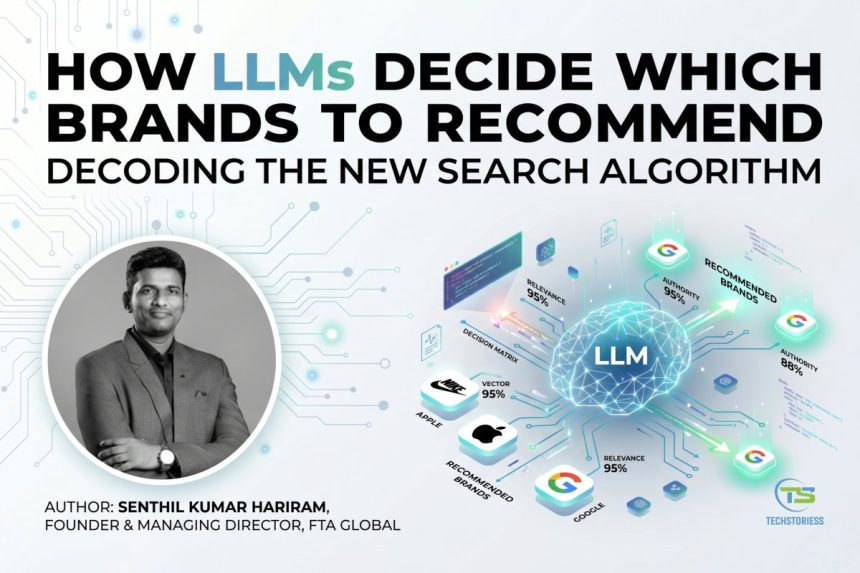
LLMs Do Not Rank Pages, They Synthesize Confidence
Unlike normal search engines that look for the most pages with keyword density, Large Language Models pull from many sources, look for patterns of consistency, and build an answer that is most credible to the user.
In other words, an LLM will not find one optimized webpage but rather confirm through repeated digital proof that your business is real, relevant, authoritative, and contextually appropriate.
Thus, rather than ranking mechanics being the foundation of the recommendation process, it is instead based on what might be called algorithmic confidence.
When a user requests the ‘best’ or ‘most trusted’ brand in a category, the model is successfully verifying:
- Which brands are repeatedly mentioned across reputable publications?
- Which names appear in category-specific comparisons?
- Which websites explain their offerings with clarity and consistency?
- Which brands have enough third-party validation to justify inclusion?
Only then does the AI feel confident enough to mention a name.
Third-Party Authority Is Becoming a Stronger Trust Signal Than Brand Claims
For many marketers, a big myth is that creating a lot of blog posts will provide enough exposure to be visible to AI.
Not so.
Research on generative engine optimization suggests that ai search systems rely on third-party consensus (earned media) more than they do on company’s own marketing materials including anything published by the company itself, it’s a reflection on what people think of the company’s products.
This means the role digital public relations plays have changed; for example, a company founder being featured in a magazine, having a quote from them used in a major news outlet, being compared against other similar brands, having analysts comment on their business, receiving positive reviews from customers or partners can all be considered as signals of trust from an AI.
In the world of LLMs, backlinks matter but the mention of your company matters even more.
Why?
Because an AI isn’t just checking if your website exists; it’s checking if any other source on the Internet has credibility when it talks about your company.
Brand Consistency Across the Web Shapes AI Memory
LLMs also rely on duplication of your content across all platforms.
If there is inconsistency in what your website states in relation to what LinkedIn or other media mentions claim about you; if you have not sufficiently completed your company profile on Business Listings, or you have fragmented customer sentiment, the LLM will receive inconsistent information and thus there will be reduced certainty (greater number of recommendations) for your product or service.
However, if your brand positioning, expertise, visibility for spokespersons through social media, industry mentions (example: mention in multiple different industry publications), and category association are consistent from website to website, then the AI will develop stronger memory (i.e., stronger memory pathways) associated to your brand entity.
In other words, LLMs have an easier time providing high volume recommendations to businesses that it can easily identify.
For this reason, some very successful companies do not show up in AI’s search recommendations; even though these companies provide high-quality services and products, they do not have enough presence in the digital communities of the models to allow the LLMs to recognize them as high-value candidates.
The New Search Algorithm Is Built on Trust, Not Just Traffic
The way we find things online is changing; it’s no longer determined by Google alone. It’s now determined by how quickly artificial intelligence can determine if an organization has a solid reputation or not in order to use that information in an aggregated answer.
So, the organizations that will be successful in search will be those that aren’t necessarily creating the most content but that create the strongest digital trust signals through clear technical practices and through using third parties, consistent semantics and expertise that can be read by machines.
In the world of large language models, showing up as a link is not simply about being one of the ten best links on the page; it’s now also about being one of three names the LLM recommends.
This is now an entirely new search algorithm that brands can’t afford to overlook.
Contributed by Senthil Kumar Hariram, Founder & Managing Director, FTA Global