


Key Takeaway
- 88% of organizations actively employ AI in at least one business function, yet nearly two-thirds haven’t yet scaled it to enterprise-wide deployment
- Job postings in AI-exposed occupations increased by 38%, directly confronting the predictions about mass redundancy
- AI-skilled workers command a 56% salary premium – over 2X the figure from a year earlier.
- 85% of employers are prioritizing workforce upskilling through 2030.
- AI agents – the next frontier – introduce yet another entirely new layer of operational roles.
For the last three years, headlines about AI disrupting the job market have dominated the tech landscape. Media narratives have repeatedly warned of machines decimating jobs, professionals being mass-fired, and automation wiping out entire professions. While such predictions make for compelling headlines, the actual data is far more complex-and, in many ways, more interesting.
- Key Takeaway
- A New Set of Questions Nobody Had Answers To
- The Jobs AI Is Actually Creating
- The Numbers That Contradict the Displacement Story
- AI Agents Are About to Add Another Layer
- Emerging opportunities and new roles in the market
- The Organizational Reckoning
- The Real Question Isn’t About Jobs. It’s About Structure.
Instead of eliminating the workforce, AI is reorganizing it. This reorganization is unfolding in a way few predicted: adoption is accelerating rapidly, but scaling continues to be the real challenge.
While AI adoption has, no doubt, moved at remarkable speed, turning that adoption into enterprise-wide impact remains a challenge. The latest State of AI survey by McKinsey reveals that 88% of organizations now use AI in at least one business function, up 10 percentage points from 78% a year earlier. Ironically, the same survey finds that most companies remain confined to the experimentation or pilot stage rather than scaling AI across the organization.
But at this point the narrative becomes more nuanced. AI tools are widely available, but making them work consistently across an organization remains the real challenge. According to McKinsey’s 2025 research, nearly two-thirds of organizations still struggle to move past pilot projects, while only about one-third have reached company-wide implementation. The substantial gap between adoption and deployment underscores a critical reality: turning AI on is easy, but embedding it into daily operations is far harder.
A New Set of Questions Nobody Had Answers To
Once organizations venture past the pilot stage, the real complexity begins. Moving into production environments, they encounter a series of complex questions that barely existed five years ago: Who oversees AI outputs? Who owns the consequences of AI-driven decisions? How are models governed, monitored, and updated? How are employees trained to coordinate with autonomous systems? And how is compliance maintained as AI regulations evolve across different jurisdictions?
These are not just technology issues, nor are they solely compliance concerns. They emerge at the intersection of technology, operations, governance, ethics, and business strategy – and they become increasingly complex with every stage of deployment.
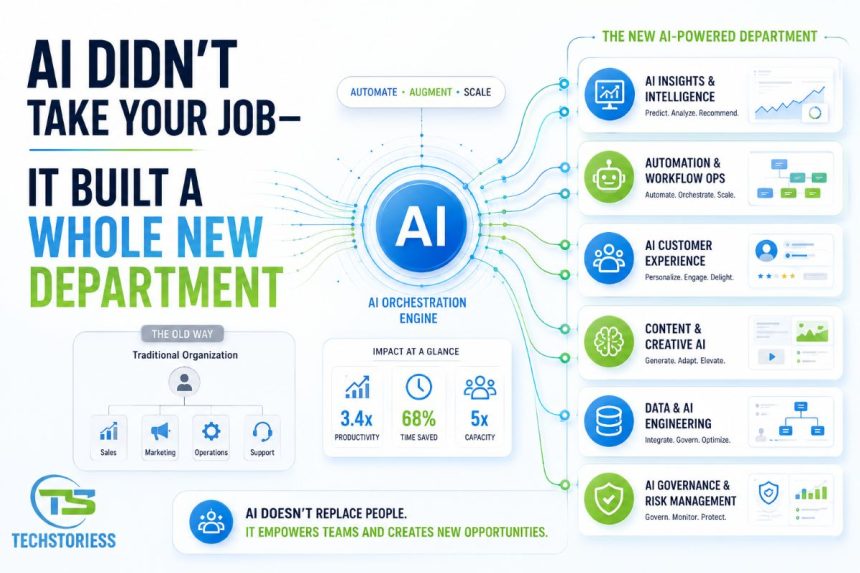
In other words, these challenges demand dedicated ownership. Committed professionals form teams that evolve into organizational functions. Over time, these functions develop into dedicated departments.
This is how every major corporate discipline begins. As managing capital grew too complex to handle informally, organizations created finance departments. As workforce management challenges multiplied in scale and complexity, HR emerged as a dedicated function. When digital systems evolved into business-critical infrastructure, IT became indispensable. AI is now following the same tradition-and it is doing so on an accelerated timeline.
The Jobs AI Is Actually Creating
Headlines often highlight job displacement, but tend to overlook a less visible yet equally important trend: the rise of entirely new roles that hardly existed a few years ago.
Organizations are actively recruiting for new, AI-focused roles such as AI engineers, agent engineers, AI product managers, governance leaders, responsible AI specialists, AI operations managers, trust and safety professionals, and AI security experts. These positions have emerged as AI systems demand continuous design, orchestration, monitoring, governance, compliance, and optimization. Starting as short-term responses to a technology trend, these positions are becoming permanent organizational functions.
This shift is supported by labor market data. LinkedIn’s Jobs on the Rise reports have repeatedly identified AI-focused roles among the fastest-growing job categories worldwide. The skills data is even more revealing: PwC’s analysis of nearly one billion job postings revealed that skill requirements are evolving 66% faster in AI-exposed occupations. Instead of merely adding new job titles, the market is redefining the skills and expertise required across existing professions.
The Numbers That Contradict the Displacement Story
PwC’s 2025 Global AI Jobs Barometer strongly challenges the fears of AI-driven job destruction. Its findings run counter to conventional wisdom on almost every major point.
Industries with the highest levels of AI exposure achieved roughly 4X productivity growth compared to less-exposed sectors, indicating that AI is accelerating professional performance rather than replacing the workforce. Employees with AI skills earned an average wage premium of 56%-more than 2X the premium observed a year earlier. Perhaps most surprisingly, job postings in highly AI-exposed occupations rose by 38%.
Both headcount and wages are rising rather than falling. That is the pattern emerging among enterprises deploying AI at scale. Rather than eliminating workers, these organizations are redesigning roles around uniquely human capabilities-judgment, creativity, communication, and complex problem-solving.
This does not suggest that disruption is absent. Workers whose responsibilities primarily involve repetitive task execution-such as data entry, basic content processing, and routine customer support-are under genuine pressure. But there is a clear distinction between disruption and displacement. Much of the public discussion treats the two as interchangeable, obscuring the reality of AI’s impact on global employment.
AI Agents Are About to Add Another Layer
While the present wave of AI adoption is spawning new departments, the upcoming wave may significantly accelerate that process. McKinsey finds that 62% of enterprises are actively experimenting with AI agents-systems that can plan, reason, and execute multi-step tasks with minimal human supervision.
This represents substantial productivity potential, but also intensified operational demands.
Agents demand comprehensive monitoring frameworks. They require clearly defined permission structures, security controls, governance policies, and performance management mechanisms. When deployed at scale, every autonomous system creates a continuous need for humans responsible for ensuring that it operates safely, accurately, and within regulatory boundaries.
To understand this better, consider cloud computing. When enterprises scaled cloud infrastructure, it did not replace IT teams outright-it created an entirely new discipline: DevOps. Likewise, as AI agents evolve from experimentation to production deployment, a similar operational discipline is beginning to emerge around AI operations, agent governance, and autonomous system management.
Emerging opportunities and new roles in the market
As two-thirds of organizations haven’t yet moved their AI from pilot to production – and competitive pressure will eventually force them there – the resulting work reorganization will be considerably broader than what enterprise hiring has absorbed to date.
Here are some emerging roles in the market:
AI Trainers & RLHF Specialists
Evaluating AI outputs, feeding corrective signals back into models, and calibrating system behavior to organizational context – where subject matter expertise meets machine oversight
.
Prompt Engineers
Engineering and refining the instruction sets that govern how AI systems respond in enterprise environments. With a growing number of enterprises adopting LLMs, prompt architecture has quietly become one of the highest-leverage force multipliers in the LLM-powered enterprise.
AI Audit Leads & Algorithmic Accountability Officers
This role operates at the intersection of legal, compliance, and AI. The professional owns the decision transparency records, compliance posture, and governance documentation that frameworks like the EU AI Act are beginning to mandate – rather than merely recommend.
LLMOps Specialists
They operate across the production layer: deployment, performance monitoring, and model lifecycle management. Think DevOps – but purpose-built for large language models, and a function with no established equivalent in conventional IT.
AI Ethics Officers
It may sound adjacent to a compliance role – but the distinction matters. This function focuses specifically on the ethical integrity of AI: bias mitigation, value alignment, and the broader societal impact of automated decisions. With regulatory scrutiny tightening globally, it is fast moving from advisory committee to standing operational team.
Agent Workflow Designers
This role is centered on architecting the task sequences, decision logic, and human-in-the-loop checkpoints that govern how autonomous AI agents operate. Essentially, these are the org designers of the agent layer – a role that didn’t have a name three years ago.
The Organizational Reckoning
According to the World Economic Forum, AI is among the most significant forces redefining the labor market through 2030. It projects that 59% of workers will need reskilling or upskilling during that period, while 85% of employers are prioritizing training initiatives to prepare their workforce for the transition.
Rather than pointing towards a shrinking workforce, the data points to a restructuring of it. Human Resources will oversee AI literacy programs. Legal teams will navigate evolving compliance requirements. Operations will redesign workflows to derive the best output from human-machine collaboration. Finance will assess total investment and corresponding returns from AI initiatives. Technology teams will handle the underlying infrastructure. And increasingly, dedicated governance groups will be formed to build policy, establish accountability frameworks, and ensure AI systems operate within ethical and regulatory boundaries.
More than simply adding new jobs to accommodate a new technology, these are the building blocks of an emerging business function already taking shape inside progressive organizations-the AI Center of Excellence, AI Governance Council, and AI Transformation Office.
The Real Question Isn’t About Jobs. It’s About Structure.
The initial phase of the AI era focused on access-how to adopt the technology and get it into the hands of employees. The second phase is about implementation-how to make it work at scale without creating new risks or operational blind spots. The third phase, which has already started, is about building the institutional structures needed to manage the long-term impact of AI: governance, sustainability, and strategic coherence.
Instead of treating AI as a mere tool, enterprises need to treat it as an organizational force-and build the structure this new technology demands.
AI didn’t take your job. It created an entirely new department. The real question now is whether your organization is structured to lead it.