


The enterprise cloud has evolved from being a single strategic destination to a patchwork of decisions that compound over time. Most of these decisions are not deliberate. A department migrated to AWS in 2019. A new acquisition introduced Azure workloads. Your data science team insisted on going for Google for its superior machine learning infrastructure. These decisions turn your business into a multi-cloud environment – more by entropy than by strategy. This creates complexity where governance, cost accountability, and security consistency become structurally difficult to maintain.
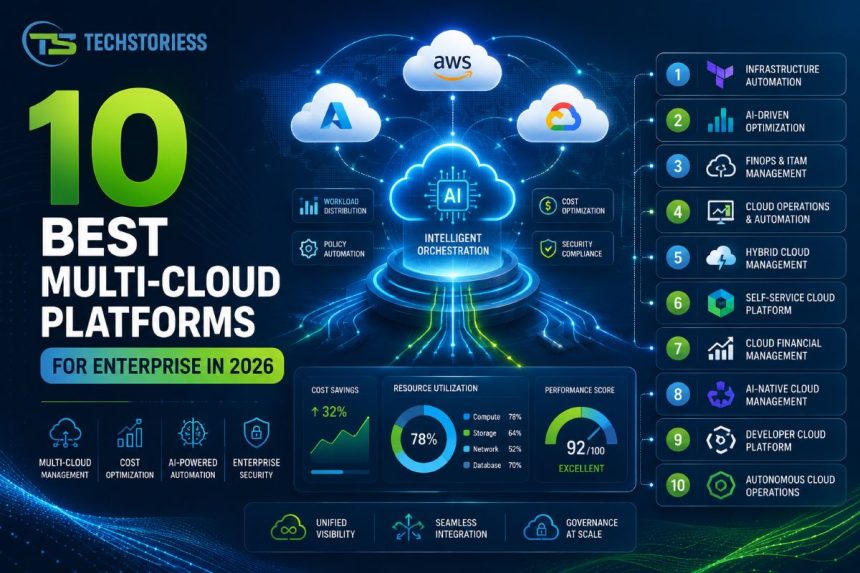
- HashiCorp Terraform (with OpenTofu) – Best for Multi-Cloud Infrastructure Provisioning
- IBM Turbonomic – Best for Autonomous Multi-Cloud Resource Optimization
- Flexera One – Best for Multi-Cloud Governance with IT Asset Management
- VMware Aria – Best for Unified Multi-Cloud Operations Management
- CloudBolt – Best for Multi-Cloud Automation with Hybrid Governance
- HPE Morpheus Enterprise – Best for Hybrid Cloud Lifecycle Management
- Apptio Cloudability – Best for Enterprise FinOps and Cloud Financial Governance
- Sedai – Best for AI-Autonomous Multi-Cloud Cost Optimization
- Northflank – Best for Developer-Centric Multi-Cloud Application Deployment
- ## 10. Holori – Best for Multi-Cloud Infrastructure Visualization and FinOps Intelligence
- Conclusion
This is not an isolated case but a wide industry reality. The Flexera 2026 State of the Cloud Report notes that 87% of global enterprises now run a multi-cloud strategy. The average organization typically operates across 2.6 public cloud providers simultaneously. Meanwhile, 66–68% of global enterprise cloud spend is collectively controlled by AWS, Azure, and Google Cloud. Valued at $9.8 billion, the global multi-cloud management market is consistently registering heavy growth with a 13.5% CAGR – reflecting that enterprises are seriously investing in solutions for managing what they have built.
The problem, however, is too costly to ignore. Every year enterprises waste $4.1 billion due to cloud misconfigurations. It is not due to engineering incompetency but due to structural challenges in enforcing consistent governance, security policy, and cost accountability across AWS, Azure, and Google Cloud. Every provider has different underlying infrastructure, its own billing schema, IAM model, own API surface, and proprietary tooling conventions. These differences accumulate into governance complexity. Without a dedicated management layer, what you perceive as architectural flexibility turns into a governance liability.
However, the tools used for governing and optimizing across these providers come from a third-party ecosystem that has significantly matured. However, enterprises often struggle to decide the best cloud management tool that aligns with their key requirements. So, we have compiled a curated list of 10 best multi-cloud management platforms To help them take informed decision:
HashiCorp Terraform (with OpenTofu) – Best for Multi-Cloud Infrastructure Provisioning
Running workloads across two or more cloud providers without infrastructure-as-code accumulates technical debt rapidly. For multi-cloud provisioning, HashiCorp Terraform has positioned itself as the de facto standard – ruling this space for nearly a decade. In 2026, it remains the foundational layer for building governable multi-cloud stacks.
The core proposition of Terraform is declarative simplicity: define your infrastructure once in HashiCorp Configuration Language (HCL) and consistently deploy it across AWS, Google Cloud, Azure, or any combination thereof. It frees you from provider-specific provisioning scripts and manual configuration drift. With its provider ecosystem spanning thousands of integrations, it can rightly be compared to the universal adapter for cloud infrastructure provisioning.
The licensing controversy of 2023 – HashiCorp moved Terraform from open-source to the Business Source License, creating genuine institutional uncertainty for enterprises building long-term cloud orchestration software strategies around it. This resulted in the rise of OpenTofu, a fully open-source (MPL 2.0) fork maintained by the Linux Foundation with full HCL and provider ecosystem compatibility. For organizations unable to afford dependency on a license model that might change in the future, OpenTofu is a legitimate and increasingly well-supported alternative. Its steadily growing third-party platform integration validates that trajectory.
Many enterprise teams seek governance layers on top of raw Terraform – like drift detection, policy-as-code, VCS-driven pipelines, and centralized remote state management. Platforms like Scalr provide such teams a compelling management layer without requiring a fundamental architecture change.
Key point
- Primary strength: Infrastructure-as-code across every major cloud provider
- Best for: Platform engineering teams building consistent, repeatable multi-cloud deployments at scale
- Pricing: Open-source (free) to enterprise tier; OpenTofu fully free under MPL 2.0
IBM Turbonomic – Best for Autonomous Multi-Cloud Resource Optimization
IBM Turbonomic occupies a relatively new and innovative category: autonomous application resource management (ARM). Almost nonexistent five years ago, this category has matured rapidly into a recognized enterprise discipline. Rather than simply flagging overprovisioned workloads, it resizes, relocates, and scales them in real time based on measured application demand. It can wait for your permission or automatically execute those actions if configured for full autonomy – all while respecting the performance SLAs defined by you.
Turbonomic connects across AWS, Azure, Google Cloud, VMware, Kubernetes, Nutanix, Hyper-V, and more.
It is equipped with an ML-driven engine that continuously models the relationship between infrastructure resources and application performance, generating optimization actions and executing them without human intervention if configured for full autonomy. Its impressive qualities are reflected in ratings across authentic review platforms like PeerSpot, where it secures 9.1/10 and holds a top ranking among cloud management platforms in the January 2026 PeerSpot buyer survey.
Key Points
- Primary strength: AI-driven autonomous resource management across hybrid and multi-cloud environments
- Best for: Large enterprises aiming to automate performance and cost decisions at a scale where manual tuning is no longer viable
- Pricing: SaaS tier starts ~$40,000/year; scales with managed asset volume
Flexera One – Best for Multi-Cloud Governance with IT Asset Management
Flexera One ideally combines serious cloud governance with enterprise IT asset management into a single operational platform. Following its acquisitions of CloudCheckr in 2021 and Spot by NetApp in 2023, Flexera now delivers one of the broadest feature sets in the category: discovery, provisioning, orchestration, operational monitoring, governance, and cloud cost optimization across public clouds, private clouds, virtual machines, and bare-metal serverless architectures – all from a single platform.
Where Flexera differentiates itself is at the intersection of cloud financial management and software licensing compliance. If your CISO is worried about compliance exposure from unlicensed software deployed across multi-cloud environments, and your CFO is simultaneously demanding to know why cloud costs increased 34% last quarter, Flexera One is one of the few platforms capable of answering both questions from a single governance layer.
Flexera’s modular pricing architecture allows enterprises to start with cloud visibility and cost reporting, then expand into full multi-cloud governance, automation, and ITAM over time. This staged onboarding model is pragmatically valuable – it avoids the implementation paralysis that comprehensive enterprise platforms sometimes create.
Key Points
- Primary strength: Unified cloud cost optimization, multi-cloud governance, and IT asset lifecycle management
- Best for: Enterprises managing cloud spend and SaaS licensing under one financial governance framework
- Pricing: Modular; enterprise contracts typically run $30,000–$640,000 annually based on scope
VMware Aria – Best for Unified Multi-Cloud Operations Management
VMware Aria – earlier known as vRealize Suite – is among the few platforms that genuinely cover almost the full operational stack for multi-cloud environments. Powered by CloudHealth, Aria Cost addresses financial governance while Aria Operations optimizes performance and manages capacity. Likewise, Aria Automation offers cloud orchestration and Aria Networks provides network observability and management. Collectively, these modules deliver a unified operational control plane that few platforms in this category can match.
For enterprises with deeply established VMware infrastructure investments, this integration provides a real and meaningful advantage. Aria is natively compatible with vSAN, vSphere, and NSX. It offers a single operational control plane for both on-premises VMware environments and public cloud workloads. With enterprises navigating hybrid cloud strategy spanning decades-old data centers alongside modern public cloud deployments, such a unified view removes the operational silos that affect both cost control and incident response.
PeerSpot’s January 2026 market data notes that VMware Aria Automation has the largest share in the cloud management category at 6.2% – reflecting the breadth of the platform as well as VMware’s installed enterprise base spanning virtually every large organization across the globe.
Formerly known as CloudHealth, Aria Cost specifically remains a top-tier FinOps platform with powerful multi-cloud governance capabilities, policy-driven cost allocation, and Reserved Instance and Savings Plan optimization. It establishes Aria Cost as a go-to solution for finance and IT operations teams that need a single efficient tool for both governance and cost reporting.
Key points
- Primary strength: Unified cloud cost optimization, multi-cloud governance, and IT asset lifecycle management
- Best for: Enterprises managing cloud spend and SaaS licensing under one financial governance framework
- Pricing: Modular; enterprise contracts typically run $30,000–$640,000 annually based on scope
CloudBolt – Best for Multi-Cloud Automation with Hybrid Governance
CloudBolt packs orchestration capabilities spanning both cloud orchestration software and financial governance, making it a strong fit for platform engineering teams that frequently struggle with shadow IT and ungoverned resource sprawl. Its self-service catalog enables development teams to provision approved resources within policy guardrails, eliminating the ITSM ticket queue without compromising on governance integrity.
Leveraging its AI-powered anomaly detection and optimization capabilities, CloudBolt addresses a core operational challenge of multi-cloud management: detecting runaway spend before it breaches the budget. CloudBolt’s FinOps features are specifically designed for the scaling phase of cloud maturity – graduating from basic cost visibility to automated remediation and executive reporting.
CloudBolt’s native ServiceNow integration represents a meaningful advantage for enterprises running ITSM-driven infrastructure workflows. CloudBolt doesn’t bypass existing request management processes – it plugs into them. It allows for end-to-end automation from service request to resource delivery within governance-defined boundaries.
Key Points
- Primary strength: Self-service provisioning, lifecycle automation, and FinOps across hybrid and multi-cloud environments
- Best for: Platform and operations teams that need governance guardrails without ticket-queue bottlenecks
- Pricing: Commercial subscription; enterprise contracts scale with managed asset volume
HPE Morpheus Enterprise – Best for Hybrid Cloud Lifecycle Management
HPE Morpheus Enterprise provides platform and operations teams a single control platform across virtually every infrastructure type: Nutanix, on-premises VMware, Kubernetes clusters, OpenStack, and all major public cloud providers. Unlike other multi-cloud management platforms that treat on-premises infrastructure as secondary or legacy, Morpheus was specifically architected from the start to tackle heterogeneous environments with equal operational rigor.
The multi-tenant RBAC model and role-aware service catalog of the platform enable enterprise IT to provide genuine self-service to application teams without compromising on governance. The catalog enforces approvals, spending limits, and policy checks at the point of provisioning – before resources are created, rather than discovered after the bill arrives. This governance architecture is operationally essential for large organizations where multiple business units operate under different compliance regimes and budget envelopes.
Morpheus also offers robust Kubernetes and VM lifecycle management – with container adoption reaching near-universal status among enterprise engineering teams, this adds a critical capability in 2026. Recent developer surveys document 96% enterprise Kubernetes adoption, creating wider demand for a platform that can handle Kubernetes lifecycle alongside traditional VM workloads. In such a scenario, Morpheus represents a preferred multi-cloud management solution for modern infrastructure.
Key points
- Primary strength: Unified self-service provisioning, lifecycle automation, and governance across on-premises and public cloud
- Best for: Enterprise IT teams managing complex hybrid estates spanning data center, private cloud, and multiple public clouds
- Pricing: Commercial subscription (proprietary); now part of HPE portfolio post-2024 acquisition
Apptio Cloudability – Best for Enterprise FinOps and Cloud Financial Governance
Apptio Cloudability did not just participate in the creation of the enterprise FinOps category – it largely invented it. Now under IBM, it provides the financial allocation engine, forecasting models, commitment optimization tooling, and executive reporting infrastructure that mature FinOps programs depend on.
The competitive strength of Apptio Cloudability is its analytical depth. Cloudability can seamlessly correlate cloud spending with business outcomes. Rather than just reporting the expenses of a specific team or account, it also surfaces the derived business value – the framing enterprise finance teams and boards require. Cloud has become a value generation argument demanding the same financial rigor applied to any capital investment.
With 53% of enterprises yet to see any substantial value from their cloud investments (according to PwC research), the pressure to demonstrate cloud ROI has become acute. Public cloud now represents 45% of enterprise IT spending, up from just 17% in 2021.
With boards increasingly skeptical of escalating cloud budgets, rigorous financial attribution is not just an option – it is a strategic requirement.
Cloudability efficiently integrates with the FinOps Foundation’s FOCUS standard for normalizing multi-cloud billing data, significantly simplifying the cross-provider cost analysis that manually-built reporting pipelines earlier required several weeks to produce. For the 70% of large enterprises with a dedicated FinOps or cloud economics team, this standards-based approach future-proofs investment in financial tooling.
Key points
- Primary strength: Cloud cost allocation, forecasting, business mapping, and financial governance at enterprise scale
- Best for: Finance-led FinOps teams requiring rigorous cost accountability, benchmarking, and multi-cloud spend forecasting
- Pricing: Enterprise commercial; contact IBM Apptio for current pricing
Sedai – Best for AI-Autonomous Multi-Cloud Cost Optimization
In the space of cloud optimization tools, Sedai defines the next maturity evolution: it is a platform that doesn’t passively generate recommendations for humans to act on later – it continuously acts in real time as workload patterns constantly evolve. While conventional FinOps tools generate dashboards and weekly reports requiring human interpretation and manual follow-through, Sedai studies and learns the behavior of your services, models the ripple effects of resource changes across distributed systems, and autonomously adjusts resource configurations, commitment purchases, and workload placements to simultaneously optimize cost and performance.
It leads to consistently striking results. Platform clients consistently report cloud cost savings in the range of 30–50% – rather than one-time rightsizing audits, they accrue cost benefits from continuous adaptive optimization that follows changing workload patterns. This holds key importance as the multi-cloud cost problem is not a static snapshot – it is a fundamentally dynamic challenge. A conventional tool that analyzes spending weekly and generates recommendations to be eventually implemented by engineers is structurally too slow and reactive to keep pace with fast-evolving modern cloud environments.
The broader market context validates this trajectory. FinOps tooling and cost optimization services are growing at approximately 28% year-over-year, and organizations using FinOps frameworks are 2.5x more likely to meet or exceed their cloud ROI expectations than those without formal practices. The autonomous tier of FinOps tooling – where Sedai sits – represents the next maturity leap.
Key points
- Primary strength: Continuous, autonomous cloud cost and performance optimization at scale
- Best for: Engineering-led organizations managing large multi-cloud environments that need compounding savings without compounding manual effort
- Pricing: Commercial; typically ROI-based pricing models tied to documented savings
Northflank – Best for Developer-Centric Multi-Cloud Application Deployment
While most multi-cloud management platforms are architected for infrastructure and operations teams, Northflank is engineered for developers. This makes a significant difference in 2026 as engineering velocity is emerging as a competitive differentiator and the cognitive overhead of multi-cloud tooling can quietly but steadily erode it.
With its unified deployment layer spanning AWS, Azure, Google Cloud, and other providers, Northflank abstracts the Kubernetes complexity and provider-specific configuration typically demanding dedicated platform engineering expertise. It allows teams to quickly deploy applications across multiple cloud providers – what earlier took weeks can take hours now. It meaningfully contrasts with enterprise platforms like Azure Arc or Google Anthos that may require months for full implementation.
The platform is not designed for enterprises managing massive, complex hybrid estates. It is relevantly designed for engineering-led organizations – startups rapidly scaling, companies in regulated sectors building cloud-native applications, and development teams requiring multi-cloud flexibility without multi-cloud operational overhead.
Key points
- Primary strength: Streamlined application deployment and management across cloud providers with minimal Kubernetes complexity
- Best for: Development teams deploying cloud-native applications across providers without dedicated DevOps or platform engineering staff
- Pricing: Usage-based; developer-friendly entry pricing with enterprise tiers
## 10. Holori – Best for Multi-Cloud Infrastructure Visualization and FinOps Intelligence
Most platforms underestimate a foundational multi-cloud management problem – enterprises cannot govern what they cannot see. Holori takes a distinctive approach that directly addresses this by combining infrastructure visualization capability with FinOps intelligence – providing real-time, interactive maps of multi-cloud resources, dependencies, and cost flows. It brings operations, finance, and security teams onto the same page, giving them a shared understanding of the environment that is rarely achieved by dashboards alone.
In 2026, when the dominant enterprise cloud concern is cost accountability and governance rather than simply provisioning new capacity, the visualization layer provided by Holori is foundational to intelligently managing the full estate.
The platform establishes a direct connection between cost visibility and infrastructure topology – meaning teams can immediately trace any anomaly in cloud spend to the specific resource, service, or architecture pattern generating the cost. It almost eliminates the investigative lag and cross-team coordination overhead that conventional tooling imposes. By integrating infrastructure mapping and FinOps intelligence, the platform accelerates cost optimization as well as root cause analysis in ways that cannot be replicated by separate tooling.
Key Points
- Primary strength: Infrastructure visualization, cost visibility, and FinOps governance across multi-cloud environments
- Best for: Enterprise teams that need real-time infrastructure mapping combined with financial governance for informed cloud decision-making
- Pricing: Commercial; tiered by infrastructure scale
Conclusion
No single platform in this list manages the full range of multi-cloud management challenges. For enterprises, here is a critical insight: no single platform represents an ultimate, go-to solution. In industry research, one thing consistently stands out – most enterprise teams deploy two to three tools relevant to their highest-pain workflows. Reading this guide will help you identify the platforms that belong in your stack – and what purpose they solve.








From my experience, operating multi-cloud consistently can be quite complex, in the real corporate environmen. For CTOs, success depends less on the number of cloud providers and more on having unified security, observability, and cost governance from the start